
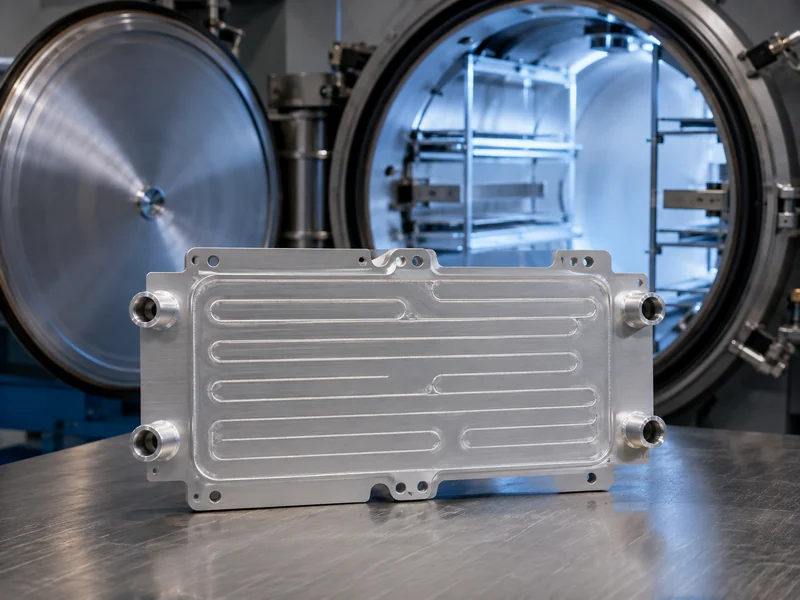
Aluminium vacuum brazing joins aluminum assemblies inside a sealed, evacuated furnace, with no flux at any stage. That flux-free character is one reason it is used for leak-tight battery cold plates, where coolant has to move through the pack without escaping. The process melts a thin aluminum-silicon filler between mating surfaces while the base metal stays solid, so a cold plate can be sealed at many internal joints in a single furnace cycle. The same single-cycle behavior is why it competes with controlled atmosphere brazing for EV and energy-storage thermal hardware. It also sets the main costs: a well-sealed vacuum furnace, tight cleanliness, and careful control of the alloy’s magnesium level. This article covers how the process works, the conditions it runs at, how it compares with controlled atmosphere brazing, and what to verify when the brazed part is a liquid cold plate.
What Aluminium Vacuum Brazing Is and How It Works
Aluminium vacuum brazing relies on a vacuum, not a chemical flux, to clear the way for the filler. Aluminum forms a tenacious oxide film almost instantly in air, and that film — not the metal — is the real obstacle to joining. Brazing research published in *Materials* (2022) notes that alumina melts near 2,072 °C, far above aluminum’s melting point of roughly 660 °C, so the oxide cannot simply be melted away at braze temperature. The process has to get around the oxide instead of through it.
Two effects get around the oxide: a thermal-expansion mismatch that cracks the film, and magnesium that scavenges the leftover oxygen. Aluminum expands considerably more than its own oxide as the assembly heats. The thin native film — only a few nanometers thick, on the order of 2–5 nm per the same published work — cracks under that mismatch and lets the liquid filler reach the metal beneath. Magnesium in the filler or cladding then vaporizes in the vacuum and works as a getter, scavenging residual oxygen and breaking down remaining surface oxide so the filler can flow and form fillets.
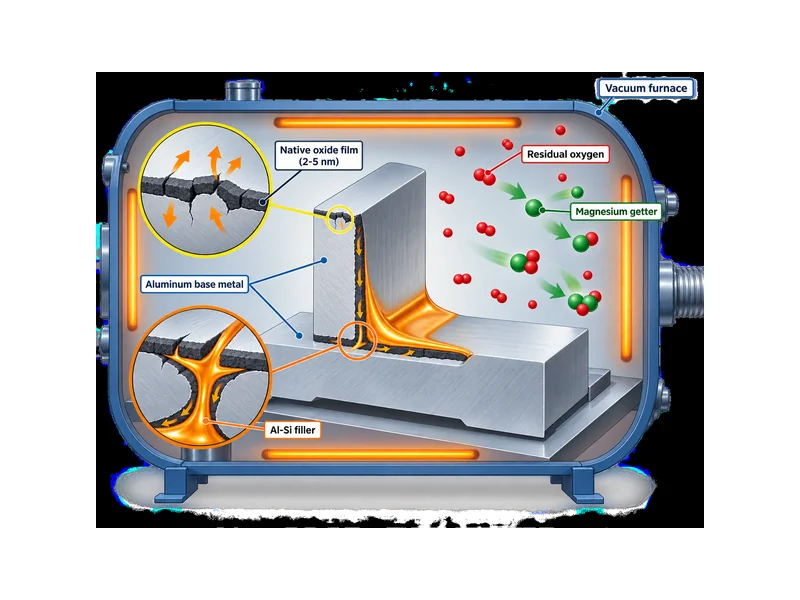
The filler is the second half of the mechanism, and it usually arrives as a clad layer instead of a separate addition. At least one mating part is typically supplied as brazing sheet — an aluminum core rolled with a thin aluminum-silicon cladding that melts below the core. During the cycle the cladding melts, flows by capillary action into the joint, and solidifies on cooling. The base metal never melts, so joint geometry and part tolerances are preserved — which matters when the “part” is a cold plate whose flatness feeds directly into thermal contact.
Process Conditions and Filler Metals
Two temperatures bound the process, and they sit close together. Braze temperature has to stay above the filler’s melting point but below the base alloy’s, and for most aluminum systems that gap is narrow. Industry sources place the working range at roughly 580–620 °C (about 1,080–1,150 °F), with the exact recipe depending on the alloy, the total mass loaded into the furnace, and the furnace itself. That narrow margin is why furnace uniformity and load thermal mass are process variables, not afterthoughts. A heavy or uneven load that lags in temperature can leave joints unfilled while lighter sections overheat.
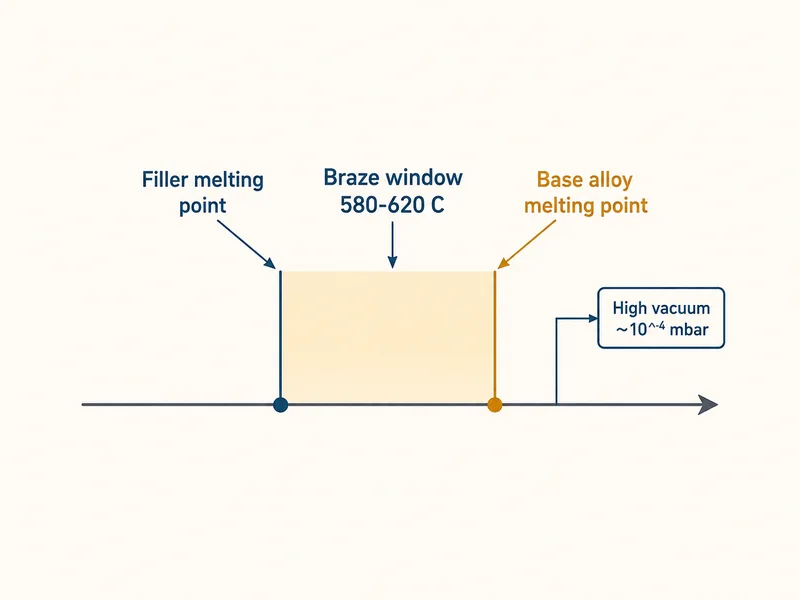
Vacuum level is the other controlling condition. Fluxless aluminum brazing generally calls for a high vacuum — commonly cited around 10⁻⁴ mbar or better — together with getter material to capture residual oxygen that would re-oxidize freshly cracked surfaces. Reported values vary with the unit of measure and the source, so a given furnace’s setpoint should be confirmed against its own qualified recipe, not a general figure.
Filler chemistry follows from both conditions. Aluminum-silicon alloys supply the melting-point depression that lets the filler flow below the base metal’s melting point, and magnesium drives the gettering and oxide-disruption steps above. For specifying a part, the filler and the base alloy have to be treated as a matched system. A silicon content or cladding ratio pulled from one datasheet should not be assumed for a different alloy without checking that material’s own specification.
Vacuum Brazing vs. Controlled Atmosphere Brazing
The choice between vacuum brazing and controlled atmosphere brazing (CAB) turns on the alloy and filler system, flux tolerance, and furnace economics — not on which process is more advanced. CAB heats parts under an inert gas and uses a fluoride flux to remove oxide and protect clean surfaces. Vacuum brazing removes the oxygen instead and uses no flux at all. Both can produce sound aluminum joints when their material and process requirements are met. The practical deciding factors are then the alloy and filler system, the qualified process, and the production volume.
Magnesium behaves differently in the two routes. In vacuum brazing it is actively useful: the magnesium that vaporizes is the same magnesium doing the gettering. In a flux-based process it is more often described as a constraint, because it can interfere with fluoride flux chemistry. The workable magnesium range for CAB should therefore be confirmed against the specific flux and alloy system, not assumed. Which route fits a given design comes back to the matched alloy, the filler or cladding, and the qualified process, weighed against cost and volume. Where a sealed vacuum furnace and its cleanliness discipline are justified, vacuum brazing fits. Where volumes are high and the alloy and flux are compatible, CAB’s lower furnace cost and higher throughput often decide.
| Factor | Vacuum brazing | Controlled atmosphere brazing (CAB) |
|---|---|---|
| Flux | None; no flux residue to clean | Fluoride flux required, then handled/cleaned |
| Magnesium | Actively used — vaporizes to getter oxygen | Can interfere with fluoride flux; confirm workable range per flux/alloy |
| Furnace and throughput | Sealed vacuum furnace; more capital-intensive | Typically lower cost, higher throughput |
| Finish | Clean, flux-free surface | Flux residue managed as part of the process |
The residue difference matters most for cooling hardware. A flux-free joint leaves no corrosive flux residue inside the coolant passages, which removes one long-term corrosion pathway from a sealed loop. The counterweight is cost and control: a vacuum furnace has to hold a good seal and stable pressure, and stock has to arrive clean, all of which add capital and process discipline.
Leak-Tight Aluminum Cold Plates for Battery Thermal Management
A liquid cold plate stacks two or more aluminum layers — a channel layer and a cover — that must bond into one leak-tight path for coolant between the cells and the loop. Brazing forms all of those internal joints at once under uniform heating. Distortion stays low across a large plate, and the many parallel channels seal together in one pass instead of one weld at a time. Every internal joint is a potential leak point, so sealing a whole channel network hermetically in a single cycle is the property that is hard to match with localized joining.
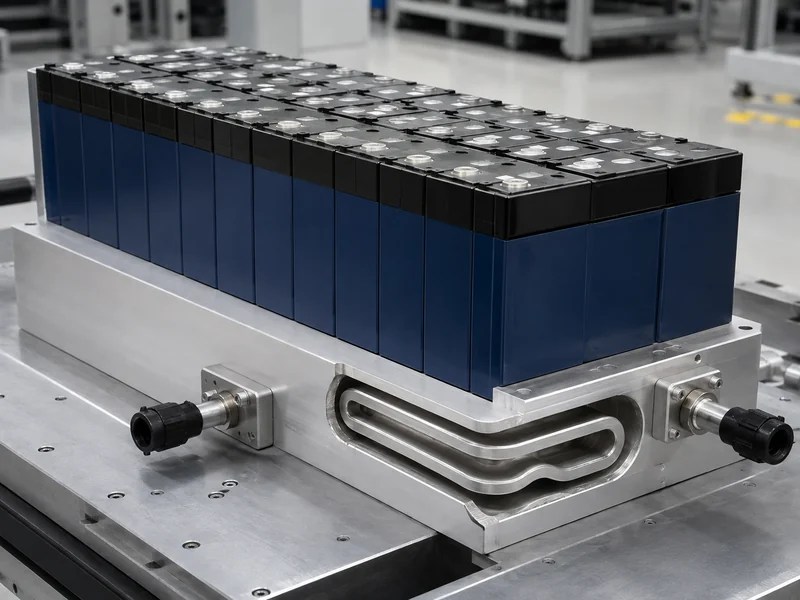
Vacuum brazing is not the only way to close a cold plate, and the method interacts with the design. Stamped-and-brazed plates, friction stir welding, and other joining routes each suit different channel geometries and volumes, so the joining method belongs in the design conversation, not after it. The trade-offs among cold plate joining and welding methods track channel complexity, required flatness, and how many sealed joints the part needs at once. Where a plate has many fine internal channels that all need sealing in one pass, brazing’s simultaneous-joint behavior is the practical advantage.
Because the brazed plate sits directly in the cell-to-coolant heat path, its manufacturing route is inseparable from its thermal duty. That is where custom cold plate solutions come in — hardware whose channel layout, flatness, and coolant fittings are matched to a specific cell format and pack geometry. Matching those to the cells lets the joining process, the plate flatness, and the cell interface be decided together, not in isolation. Trumonytechs designs and builds aluminum liquid cold plates for EV and ESS packs with that heat path in mind, connecting the brazed plate to the interface materials and the coolant loop around it.
Design and Verification Considerations
Three consequences of aluminium vacuum brazing need planning before the furnace cycle, not after it: how the thermal cycle affects the part’s temper, how demanding the cleanliness is, and how the joints will be proven leak-tight. Braze temperatures sit close to the melting range of many aluminum alloys, so the cycle can change a part’s mechanical condition. Whether any post-braze heat treatment is needed — and whether that means a quench, a full heat-treat schedule, or nothing — depends on the alloy, whether it is heat-treatable, the target temper, and the qualified process. Settle it from the material specification alongside the alloy choice.
Cleanliness and fit are the next controllables, and they act like variables, not pass/fail checkboxes. Vacuum brazing has no flux to compensate for surface contamination, so oil, oxide, and debris on the stock translate directly into unfilled or weak joints. Assembly tolerances and joint gaps also have to stay in the range where capillary action pulls filler through, because a gap that is too wide starves the joint. The verification action is straightforward: confirm incoming-stock cleanliness and joint fit-up against the brazing spec before loading, not after a failed leak test.
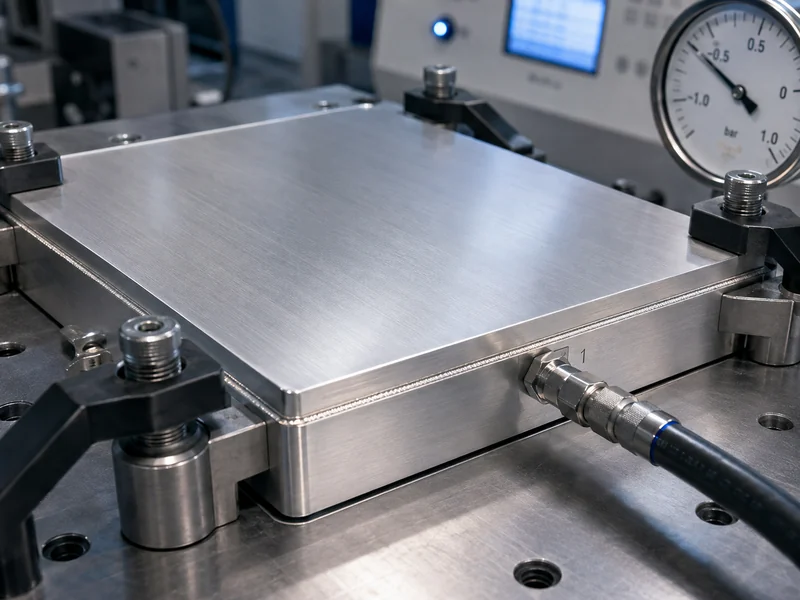
Leak integrity, flatness, and thermal performance all get checked on a cold plate, but they belong to different kinds of verification, and it helps to keep them separate. Sealing is usually proven with a leak check — a pressure test and, for fine leaks, a helium leak test. A burst or proof-pressure test, by contrast, is often a destructive qualification run on samples, not a release test on every part. Flatness is typically measured after brazing, because the thermal cycle can introduce warpage that degrades contact with the cells. Temperature uniformity across the plate is a thermal-performance criterion that may sit in design validation, not in per-piece acceptance. Which tests apply to a given plate, and at which stage, should come from the part’s drawing and its DVP&R or control plan — not from a fixed, one-size-fits-all sequence.
Conclusion
The useful way to read aluminium vacuum brazing is as a flux-free, single-cycle sealing route: it gets around aluminum’s oxide by removing oxygen and using magnesium as a getter, and it seals many internal joints at once with low distortion. Its trade is a capital-intensive sealed furnace and unforgiving demands on cleanliness and fit-up. The choice between it and CAB is not newer-versus-older; the matched alloy and filler, the qualified process, and the production volume decide, and the flux-free result is a corrosion argument, not a quality-grade claim. For a battery cold plate, the practical move is to settle the joining route, the alloy and any post-braze heat treatment, and the flatness and leak criteria together with the channel design. Confirm each against the specific material specification and the program’s verification plan. Trumonytechs can help validate those variables against a specific cell format and coolant loop when a plate is being matched to a pack.
FAQ
Do I need vacuum brazing instead of CAB if my aluminum alloy has high magnesium?
Magnesium is one factor, not a decision on its own. In vacuum brazing, magnesium is actively useful, because it vaporizes and helps getter residual oxygen. In a flux-based process it is more often a constraint, since it can interfere with fluoride flux chemistry, so the workable magnesium range for CAB should be confirmed against the specific flux and alloy system. Before committing to either route, confirm the alloy and filler as a matched system and check it against the qualified process.
What temperature and vacuum level does aluminum vacuum brazing run at?
Aluminum vacuum brazing typically runs in the region of 580–620 °C (about 1,080–1,150 °F) under a high vacuum, often cited around 10⁻⁴ mbar or better. The exact recipe depends on the alloy, the furnace load, and the furnace itself. The margin between the filler’s melting point and the base alloy’s is small, so the qualified recipe for a given part governs, not a general number.
Do vacuum-brazed aluminum parts need quenching or heat treatment afterward?
Post-braze treatment is not automatic; it depends on the alloy and the temper the part needs, not on the brazing process by itself. Braze temperatures sit close to the melting range of many aluminum alloys, so the thermal cycle can change a part’s mechanical condition. Whether the part then needs a quench, a full post-braze heat-treat schedule, or nothing is set by the alloy, whether it is heat-treatable, the target temper, and the qualified process — so decide it from the material specification alongside the alloy, not after the fact.
Is vacuum brazing better than CAB for leak-tight EV battery cold plates?
Neither process is inherently better for cold plates; the choice follows the alloy and filler system, the channel design, and the volume. Vacuum brazing’s flux-free joints leave no corrosive residue inside the coolant passages and seal many internal joints in one cycle, which suits complex plates. CAB can be more economical at high volume when the alloy and flux are compatible. Confirm the matched alloy, filler, and qualified process before deciding.
Can vacuum brazing seal a cold plate with many internal channels in one cycle?
Vacuum brazing forms all internal joints at once under uniform heating, so a plate with many parallel channels can be sealed in a single furnace cycle with low distortion. That simultaneous-joint behavior is a practical advantage for plates whose channels would be hard to seal one joint at a time.
Further Reading
- Flux-Free Plasma Brazing of Aluminum in a Local XHV-Atmosphere, *Materials* (MDPI, 2022) — peer-reviewed research. Supports the oxide-layer physics behind fluxless aluminum brazing (native oxide thickness and the alumina-versus-aluminum melting points); applies to the mechanism, not to any specific production recipe.
- Aluminum Extruders Council — Brazing resource — technical material from an aluminum industry association, for general background on aluminum brazing and the vacuum-versus-CAB comparison; not a source for part-specific parameters.
Related Articles
- Data Center Chillers: Choosing Between Air-Cooled and Water-Cooled Plants — explains where a chiller sits in the cooling chain and how to choose between air-cooled and water-cooled plants upstream of the cold-plate loop.
- What Is a Tubed Cold Plate? — covers an alternative cold-plate construction, where tubing is bonded into an aluminum base instead of brazing internal channels.
- How Does Heat Pipe Cooling Work and When Should You Use It? — helps a reader weigh passive heat-pipe transport against a liquid cold plate for a given thermal duty.
- What is Heat Transfer? Detailed Explanation — reviews the conduction and convection fundamentals behind the cell-to-coolant heat path a cold plate has to serve.
- Install Liquid Cold Plates Step by Step — walks through installing a finished liquid cold plate for stable contact and flow once it has been brazed and verified.