
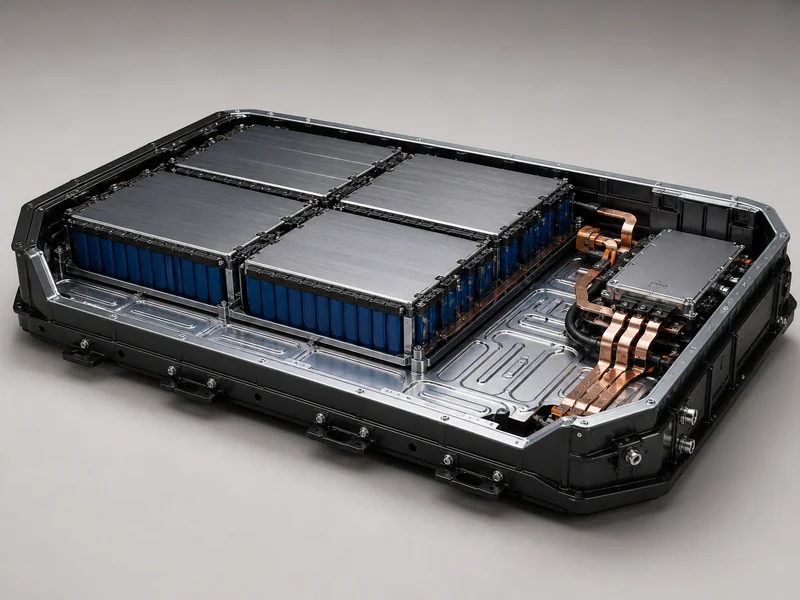
A battery module and a battery pack differ in scope. A module is an intermediate assembly of cells; a pack is the complete, enclosed system that combines one or more modules with pack-level control, protection, and thermal management. Spec sheets and sourcing calls often use the two terms interchangeably. They actually describe different layers of the same build, and the layer decides who owns the wiring, the safety case, and the cooling. For anyone integrating cells, interface materials, and liquid cooling into an EV or energy-storage design, that boundary is also where responsibility for the heat path changes hands. The sections below define each layer, compare them on the dimensions that matter, and show where the thermal path splits between the two.
What a battery module is
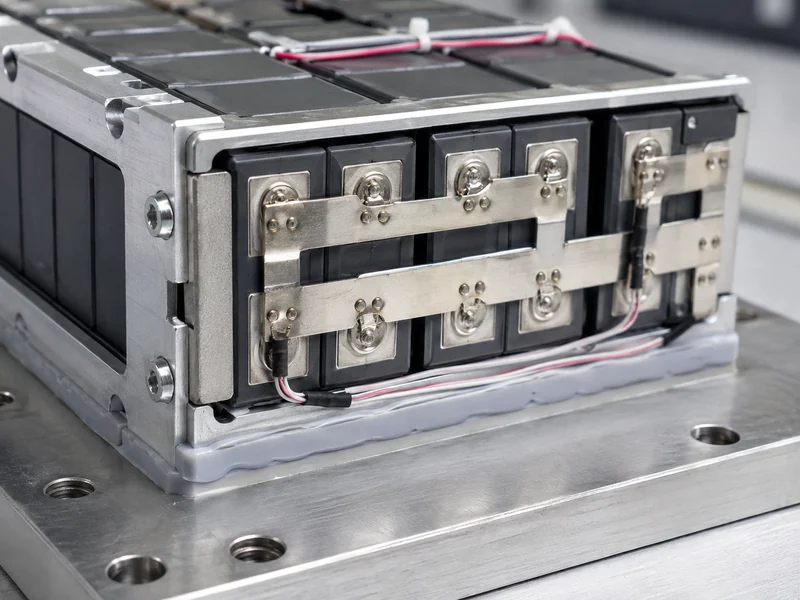
A battery module groups individual cells in series and parallel until they reach a target voltage and capacity. The module then adds enough structure and monitoring to be handled and installed as one unit. It sits one level above the cell in the familiar cell-to-module-to-pack hierarchy. Series connections raise voltage and parallel connections raise capacity, so the module is where a collection of low-voltage cells first becomes a usable voltage block. A single lithium-ion cell has a nominal voltage of about 3.7 V, which is why dozens of them are connected before the assembly does meaningful work.
A module is more than a bundle of cells held together. It typically carries cell interconnects and busbars, a mechanical frame or housing that sets the cells’ spacing and clamping, and sensing for voltage and temperature. It also adds a first layer of thermal management, such as heat-spreading surfaces or a gap filler against a cooling face. The cell format drives much of this layout. Cylindrical, prismatic, and pouch cells each impose a different internal arrangement, and the trade-offs between those EV battery module types affect how heat leaves the cells and how a module clamps to its cooling surface. In EV and ESS designs, battery modules are the intermediate building block that makes a large system easier to scale, service, and replace one section at a time.
What a battery pack is
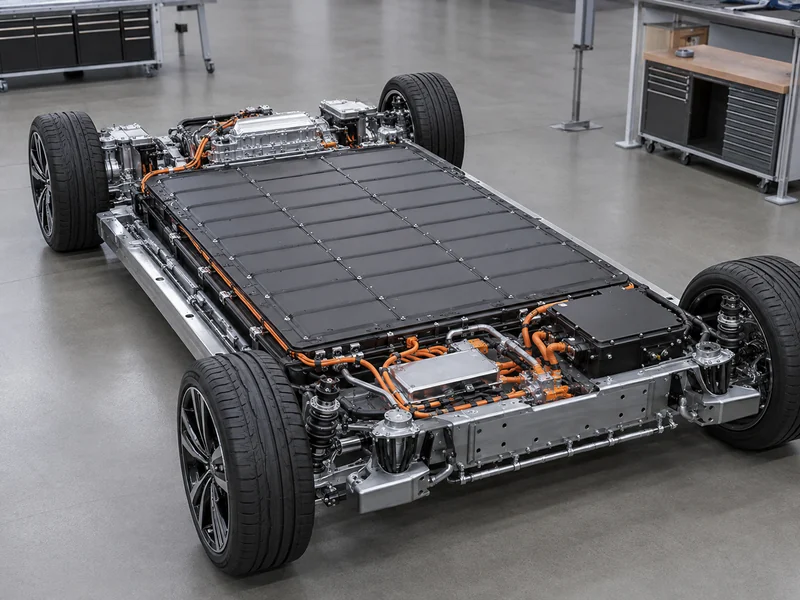
A battery pack completes the assembly into a ready-to-use energy system. The pack integrates one or more modules with a pack-level battery management system, power distribution and protection, an enclosure, and the thermal management that keeps everything in range. Where a module is a voltage-and-capacity block, the pack is the product that actually ships into a vehicle or an energy-storage cabinet. It adds the parts that make the assembly safe and controllable as a whole, not section by section.
Pack-level integration is what separates the two layers most clearly. The pack-level BMS supervises every module, manages balancing and state estimation across the full string, and enforces the protection limits. This battery management system is central to keeping cells inside safe voltage and temperature windows. Around that, the pack carries the high-current busbars, contactors and fuses, connectors and seals, and a sealed enclosure rated for the application. The certification case usually lives at this level too, because the pack is the unit a system is tested and deployed as.
Battery module vs battery pack: the differences that matter
Comparing the cell, module, and pack on the same dimensions makes the jump in scope from one to the next explicit in a way separate definitions cannot. The table below lines up the three layers so that jump is easy to read.
| Dimension | Cell | Module | Pack |
|---|---|---|---|
| What it is | Smallest electrochemical unit | Group of cells as one block | Complete integrated system |
| Building blocks | Electrodes, electrolyte, separator | Multiple cells + interconnects | One or more modules |
| Electrical role | Stores energy (~3.7 V nominal) | Sets voltage/capacity via series-parallel | Delivers full system voltage and current |
| Control electronics | None on its own | Cell sensing / module-level monitoring | Pack-level BMS, contactors, fuses |
| Thermal management | Generates heat | Heat-spreading, gap fill to a cooling face | Cold plates, coolant loop, uniformity control |
| Enclosure and safety | Cell can/pouch wall | Frame or sub-housing | Sealed, rated enclosure; system safety case |
| Typical use | Bought and assembled | Serviceable sub-assembly | Shipped end product (EV, ESS) |
The pattern across the row is consistent: each step up adds integration, control, and a wider safety boundary. A module raises voltage and capacity and adds local monitoring; a pack wraps modules in the electronics, protection, and cooling that let the system run on its own. Reading the two as the same thing at different sizes is the most common mistake, and it hides exactly the interfaces an integrator has to get right.
Where the thermal path splits between module and pack
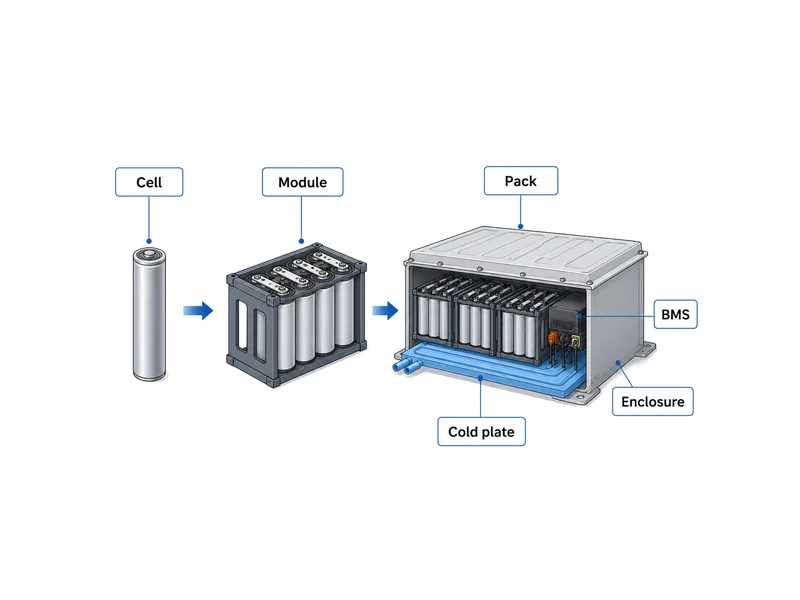
On the heat path from cell core to coolant, the module and the pack own different segments, and that split is the clearest engineering difference between them. At the module level, the job is to move heat out of the cells and across the small, often uneven gap between the cells and whatever surface they sit on. That is the domain of contact pressure, surface flatness, and thermal interface materials for batteries, which fill air gaps so heat conducts into the structure instead of stalling at a poor contact. Get this layer wrong and no amount of pack-level cooling recovers the lost conduction.
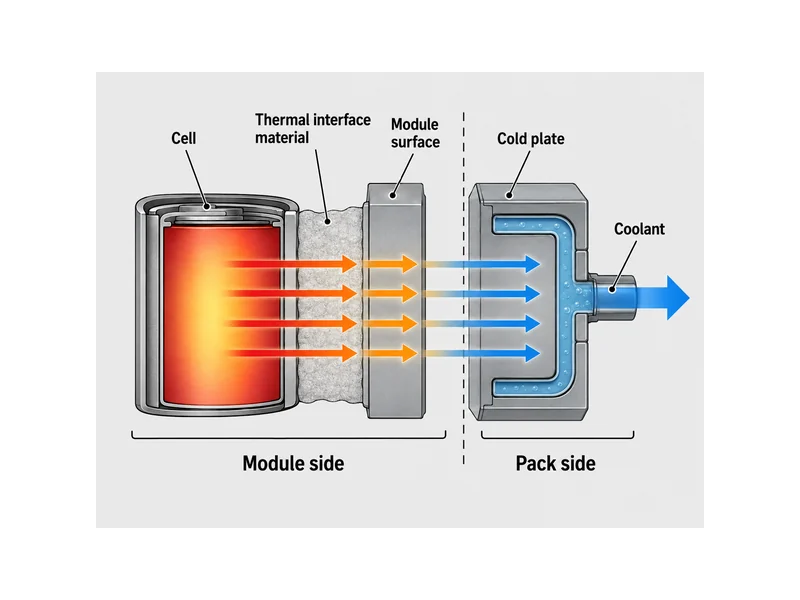
At the pack level, the task shifts to carrying that collected heat away and keeping every module within a narrow temperature band. This is where liquid cooling usually enters, moving a water-glycol coolant through a cold plate or channel network so heat is rejected outside the enclosure. Whether to use air or liquid, and whether to put a plate under the cells or channels between rows, is a pack-architecture decision, not a cell one. The same air-versus-liquid trade-off appears at the component level, which is why the practical difference between heat sink and cold plate maps onto this choice directly. Designers generally aim to keep the cell-to-cell temperature spread tight, often within just a few degrees, because uneven temperatures age cells at different rates and weaken the whole string.
The two layers also pull different products from a thermal supplier. At Trumonytechs, thermal interface materials cover the module side of the path, selected for gap, assembly stress, and conduction, while matched liquid cold plates and cooling components cover the pack side. The two are specified against different variables even though they sit on the same continuous heat path. Cell-to-pack (CTP) designs complicate this split. They mount cells straight into the pack and thin or remove the module layer, which pushes gap-fill and structural-bonding decisions that once lived in the module up into the pack build.
Why the module-versus-pack distinction matters for sourcing and integration
Getting the module-versus-pack boundary right matters because it decides scope, interfaces, and the safety case long before hardware is built. When a specification says “module,” a buyer is contracting for a voltage-and-capacity block with defined mechanical and sensing interfaces. When it says “pack,” the buyer is contracting for a controllable, enclosed, deployable system. Confusing the two leads to gaps where the BMS integration, sealing, or cooling connection was assumed to belong to the other party.
For a sourcing team, the practical test is which interfaces are written into the contract. A module purchase order has to pin down cell format, series-parallel configuration, sensing outputs, and the mechanical and thermal interface to the next level up. A pack purchase order has to pin down the same things one layer out: BMS behavior, protection thresholds, enclosure sealing, and the coolant connection. Naming the layer wrong is how a cooling interface or a balancing function ends up owned by no one.
The compliance and testing boundary tends to follow the pack, not the module. Standards such as UL 2580 for electric-vehicle batteries or UN 38.3 for transport typically apply to the pack as the deployed unit. Cell-level requirements such as IEC 62660 sit further down at the cell. That matters when scoping who certifies what, and it is another reason the pack is treated as the product of record even when modules are sourced separately. Serviceability follows the same logic: a modular pack lets a single module be diagnosed or replaced without discarding the whole assembly. That is a maintenance argument for keeping a distinct module layer, not only a technical one.
Reading the module-to-pack boundary correctly
Treat a module and a pack as one thing at two sizes and you misread both. They are two layers with different jobs, and the pack earns its name from the integration, control, protection, and cooling it adds on top of its modules. Read the module as the voltage-and-capacity block and the pack as the deployable, certified system, and most of the spec-sheet ambiguity resolves. The point most often misread is the heat path. The module owns the cell-to-surface conduction, where interface materials and contact matter; the pack owns heat rejection and temperature uniformity, where cold plates and the coolant loop matter. When your design lands on that split, we can help match the interface materials and cold-plate components to each side of it.
FAQ
What is the difference between a battery module and a battery pack?
A module is an intermediate assembly of cells, while a pack is the complete system that combines modules with a pack-level BMS, protection, an enclosure, and thermal management. The module sets voltage and capacity; the pack makes that block into a controllable, deployable product.
Is the BMS in the module or in the battery pack?
Pack-level supervision lives in the pack, while modules usually carry only local sensing or a lightweight monitoring layer. In many designs a distributed module monitor feeds a central pack BMS that manages balancing, state estimation, and protection across the full string.
Where does liquid cooling sit, at the module or the pack level?
Liquid cooling is generally a pack-level system, since the cold plate and coolant loop reject heat for the whole assembly and hold temperature uniformity across modules. The module side of the path is handled by conduction into the cooling surface, where gap fillers and contact pressure govern how well heat reaches that loop.
What is cell-to-pack, and does it remove the module layer?
Cell-to-pack (CTP) mounts cells directly into the pack and thins or removes the traditional module layer to save weight and volume. It does not remove the functions; instead it moves gap-fill, structural bonding, and monitoring decisions that once lived in the module up into the pack build.
How many modules are in a battery pack?
The module count varies with the target voltage, capacity, and packaging of the application, so there is no fixed number. Series and parallel arrangement of modules sets the pack’s voltage and capacity, so the count follows from those targets.
Further Reading
- Battery Thermal Management for EV Battery Packs — engineering technical media on pack-level cooling (air vs liquid, cold plates, temperature uniformity) and the standards referenced for EV batteries.
- Battery Cell vs Module vs Pack: Key Differences Explained — manufacturer technical article on the cell-to-module-to-pack hierarchy and the module-level control versus pack-level BMS distinction.
Related Articles
- What Is TEC Cooling? — A look at thermoelectric (Peltier) cooling for cases that need precise, reversible temperature control beyond passive conduction.
- How Much Does an ESS Battery Cost? — Breaks down what drives ESS battery pricing from bare pack to turnkey system, useful when scoping a pack purchase.
- Vapor Chamber Cooling — Explains vapor chamber cooling and where its high effective conductivity fits in electronics and EV battery thermal design.
- What Is an Energy Cell? — Defines the energy-type cell one layer below the module and what it means for pack thermal management and TIM choice.
- What Is The Purpose Of The Cooling Plate? — Describes how a cold plate moves heat away at the pack level, the pack-side counterpart to module conduction.