
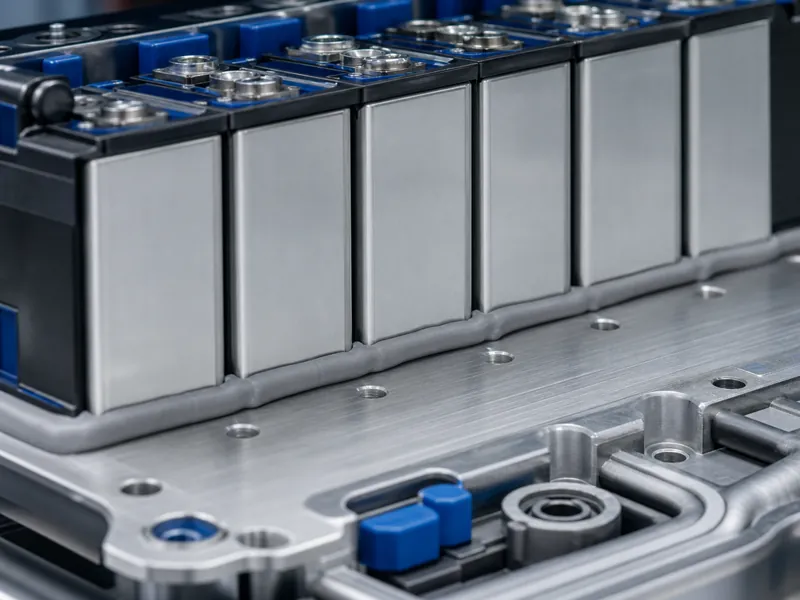
A silicone thermal pad is good for most electronics and battery-pack interfaces that have an uneven gap, need electrical isolation, and run within the pad’s rated temperature band. It is not automatically the best thermal interface material for every joint. What decides it is the interface gap, the clamp or assembly stress the pad will see, the working temperature, and how much electrical insulation the design needs. This article looks at silicone thermal pads the way a battery-pack or product engineer would: what they do in the heat path, where they fit, where they fall short, and how to decide when a pad beats paste or a graphite sheet.
How Silicone Thermal Pads Work
A silicone thermal pad works by replacing the insulating air trapped between a heat source and a heat sink with a soft, conformable solid that carries heat across the joint. Air is one of the worst conductors in the assembly, so any pocket it fills quietly drives up interface resistance. The pad, made of silicone rubber loaded with ceramic or other thermally conductive fillers, compresses into the surface texture, displaces that air, and forms a continuous path from the component into the cooling structure.
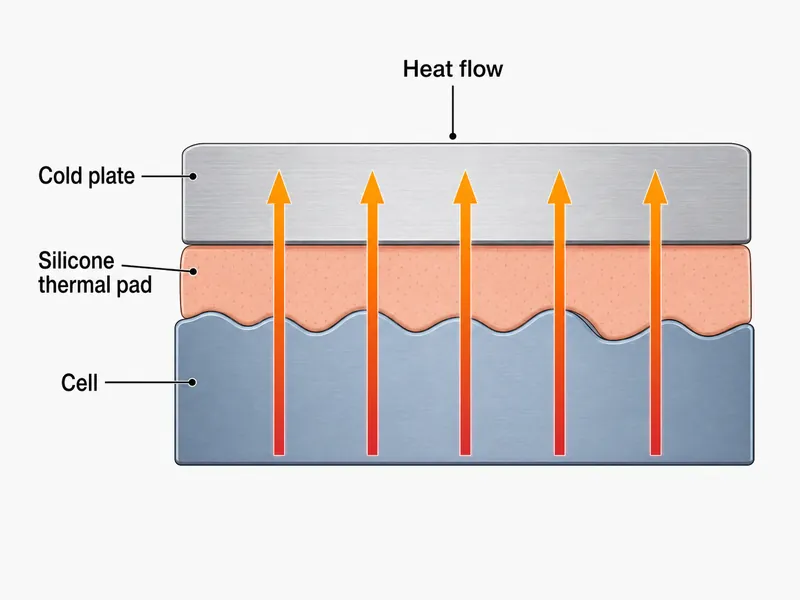
The property that matters most here is not raw bulk conductivity but how well the pad cuts contact resistance under real clamp load. A pad that conforms and wets both faces at the design pressure often beats a stiffer, higher-rated pad that only touches the high spots. When you compare candidates on their rated thermal conductivity, read it together with the pad’s compression behavior. The datasheet number is measured on a test stack, not guaranteed in yours.
Common Applications of Silicone Thermal Pads
Silicone thermal pads earn their place wherever a conformable, electrically isolating interface has to move heat off many small or uneven contact areas, which is exactly the situation inside an EV or energy-storage battery pack. Between cells or modules and a cold plate, the pad bridges tolerance stack-up and cell-to-cell height variation that a rigid interface could never follow. With a grade chosen for it, the same pad can also help keep the live cell surface electrically separated from the cooling structure.
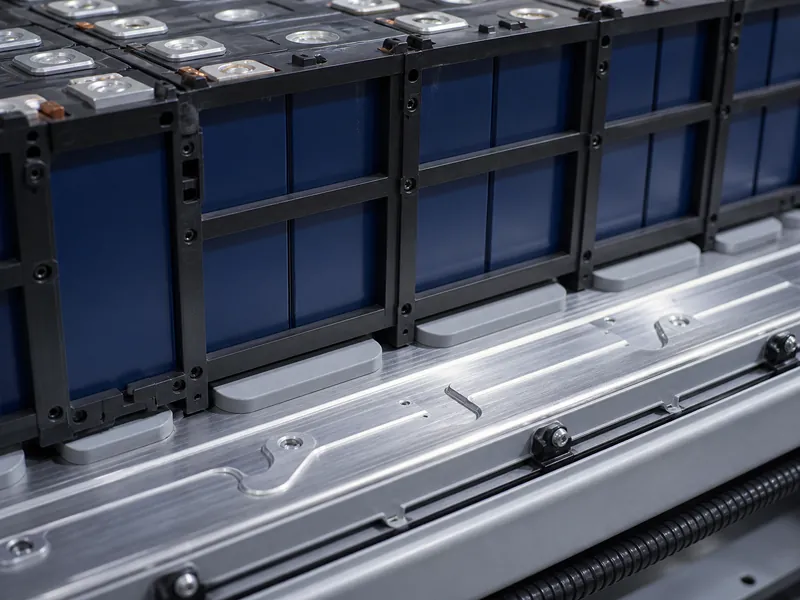
Beyond the pack, the same properties suit power electronics, where pads sit under MOSFETs, IGBTs, or voltage regulators to feed heat into a chassis or heat sink. Consumer hardware such as laptops, GPUs, and data-center boards uses them for the same reason. The governing constraints differ by application, though. A traction or storage pack typically adds vibration, thermal cycling, and isolation duty that a benchtop board may not, so the pad has to be specified to each case instead of assumed equivalent.
Strengths and Limits of Silicone Thermal Pads
The core strength of a silicone thermal pad is predictable, low-mess assembly: it arrives as a preformed sheet, compresses to a repeatable bond line, and does not pump out or dry out the way grease can over thermal cycles. Because the silicone base is naturally non-conductive and the fillers are usually ceramic, many grades can also provide electrical isolation alongside heat transfer. That is why designers check whether thermal pads are electrically conductive and confirm the dielectric rating before placing one against a live bus or cell tab.
The practical strengths worth weighing are:
- Conformability: fills uneven gaps and follows tolerance variation without machining surfaces flat.
- Electrical isolation (grade-dependent): the silicone-plus-ceramic build can separate the conductor from the cooling structure when the pad’s dielectric rating is specified for it.
- Assembly stability: no cure step and no pump-out or dry-out, so parts can be handled immediately.
- Serviceability: pads can usually be inspected, removed, and in some cases reused if undamaged.
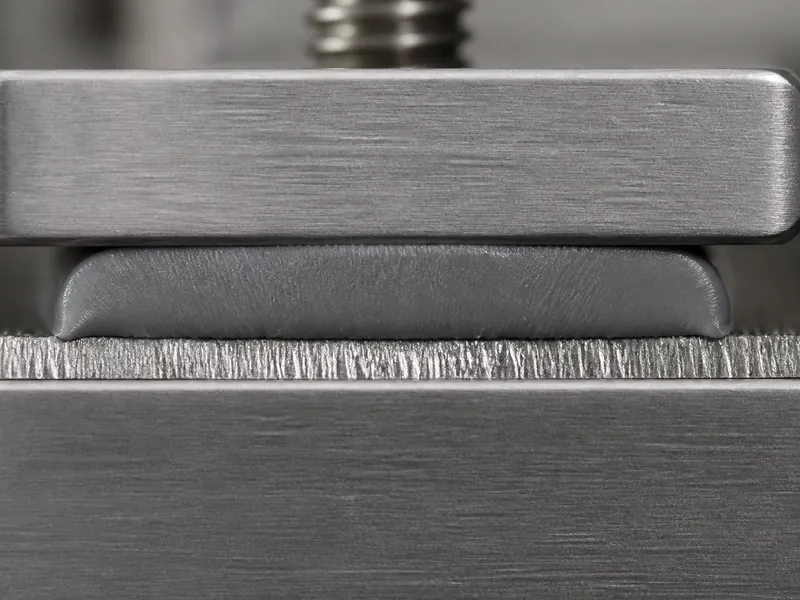
One boundary matters for high-voltage packs. A silicone thermal pad should not stand in for a system-required insulation barrier without dielectric-strength evidence for that specific pad, thickness, and compressed state.
The limits weigh just as heavily in an honest “is it good” answer. Silicone pads sit below the best pastes on raw conductivity. In sensitive optical or high-voltage builds, silicone bleeding or out-gassing can be a real constraint that pushes a design toward silicone-free chemistries.
A subtler trap is reading the datasheet W/m·K as the heat transfer you will actually get. Three numbers are not the same thing: the product’s nominal conductivity, the apparent conductivity and thermal impedance measured under the ASTM D5470 method, and the effective conductivity of a specific built-up joint. The ASTM value already folds in interface contact resistance and shifts with thickness. In one peer-reviewed study in ACS Applied Electronic Materials, two real interface materials measured in a 125–140 μm layer between metal faces came out near 1.2 and 4.4 W/m·K, well below their bulk figures. For EV and ESS packs, silicone thermal pads are commonly specified in a 1 to 5 W/m·K nominal range, but the installed result still depends on bond line, contact area, clamp pressure, and allowed temperature rise. Treat any rating as a selection input, not a delivered value.
When a Silicone Thermal Pad Is the Right Choice
Choose a silicone thermal pad when the interface has a real, variable gap, needs electrical isolation, and runs at moderate temperatures, and reach for another TIM when any one of those conditions breaks. Gap size sets the first cut. Pads perform from a few tenths of a millimeter up to several millimeters, but past roughly 5 mm the added thickness raises thermal resistance enough that a spacer-plus-pad or a dispensed gap filler is usually the better call.
Assembly stress and temperature set the next two cuts. A pad needs enough clamp load to conform, but not so much that it over-compresses a fragile board or cell tab. Where clamp load is low and the gap is tiny, paste or a phase-change film wets the surfaces more completely. Where the joint runs hot or demands maximum conductivity across a flat, well-machined interface, paste or a graphite sheet may suit it better. Graphite’s high conductivity is mostly in-plane, though, so the through-plane path across the interface has to be confirmed before you count on it.
| Interface condition | Silicone thermal pad | Thermal paste | Graphite sheet |
|---|---|---|---|
| Large or uneven gap (mm-scale) | Suits it — conforms and fills | Not suited — too thin, can run | Limited — thin, needs flat faces |
| Electrical isolation needed | Grade-dependent — verify dielectric rating | Only in a non-conductive grade | Not suited — conductive in-plane |
| Thin, flat, high-heat joint (through-plane) | Workable | Often lower through-plane resistance | High in-plane spreading; verify through-plane |
| Assembly and rework | Conforms, often reworkable | Single-use, can be messy | Clean but fragile |
Compare each option on the same terms: fillable gap, target bond line, contact pressure, through-plane resistance, electrical isolation, and rework, not on one headline number. Read the table by your worst constraint first: lock the gap and the isolation requirement, then compare on conductivity. When the decision narrows to a thermal pad versus thermal conductive paste, the trade is conformability and serviceability against peak through-plane conductivity.
Conclusion
So, is a silicone thermal pad good? For a conformable, electrically isolated interface with a variable gap and moderate temperatures, yes—it is often the most practical thermal interface material. The condition is that you treat its datasheet conductivity as an apparent value and confirm the installed thickness and clamp load. The idea most often misread is that a higher-W/m·K pad always cools better. In practice the thinnest pad that still fills the gap and holds isolation tends to win, because interface resistance, not bulk conductivity, sets the outcome. Where the gap is tiny and flat, the joint runs hot, or silicone out-gassing is a risk, another TIM is the honest choice. Trumonytechs builds silicone thermal pads and matched cooling components, so a pad can be specified against the actual pack interface instead of a catalog number; our team can help match one to your gap, stress, and isolation targets.
FAQ
Are silicone thermal pads safe to use?
Whether a silicone thermal pad is safe depends on the specific grade and the system’s requirements, not on the material class alone. Confirm the pad’s operating temperature range, its SDS, any required flame rating, dielectric data where it sits near live parts, and outgassing limits for sensitive optical or high-voltage assemblies, then verify the installed compression. A grade cleared against those checks is safe for its intended use, but the class as a whole is not automatically safe for every battery application.
Is a thermal pad or thermal paste better?
Neither is universally better; the interface decides. A pad wins on uneven or larger gaps, electrical isolation, and clean, reworkable assembly, while paste wins on thin, flat, high-heat joints where the lowest possible interface resistance matters most.
Are silicone thermal pads electrically insulating?
Most silicone thermal pads are electrically insulating because the silicone matrix is non-conductive and the fillers are typically ceramic instead of metal. A design that needs a guaranteed dielectric barrier should still confirm the breakdown rating on the specific pad, since filler type and thickness change it.
How thick should a silicone thermal pad be?
The right thickness is the thinnest pad that still fills the gap under clamp load without leaving air behind. Thicker pads bridge bigger gaps but add thermal resistance, so past a few millimeters a spacer-plus-pad or a dispensed gap filler often performs better.
Can a silicone thermal pad be cut to size, and what should you avoid in assembly?
A silicone thermal pad can be cut to size, but cut it to the drawing and tolerance so it covers the contact area without gaps. Do not stack pads to make up a thickness mismatch unless that build has been validated, since each added interface raises resistance. Do not default to combining a pad with thermal paste unless the supplier and your validation plan allow it.
Can silicone thermal pads be reused?
A silicone thermal pad can sometimes be reused if it is undamaged and has not taken a compression set, but reuse is a judgment call. Inspect it for tears, embedded debris, and lost conformability, and replace it if the bond line or contact area looks compromised.
Further Reading
- ASTM D5470-17, Standard Test Method for Thermal Transmission Properties of Thermally Conductive Electrical Insulation Materials — Standard (T1). Defines how a TIM’s apparent thermal conductivity and impedance are measured, which supports reading a pad’s rating as an installed value rather than a bulk-material figure.
- Simultaneous Measurement of Thermal Conductivity and Volumetric Heat Capacity of Thermal Interface Materials (ACS Applied Electronic Materials, 2024) — Peer-reviewed (T2). Reports effective conductivities of real interface materials in the low single-digit W/m·K range, backing the nominal-versus-effective distinction.
Related Articles
- What Is Thermal Paste Made Of? — Explains how filler type, particle size, and loading set a paste’s conductivity and electrical safety, useful when weighing a pad against grease.
- Ceramic Thermal Paste: What It Is, How It Works, and When to Use It — Covers ceramic-filled, non-conductive grease and where it fits EV battery gap-filling versus a pad.
- Conductive vs Non-Conductive Thermal Paste: A Selection Guide — Separates thermal from electrical conductivity and argues the non-conductive default for EV, ESS, and industrial packs.
- Phase Change Thermal Pad: Transition Band, Clamp Pressure, and Bond Line — Details the transition band, clamp load, and flatness a phase-change pad needs, the alternative named in this article’s low-clamp case.
- Thermal Interface Materials Types & Characteristics — Maps the main TIM families and how they cut thermal resistance, for readers comparing pads, pastes, and phase-change films.