
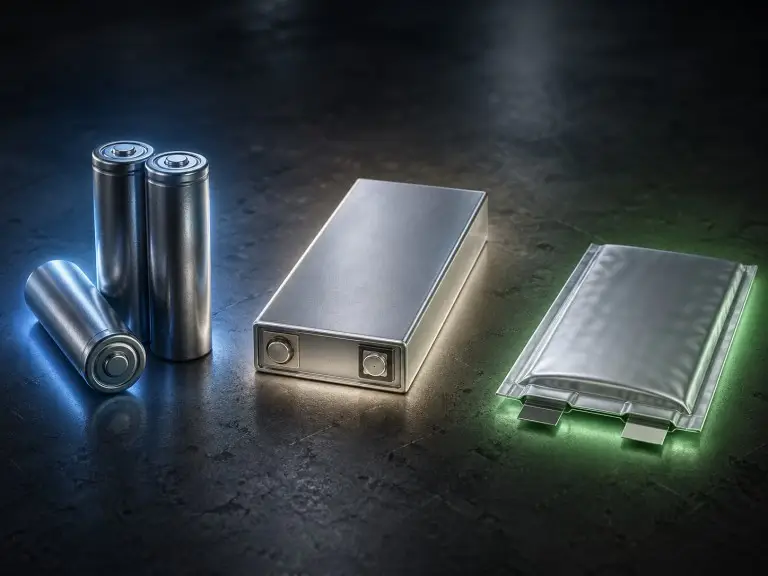
When engineers and procurement teams refer to “EV battery module types,” the real decision variable is cell format — the physical geometry and casing of the individual electrochemical unit. Cell format determines how cells sit in a module, how heat leaves the pack, how swelling is managed, and what cold plate and interface design the thermal system needs. Cylindrical, prismatic, and pouch formats each involve distinct trade-offs across energy density, thermal management, manufacturing cost, and safety. No single format suits every application.
At Trumonytechs, we work across all three cell formats in EV and ESS thermal management programs. Cell format is one of the most important upstream inputs to cold plate geometry, TIM selection, and contact pressure specification.
The Three Main EV Battery Cell Formats
Cylindrical Cells
Cylindrical cells are the oldest mass-produced lithium-ion format. They roll electrode materials into a rigid metal cylinder — similar in geometry to a standard AA battery, just larger. Common form factors include the 18650, 21700, and Tesla’s 4680.
The format’s main advantages are manufacturing maturity and supply chain breadth. Cylindrical cells use highly automated production lines and benefit from strong economies of scale. This keeps unit cost low and reduces single-source risk. The rigid casing provides inherent structural protection. Unlike prismatic or pouch formats, cylindrical cells do not swell during cycling. This simplifies module compression design.
From a safety perspective, packs can space cylindrical cells apart to limit propagation between adjacent cells. Flat formats do not provide this passively. Cylindrical cell spacing is one of the structural responses to cell-to-cell thermal runaway that flat formats must address through other design measures.
The main trade-off is pack volumetric efficiency. Gaps between cylinders are unavoidable. This reduces space utilization compared to flat formats. Achieving equivalent energy storage also requires more cells than large-format prismatic designs. That increases BMS complexity and electrical connection overhead.
Tesla built its early vehicles around cylindrical cells — first 18650, then 21700, then the 4680. The choice was driven by availability, manufacturing maturity, and cost.

Prismatic Cells
Prismatic cells enclose electrode materials in a rigid rectangular aluminum or steel casing. The flat, stackable geometry improves pack space utilization. Multiple cells stack directly against each other with minimal dead volume.
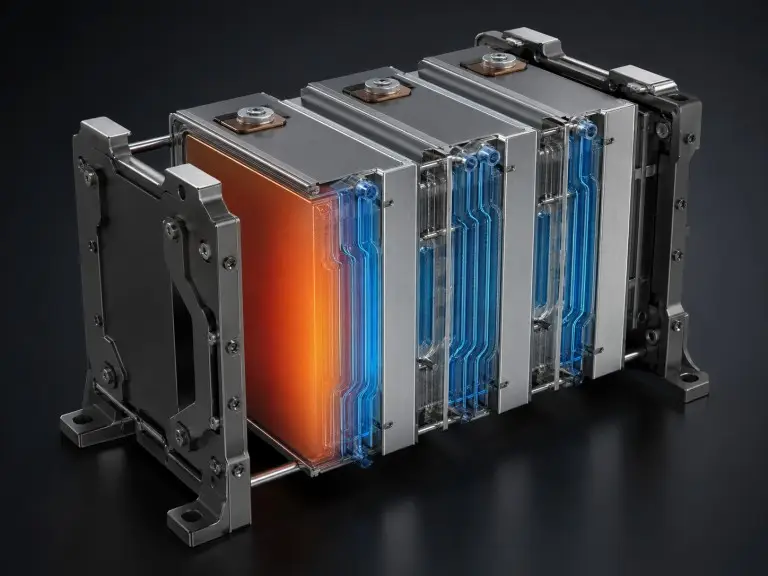
High cell capacity — typically 50–200 Ah in EV applications — reduces total cell count and simplifies BMS and busbar design. Flat faces allow direct cold plate contact. The stacked internal layer configuration also aids heat dissipation through the cell thickness. This makes prismatic cells well-suited to applications where thermal management is a priority.
Swelling is an important design consideration. Prismatic cells expand during cycling as gases build up and electrodes shift. Module enclosures must include growth allowances. Without adequate compression management, swelling causes uneven contact pressure at the cold plate interface and degrades thermal uniformity over time. The extent of swelling depends on cell chemistry, capacity, and cycle history. It is not a fixed value across all prismatic formats and should be characterized for the specific cell used.
CATL and Samsung SDI supply large-format prismatic cells across a wide range of OEM programs. BYD’s Blade battery is a key prismatic variant. The Blade uses an elongated cell geometry that integrates directly into the pack structure, removing the intermediate module layer. BYD states that Blade packs achieve substantially higher space utilization than conventional module-based architectures, with improved thermal stability and lower thermal runaway risk. Tesla introduced LFP prismatic cells — sourced from CATL — in standard-range Model 3 and Model Y built in China, to reduce cost and enable more direct pack integration.
Pouch Cells
Pouch cells enclose electrode materials in a flexible laminated aluminum-plastic film. This gives the highest gravimetric energy density of the three formats. It also allows cell geometry to fit irregular or space-constrained module designs.
However, this packaging advantage comes with two design challenges. First, pouch cells have relatively low thermal conductivity through the pouch material. Thermal-critical applications may need larger cold plate contact area or bilateral cooling — plates on both faces of the cell stack. Second, pouch cells swell during cycling. Unlike prismatic cells with rigid casings, pouch cell swelling must be managed at the module level through compression frames and constraining structures. Without controlled compression, swelling over the service life causes contact pressure variation at the cold plate interface. This produces cell-to-cell temperature differences during cycling. Module compression design and battery TIM selection are interdependent in pouch cell programs. Neither can be specified independently of the other.
SK On supplies pouch-format cells to Ford for certain EV programs. LG Energy Solution and Samsung SDI also produce high-volume pouch cells for automotive applications.

Key Differences at a Glance
| Parameter | Cylindrical | Prismatic | Pouch |
|---|---|---|---|
| Casing | Rigid metal cylinder | Rigid rectangular hard case | Flexible laminated film |
| Gravimetric energy density (cell level) | High | High | Highest |
| Pack volumetric efficiency | Moderate | High | High |
| Dimensional change with cycling | None | Moderate — requires growth allowance | Significant — requires compression management |
| Thermal management approach | Radial extraction; cell spacing limits propagation | Direct flat-face cold plate contact | Flat-face contact; compression-dependent across service life |
| Manufacturing maturity | Very high | High | High |
| Typical applications | Passenger EVs, performance vehicles, consumer electronics | Commercial EVs, ESS, buses, cost-optimized passenger EVs | Premium passenger EVs, hybrid vehicles |
| OEM examples | Tesla (18650, 21700, 4680) | BYD Blade, CATL (Tesla standard range China) | SK On (Ford programs), LG Energy Solution, Samsung SDI |
Market Format Trends
Format market share has shifted significantly. Based on 2024 global EV battery deployment data, prismatic cells hold approximately 69% share. That is up from roughly 40% in 2020. The shift reflects broader LFP adoption, which pairs naturally with prismatic formats, and the growth of cell-to-pack integration. Cylindrical share has declined in relative terms. Pouch share has grown modestly.
This does not mean prismatic is the right choice for every program. It reflects where cost and integration priorities have moved, particularly in China. High-performance and long-range applications still rely on high-energy-density NMC chemistry. NMC appears across all three formats depending on the OEM’s strategy.

How Cell Format Affects Thermal Management
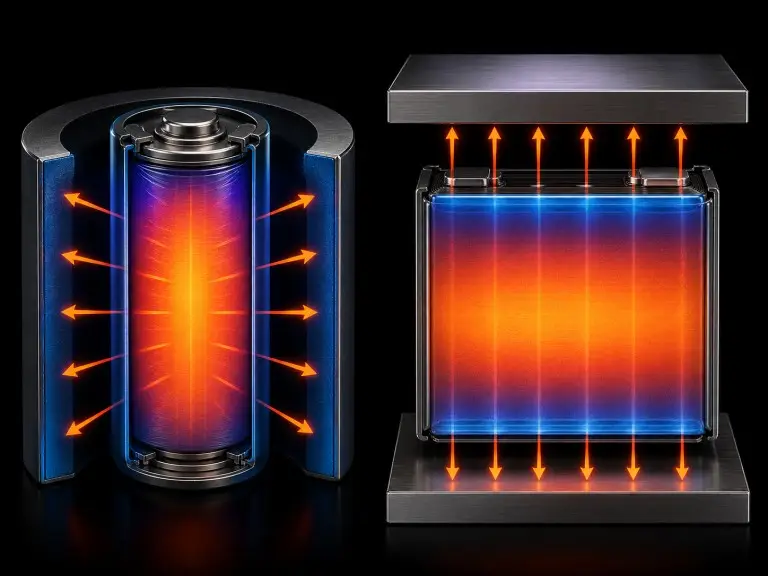
Cell format determines heat extraction geometry and narrows the viable battery cooling system types before detailed thermal design begins. The interface design needed to achieve pack-wide temperature uniformity varies significantly by format.
Cylindrical cells dissipate heat radially. Cold plate routing must reach each cell’s base or side wall. The natural gaps between cells limit thermal runaway propagation. This is a passive safety benefit. The same spacing reduces pack volumetric efficiency but simplifies thermal isolation at the cell level.
Prismatic and pouch cells use flat-face cold plate contact. This simplifies cooling geometry. However, it makes contact pressure uniformity the critical variable. For prismatic cells, swelling over cycling gradually changes contact conditions. The module design must maintain adequate pressure throughout the service life — not just at initial assembly. For pouch cells, the compression frame must actively manage swelling while preserving thermal contact. Bilateral cooling is more practical for pouch and prismatic formats than for cylindrical arrangements.
Cell Chemistry and Format: How They Interact
Cell format and chemistry are independent variables. However, they interact in thermal management specification. NMC provides higher energy density but requires tighter temperature control due to lower thermal stability. LFP offers lower energy density with superior thermal stability and longer cycle life. LFP is widely used in prismatic format for commercial EVs, ESS, and cost-optimized passenger EV programs.
The practical implication is direct. NMC demands tighter ΔT control and more conservative temperature limits than LFP — regardless of cell format. Specifying cold plate geometry from cell format alone leaves part of the thermal design undefined. Battery pack thermal management requires both cell format and chemistry to be confirmed before channel geometry or interface specification is finalized.
Standards and Safety Validation Context
Cell format affects how safety validation is structured. Key standards applicable to EV battery cells and modules include:
- IEC 62660-1: Performance and life testing for lithium-ion cells in EV traction applications
- IEC 62660-2: Reliability and abuse testing
- IEC 62660-3: Safety performance requirements
- UN 38.3: Transport testing for lithium cells and batteries
- GB 38031-2025: China’s safety requirements and test methods for EV traction battery cells, modules, and packs
These standards apply across all three formats. However, format-specific mechanical behavior — particularly swelling in prismatic and pouch formats — affects how compression, enclosure, and thermal management designs must be validated against abuse and cycling test requirements.
When to Choose Each Format
Format selection is a system-level decision. As a general orientation:
Cylindrical cells suit applications where supply chain breadth, low cost, and passive thermal runaway containment are priorities. They work well for high-performance passenger EVs and standardized pack designs where higher cell count is manageable.
Prismatic cells suit applications where pack space utilization, simplified BMS design, and direct cold plate contact are priorities. Commercial EVs, stationary ESS, and cost-optimized passenger EV programs using LFP chemistry are the strongest fit.
Pouch cells suit applications where gravimetric energy density and packaging flexibility are priorities. Premium passenger EVs and hybrid vehicles — where weight and space efficiency justify additional compression engineering — are the primary use case.
In practice, OEM format decisions also depend on supplier relationships, regional supply chain access, and integration architecture. There is no universal answer. The right format depends on the full set of design constraints for the specific program.
Conclusion
Cylindrical, prismatic, and pouch cells offer distinct trade-offs across energy density, thermal management, manufacturing, and safety. Prismatic formats now dominate global EV battery deployment, driven by LFP adoption and cell-to-pack integration trends. However, all three formats remain active across different vehicle segments and applications.
At Trumonytechs, cell format is one of the first inputs we confirm when starting a new thermal management program. It drives cold plate geometry, interface material requirements, and the compression and contact pressure conditions we design for. If you are selecting a cell format for a new program or adapting an existing thermal design to a different cell geometry, share your pack layout, cell format, chemistry, and thermal targets with our team. We will review the interface design and provide a direction for EV battery water cooling plates and TIM selection based on your specific application.
FAQ
What is the difference between EV battery cell format and module type?
Cell format is the physical geometry of the individual electrochemical unit — cylindrical, prismatic, or pouch. Module type refers to how cells are arranged, compressed, connected, and cooled within a module assembly. Most discussions about “EV battery module types” are comparing cell formats, since format drives most module design decisions.
Which cell format dominates the current EV market?
Prismatic cells hold approximately 69% of global EV battery deployment capacity as of 2024 — up from roughly 40% in 2020. This reflects LFP adoption and cell-to-pack integration trends, particularly in China.
Why do pouch and prismatic cells require compression management?
Both formats change dimensionally during cycling. Prismatic cells expand as gases build up and electrodes shift. Pouch cells swell because their flexible packaging does not constrain expansion. Without compression management, swelling causes uneven contact pressure at thermal interfaces and degrades temperature uniformity over the service life.
Which cell format handles thermal runaway containment best?
Cylindrical cells use cell spacing to limit thermal runaway propagation between adjacent cells. BYD’s Blade battery addresses this through structural integration and LFP chemistry’s inherent thermal stability. Pouch cells have lower passive containment and rely more on active monitoring and module-level protection design.
What standards apply to EV battery cell safety validation?
Key standards include IEC 62660-1, IEC 62660-2, IEC 62660-3, UN 38.3, and GB 38031-2025. These apply across all three cell formats. Format-specific swelling and compression behavior affects how enclosure and thermal management designs are validated against abuse and cycling test requirements.