

ESS liquid cooling earns its place in modern battery energy storage for three engineering reasons: it holds cells inside their optimal temperature band, it supports higher usable energy density in the same footprint, and it lowers the heat-driven stress on cells during normal operation. Those benefits matter most as systems move to higher capacity and higher charge/discharge rates, where air cooling starts to run out of headroom. This article looks at the benefits from a battery-pack integration view, the cell-to-coolant heat path, and where the gains actually apply. It does not rank specific vendor products or quote system-level performance numbers, since those depend on cell chemistry, pack geometry, and duty cycle.
Enhanced Thermal Management
Liquid cooling manages ESS heat by carrying it away through a cold plate, so modules stay closer to their target temperature under load. In a typical cold-plate design, the coolant fluid flows inside the plate. Heat leaves each cell across the module contact face and any interface material, crosses the plate wall, and only then enters the coolant. Liquid cooling placed this close to the cells carries heat away where it is generated instead of relying on air blown across a loosely packed array. Direct fluid-to-cell contact is a different system, immersion cooling, not the indirect cold-plate path described here.
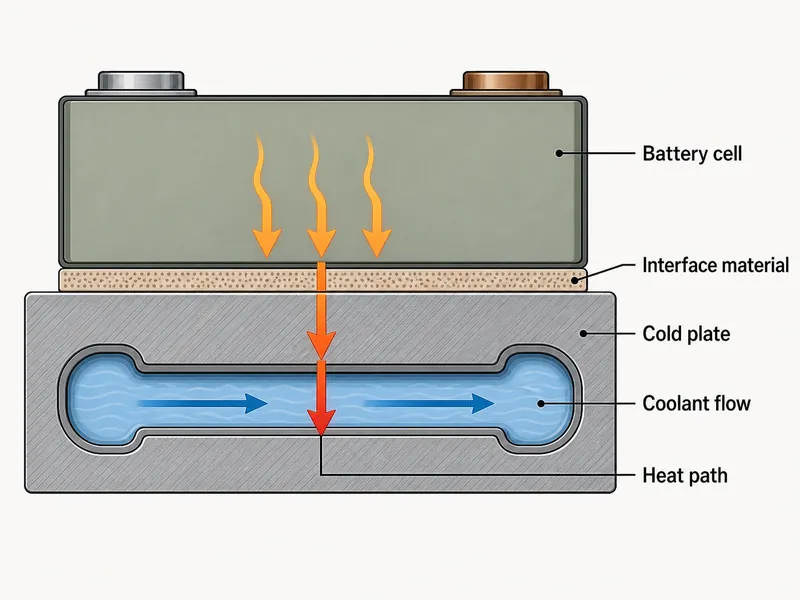
Lithium-ion cells operate best in a fairly narrow band, which is what makes that heat path worth engineering. Per a peer-reviewed review in *ACS Omega* (2024), the optimal range is roughly 15–35 °C, and both higher and lower temperatures accelerate degradation and cut efficiency, with the exact band shifting by cell chemistry. Liquid cooling helps a pack stay inside that range and helps flatten the cell-to-cell temperature difference, the variable that drives hotspots and uneven aging. Trumonytechs builds liquid cooling solutions around this cell-to-coolant path, matching cold-plate geometry and interface materials to the cell format so contact stays uniform across the module.
Increased Efficiency and Performance
Stable, uniform temperatures let an ESS charge and discharge harder without the derating that heat forces on an air-cooled pack. When cells stay near their optimal band, the system does not have to throttle to protect the hottest cell, so it can sustain higher C-rates. This is where liquid cooling pays back in high-density, high-throughput applications such as utility-scale and commercial-and-industrial storage.

Temperature uniformity is the underlying lever, not just peak temperature. Large cell-to-cell gradients push some cells outside the optimal band while others sit cold, which caps the pack at its weakest link and wastes usable capacity. Because a liquid loop pulls heat from every module through a defined interface, it narrows that spread and keeps more of the installed capacity available. The same compactness lets liquid-cooled containers pack more energy into a given footprint. That is a directional advantage seen across current 5 MWh-class designs, though the exact figure depends on cell size and enclosure.
The uniformity gain is not automatic; it is set by the interface and the flow layout. The variable is the thermal path between cell and coolant: the gap, the flatness of the mating surfaces, and the interface material that fills it. A thick or uneven gap adds thermal resistance and reintroduces the gradients liquid cooling is meant to remove. The verification is to check the temperature spread across the plate under the worst-case duty cycle, and to confirm coolant flow is balanced so no channel is starved.
Extended Lifespan of ESS Components
Controlling heat and thermal cycling is one of the few levers an operator has on ESS service life. Battery aging is temperature-driven: holding cells lower and more uniform slows the degradation that comes from running outside the optimal band, the same 15–35 °C evidence noted above. Liquid cooling reduces both the peak temperature and the swing between charge and discharge, which is the kind of thermal stress that wears cells over their service life.
The size of that benefit depends on duty cycle and climate, so it is best stated conditionally. Under high-density, high-throughput operation, tighter thermal control can meaningfully extend usable life relative to air cooling; under light, low-C-rate duty the gap narrows. This is the mechanism by which liquid cooling extends the lifespan of ESS components, by limiting the thermal stress that accelerates capacity fade.
Comparison with Air Cooling Systems
Liquid cooling leads on efficiency, scalability, and thermal uniformity at high heat load, while air cooling keeps an edge on upfront cost and simplicity, so the choice follows the duty cycle. At the same heat load, liquid conducts and carries heat better than moving air. A liquid loop therefore holds a tighter temperature spread and can scale by raising coolant flow instead of enlarging fans and airflow channels. In high-heat-load applications it is better than traditional air cooling at keeping a dense pack uniform, though that advantage comes with an auxiliary loop to build and maintain.
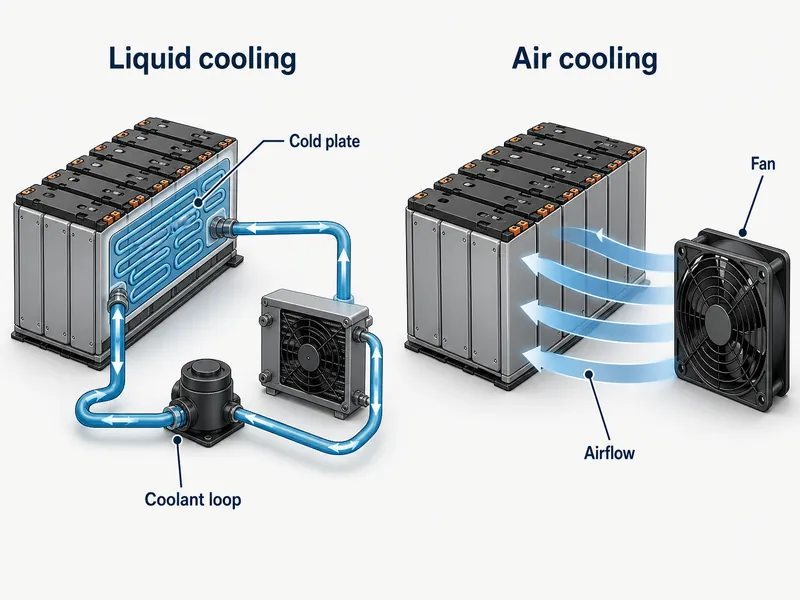
The table below compares the two at a comparable heat load and system boundary; the right choice still depends on the specific duty cycle and site.
| Dimension | Liquid cooling | Air cooling |
|---|---|---|
| Temperature uniformity | Tighter cell-to-cell spread at high heat load | Wider spread; hotspots more likely as density rises |
| Scalability | Scales by coolant flow, but adds pumps, heat exchanger, and piping | Simple airflow, but loses energy density as capacity grows |
| Maintenance | Sealed loop resists dust; adds a leak path and coolant upkeep | Fewer fluid parts; needs fan and filter maintenance |
| Best fit | High C-rate, high-density, utility/C&I when designed for it | Low C-rate or small systems with modest heat load |
The trade-off liquid cooling carries is the loop itself. It adds pumping power and a leak path that a sealed design has to manage, so pressure drop and coolant integrity are design variables, not afterthoughts. A cold plate with poorly sized channels raises pressure drop, which raises parasitic pumping load and eats into the efficiency benefit. Size channel geometry against the target flow, pressure-test the loop, and specify leak detection before the system ships. These verification steps decide whether the benefit is actually realized.
On safety, keep two cases separate: what cooling does during normal operation, and what happens if a cell fails. During normal operation, tight temperature control limits the hotspots and temperature rise that stress cells, which is a real benefit. What a cooling choice does to thermal runaway propagation once it starts is a system-level design question, verified by testing rather than assumed. UL 9540A, the only consensus test method NFPA 855 cites for large-scale fire testing, evaluates how thermal runaway spreads cell-to-cell and module-to-module. Liquid cooling does not by itself certify a system or guarantee propagation behavior; that has to be demonstrated at the relevant UL 9540A test level.
Air cooling is not obsolete. When a system is designed for low C-rate and modest heat load, and its actual sustained power, ambient temperature, and allowable temperature spread confirm it, air cooling can be sufficient and cheaper to build. Applications such as solar energy shifting or backup storage often fall here, but only when their power-to-capacity ratio and duty cycle are genuinely low, not by category alone.
Emerging Trends in ESS Liquid Cooling
Most current development targets control and interfaces rather than a new cooling principle. One design option is sensor-driven, adaptive control that matches coolant flow to real-time load instead of running the loop flat out; its effect has to be verified against temperature, flow, pressure drop, and pump power, not assumed, and it is part of moving toward integrated and intelligent cooling systems. Another is continued work on cold-plate and interface materials aimed at better heat transfer and durability while keeping the loop compact. These are engineering options to evaluate against your own duty cycle, not guaranteed gains.
Conclusion
For an engineer, the payoff of ESS liquid cooling is one thing you can act on: it keeps cells inside their optimal band and keeps them uniform. Sustained C-rate, usable energy density, longer service life, and a stronger normal-operation safety margin all trace back to that control. Read the benefits against your duty cycle: for high-density, high-throughput systems the case is strong, while low-C-rate or small installations may still be well served by air. The most common misread is treating a headline temperature number as the goal, when it is the cell-to-cell spread that governs aging and performance. Where those variables have to be matched to a specific cell format and pack geometry, we work from the cell-to-coolant heat path; contact Trumonytechs for custom solutions to size the cold plate and interface to your system.
FAQ
What are the main benefits of ESS liquid cooling?
The main benefits are tighter temperature control, higher usable energy density, and lower heat-driven stress on cells during normal operation. Liquid cooling holds cells within their optimal band and reduces the cell-to-cell temperature spread, which supports sustained charge/discharge and slows aging. The size of each benefit depends on duty cycle, cell format, and climate.
How does liquid cooling compare to air cooling in an ESS?
Liquid cooling manages heat more efficiently and scales better at high density, while air cooling is simpler and cheaper upfront. A liquid loop carries heat away through a cold plate and holds a tighter temperature spread, whereas air cooling relies on fans and loses energy density as capacity grows. Air cooling can still be adequate for low-C-rate or small systems.
Does liquid cooling actually extend ESS battery life?
Liquid cooling can extend battery life by reducing peak temperature and thermal cycling, but the gain is conditional. Because aging accelerates when cells run outside their optimal band, holding them lower and more uniform slows degradation, with the largest benefit under high-density, high-throughput duty. Under light, low-C-rate operation the difference is smaller.
When is air cooling still sufficient for a BESS?
Air cooling is usually sufficient for low-C-rate and smaller systems where the heat load is modest. Whether a given system qualifies depends on its sustained power, ambient temperature, and allowable temperature spread, not on the application name alone. As C-rate and density rise, liquid cooling becomes the more practical choice.
Further Reading
- UL 9540A Test Method for Battery Energy Storage Systems — UL Solutions (standards body). Supports the safety point: it defines how thermal runaway propagation is evaluated in an ESS, and is the method NFPA 855 cites for large-scale fire testing.
- Application of Refrigerant Cooling in a Battery Thermal Management System: A Review — *ACS Omega*, 2024 (peer-reviewed). Supports the optimal-temperature basis for the thermal-management and lifespan benefits, including the 15–35 °C operating band for lithium-ion cells.
Related Articles
- EV vs ESS Battery: Key Differences & Thermal Management — How EV and ESS batteries differ in chemistry and thermal-management strategy, useful once you have decided cooling matters.
- Optimizing Thermal Management of Industrial Energy Storage — Goes deeper on tuning active and passive cooling for industrial ESS to extend equipment life.
- Why Do Golf Carts Choose Liquid Cooling Over Air Cooling? — A concrete liquid-versus-air comparison in a different high-duty application.
- Commercial Building Solar Energy Storage System Case Studies — Shows the commercial ESS settings where these cooling trade-offs get applied.
- Best Materials for Dissipating Heat in Electronics — Background on the material properties behind cold-plate and interface heat transfer.