
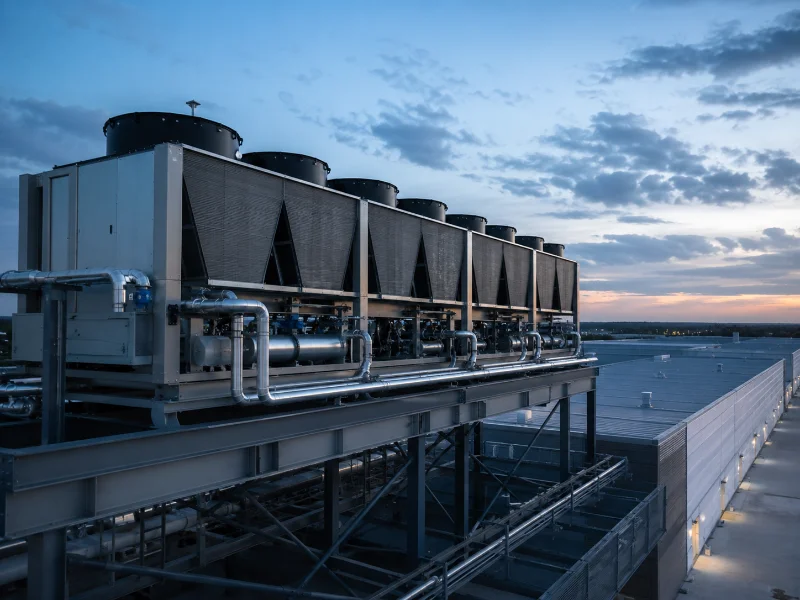
Every server, GPU, and switch in a data center turns electricity into heat, and that heat has to leave the building without ever letting the IT equipment get too warm. The chiller is the machine that makes that exit possible. It produces the chilled water that carries heat out of the white space, and its design largely sets how much electricity and water the whole facility burns to stay cool.
For operators and facility engineers, the practical question is rarely whether a site needs a chiller. It is which type fits the load, climate, and water situation. This article stays on that decision and leaves the chip-level loop, data center liquid cooling, the coolant distribution unit, and the refrigeration cycle itself to their own separate discussions.
Where a chiller fits in the data center cooling chain
A data center chiller is the refrigeration machine that produces chilled water and rejects facility heat outdoors, and its required duty depends on the rack density and climate it serves. Inside the building, computer room air handlers, in-row units, or a direct-to-chip cold-plate loop capture heat from the equipment and pass it into a chilled-water circuit. The chiller’s job begins where that water returns warm and ends where heat reaches the outdoor environment.
The chiller is one link, not the whole chain. How it performs that final hand-off to the outdoors is exactly what separates the two main chiller families, and that distinction drives most of the cost and efficiency consequences downstream.
Air-cooled vs water-cooled: the real split is at heat rejection
The labels air-cooled and water-cooled describe where a chiller sends its heat, not how the servers are cooled, and the right choice depends on water availability and peak ambient temperature. A facility can circulate chilled water throughout the building and still be “air-cooled,” because the term refers to the heat-rejection stage rather than the rack.
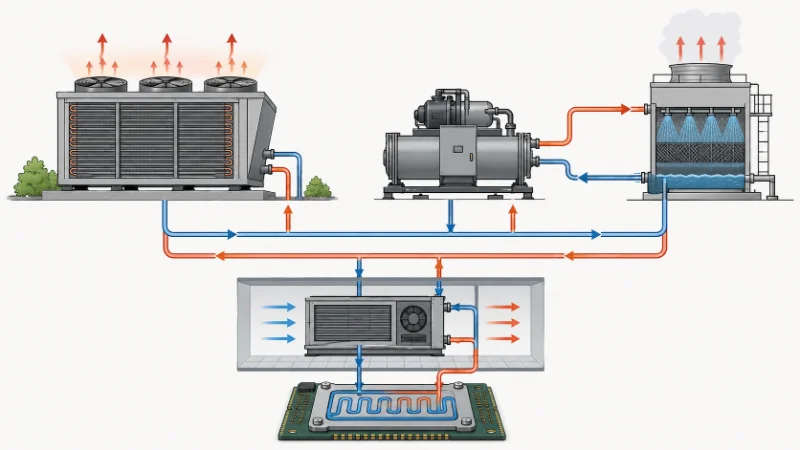
An air-cooled chiller rejects heat directly to outdoor air through condenser coils and fans, so it needs no cooling tower and consumes little or no water in normal operation. A water-cooled chiller passes heat to a condenser-water loop and a cooling tower, where evaporation does the final rejection. The water-cooled efficiency advantage is physical, not marketing: a cooling tower rejects against the outdoor wet-bulb temperature, which is lower than the dry-bulb temperature an air-cooled condenser must work against, so the refrigerant condenses at a lower temperature and the compressor draws less power. That advantage costs continuous water use, treatment, and more plant infrastructure.
| Dimension | Air-cooled chiller | Water-cooled chiller |
|---|---|---|
| Final heat rejection | Outdoor air via condenser coils | Cooling tower via evaporation |
| Efficiency driver | Limited by dry-bulb temperature | Benefits from lower wet-bulb temperature |
| Water consumption | Minimal in normal operation | Continuous; needs treatment and blowdown |
| Ambient sensitivity | Capacity drops as outdoor air heats up | More stable in high ambient |
| Plant infrastructure | Self-contained, simpler to install | Tower, condenser loop, pumps, water systems |
| Typical fit | Smaller, edge, or water-scarce sites | Large central plants where water is available |
A common sizing error hides in this table. In hot, dry climates, an air-cooled chiller’s condenser side is the first thing to lose capacity when summer ambient peaks. A plant sized to a mild design day then falls short on exactly the days it matters most. The verification step that prevents it is checking the design ambient against worst-case local conditions, not annual averages.
Standards and rating points to confirm before you compare chillers
Chiller comparisons are only meaningful against named rating standards, because two manufacturers’ numbers are not comparable unless they were measured the same way. Before weighing one plant against another, confirm where each figure comes from.
- AHRI 550/590 (I-P) or 551/591 (SI) rate factory-made water-chilling packages on the vapor-compression cycle, covering both air-cooled and water-cooled units. They define full-load efficiency in kW/ton (where kW/ton ≈ 3.516 ÷ COP) plus the part-load IPLV and NPLV. Note the caveat written into the standard itself: IPLV represents the average performance of a single chiller, so a building-specific analysis predicts real energy use more accurately.
- ASHRAE Standard 90.4 is the energy standard for data centers, applying to facilities above 20 W/ft² conditioned floor density and 10 kW IT load. It judges the plant through the Mechanical Load Component, the ratio of cooling, fan, pump, and heat-rejection energy to IT equipment energy. ASHRAE states the MLC is not directly analogous to PUE, so treat the two as separate checks.
- ASHRAE TC 9.9 Thermal Guidelines set the allowable supply temperatures and humidity envelopes that determine how warm the chilled water can run, which in turn governs how many free-cooling hours the site can claim.
- The Green Grid PUE and WUE frame the energy-versus-water trade-off discussed below.
A short pre-selection checklist keeps these from becoming abstract: design-day dry-bulb and wet-bulb, target chilled-water supply and return temperatures, full-load kW/ton and IPLV/NPLV at the actual site conditions, redundancy tier and resulting unit count, and the water budget including make-up, blowdown, and treatment.
The variables that decide which chiller type fits your site
Chiller selection turns on a handful of interacting site variables rather than a single best technology. Cooling load sets the starting point: air-cooled units are commonly applied at smaller and mid capacities, while the largest central plants more often go water-cooled, though published ranges vary by manufacturer and the crossover shifts once redundancy is applied. Climate then bends the result, because air-cooled capacity sags as the dry-bulb peaks, so a long hot summer pushes the math toward water-cooled or hybrid rejection.
Water availability is frequently the deciding constraint. Where water is scarce, costly, or regulated, an air-cooled or closed-loop design avoids the continuous tower draw and the permitting exposure that comes with it. Plant space and structure work the same way: towers, condenser piping, and pumps demand room and structural support, so a constrained roof or a retrofit often favors a self-contained air-cooled plant. Redundancy multiplies all of this, since an N+1 or 2N target raises unit count and footprint enough that the cheaper single machine can lose on total installed cost.
The recurring specification mistakes follow directly from skipping one of these variables: sizing to IT load tonnage alone, validating against average rather than peak ambient, ignoring wet-bulb, forgetting the footprint that redundancy adds, and never confirming the return-water temperature the cooling architecture will actually deliver.
Free cooling and part-load behavior, where the energy actually goes
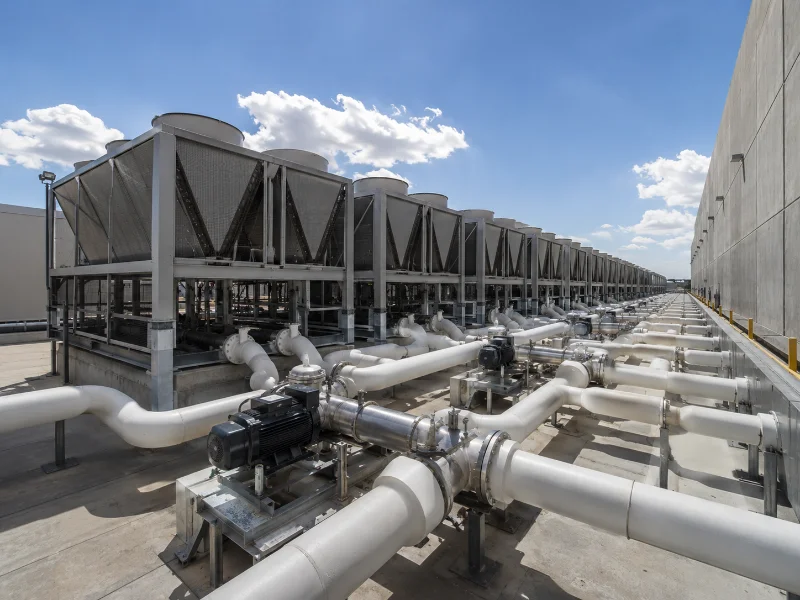
A chiller’s real energy use is driven by part-load performance and free-cooling hours, which depend on climate and chilled-water setpoint far more than on nameplate full-load efficiency. Data center load runs at part load most of the year, so behavior at 40 or 60 percent capacity matters more than the rating at 100 percent, and IPLV exists precisely to describe that range.
Free cooling is the lever that separates an efficient plant from an expensive one. When outdoor conditions are cool enough, a chiller can reduce or stop mechanical compression and let ambient conditions chill the water. In temperate climates that trims compressor energy across a large share of the year. Raising the chilled-water setpoint widens that window, and well-separated hot and cold aisles let the plant run warmer without risking the IT equipment.
The trade-off lives in two metrics. PUE equals total facility energy divided by IT equipment energy, and WUE equals annual site water use divided by IT equipment energy, reported in liters per kWh. A design can win on one and lose on the other, so a water-cooled plant with an excellent PUE may carry a heavy WUE that fails in a water-stressed region. In hybrid air-and-liquid sites, PUE alone can also understate the picture, which is why supplementary measures such as total-power usage effectiveness are sometimes added. The variable worth confirming early is which metric the site is actually judged on.
How chillers and chip-level cooling divide the work as racks get denser
As rack densities climb past what room air can carry, the chiller plant increasingly feeds a chip-level liquid loop instead of cooling air directly, yet its role as the heat-rejection backbone does not change. In a direct-to-chip arrangement, cold plates capture heat at the processor, a coolant distribution unit manages the technology-cooling loop, and a chiller or dry cooler rejects that heat outdoors. The chiller still sits at the end of the chain.
One boundary condition is widely misread: direct-to-chip cooling does not automatically mean colder chilled water. Depending on cold-plate design, CDU approach temperature, coolant type, and chip inlet limits, some architectures allow noticeably warmer chilled-water or secondary-loop temperatures, which can expand free cooling and lift efficiency. Those warmer setpoints are architecture-specific outcomes, not universal design values, so they have to be confirmed for the actual loop rather than assumed. What stays constant is that the chiller must be matched to the cooling architecture it serves: denser racks and a specific coolant temperature change the return-water condition the plant has to handle.
Bringing the chiller decision back to the load it serves
The chiller choice comes down to three linked variables: where heat is rejected, what the climate and water situation allow, and how the load is staged for redundancy. Air-cooled or water-cooled is a fit decision against a specific site, confirmed against AHRI-rated full-load and part-load numbers and an ASHRAE 90.4 view of the whole mechanical load, not a quality ranking.
At Trumonytechs our work sits on the chip-to-coolant side of this chain, in cold plates and thermal interface materials that hand heat to the loop the chiller ultimately rejects. From that vantage one variable repeatedly turns out to be decisive before a chiller is even specified: the return-water temperature, because it sets the chiller’s evaporator condition, the free-cooling hours available, the CDU approach temperature, and the cold-plate inlet the chips actually see. Build the chip-level loop around an optimistic coolant temperature and a correctly rated plant can still struggle.
If you are matching a cooling architecture to a chiller plant, the practical next step is to pin down design dry-bulb and wet-bulb, target chilled-water supply and return temperatures, and the redundancy tier before comparing equipment. On the chip side, share cold-plate heat load, chip TDP, coolant type, target CDU inlet and outlet temperatures, TIM thickness and thermal conductivity, and the pressure-drop budget, and our engineering team can help align the chip-level cooling design to the heat-rejection plant you are planning.
FAQ
Are data center chillers air-cooled or water-cooled?
Both exist, and the label describes how the chiller rejects heat to the environment, not how servers are cooled. Air-cooled chillers send heat to outdoor air; water-cooled chillers send it to a cooling tower. Many air-cooled data centers still circulate chilled water indoors.
What is the difference between a dry cooler and an air-cooled chiller?
A dry cooler rejects heat from a fluid loop to outdoor air without its own refrigeration cycle, so it can only cool the fluid toward ambient temperature. An air-cooled chiller contains a vapor-compression cycle and can produce chilled water below ambient, which a dry cooler cannot. Many high-density designs use dry coolers for free cooling and a chiller for the hours ambient is too warm.
Do air-cooled chillers use water?
Air-cooled chillers use little to no water in normal operation, which is their main advantage in water-scarce regions. Some designs add adiabatic or spray pre-cooling that uses small amounts of water only during peak hot hours to protect capacity.
Can direct-to-chip cooling use warm water?
In many cases yes, because heat capture at the chip can tolerate higher coolant temperatures than room air cooling. The achievable temperature depends on cold-plate design, CDU approach temperature, coolant type, and the chip’s inlet limit, so it should be confirmed per architecture rather than assumed.
Does a water-cooled chiller always have a better PUE?
Not always, because PUE depends on climate, setpoints, and free-cooling hours as well as chiller type. A water-cooled plant is often more efficient on energy, but it can carry a high WUE, and in cool climates an air-cooled plant with many free-cooling hours can close much of the gap.
Are chillers still needed with direct-to-chip liquid cooling?
A chiller or equivalent heat-rejection device is still needed, because direct-to-chip cooling moves heat closer to the processor but does not remove it from the building. The cold-plate loop and coolant distribution unit feed heat back to the chiller, which rejects it outdoors.