
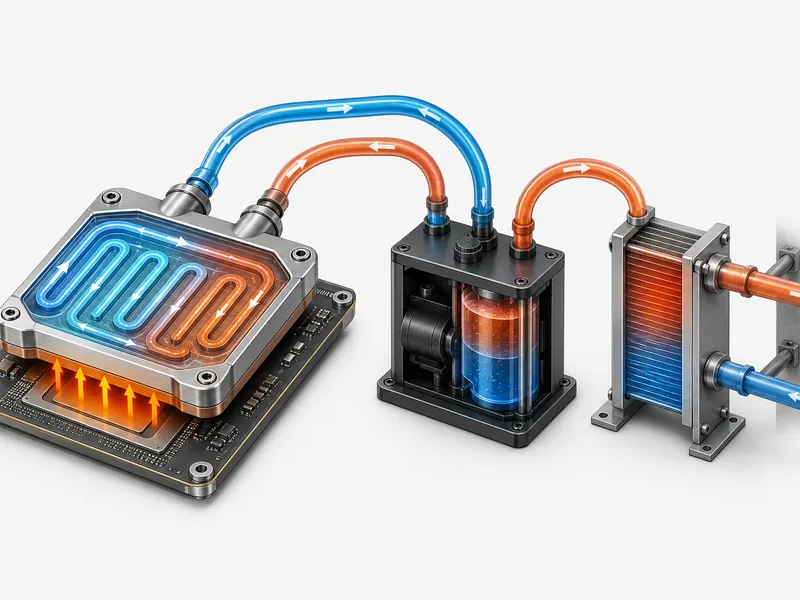
Cold plate liquid cooling removes heat from data center racks that now produce more of it than moving air can carry away. High-density servers under continuous, high-load processing concentrate heat at the chip. Fans and chilled air reach that heat slowly, and the buildup is what pushes operators toward liquid at the source. A metal cold plate sits on the processor, coolant runs through it, and the heat leaves the die by conduction.
The trade-off is new. Liquid at the rack brings integration, cost, reliability, and heat-reuse problems that air cooling never had. This article covers how cold plate cooling works in a data center, where its real challenges sit, how it compares with immersion and air cooling by heat load, and which variables to confirm before a retrofit. It does not cover immersion tank design, facility chilled-water plant sizing, or coolant procurement specs, which depend on site conditions and supplier data.
How Cold Plate Liquid Cooling Works in a Data Center
Cold plate cooling carries heat into a liquid loop by conduction, not into room air by convection. A machined metal cold plate sits against the CPU or GPU through a thermal interface material. Coolant flows through channels inside it and carries the heat to a coolant distribution unit (CDU). The CDU then hands that heat to the facility loop through a heat exchanger. Because the liquid meets the heat source directly, this setup is called direct-to-chip cooling.
Plate material, flow rate, and channel design each set a hard limit on how much heat a plate can pull. Copper conducts heat better than aluminum, near 400 against 240 W/m·K, so high-flux plates often use copper despite the added weight and cost. Flow rate cuts both ways. Too little flow lets junction temperatures climb; too much wastes pump power and can erode the channels over time. A loop has to be balanced to the plate, not turned up until temperatures look safe.
Air cooling rarely disappears, even in a liquid-cooled hall. Cold plates take the concentrated load off the processors, but memory, power stages, networking gear, and condensation control still need airflow. Most rooms end up hybrid, part liquid and part air.
The Rising Demand for Efficient Cooling in Data Centers
Rising rack density, not floor space, is what pushed air cooling past its limit. AI and high-performance computing pack more powerful processors into each rack, and heat per rack has climbed faster than air handlers can follow. As a rough planning reference, air cooling becomes impractical somewhere around 20 kW per rack, while direct-to-chip cold plates run well above that, into the range where dense AI racks now sit. The exact point depends on the hardware, the airflow the room can deliver, and the inlet temperature.
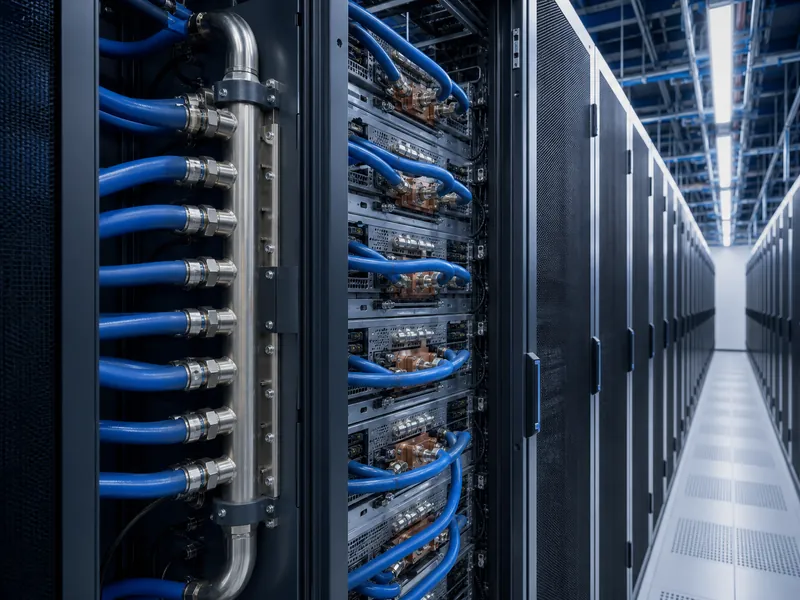
Air cooling hits a physical wall before a cost wall. Fans depend on temperature difference and airflow volume. As density rises, the airflow needed becomes impractical, and parts of the room drift above the recommended range into hot spots. Hot spots throttle performance and raise reliability risk. That is the operational reason density forces a cooling change.
Energy and emissions are the second reason to move heat with liquid. Cooling is a large share of a data center’s electricity draw, so an inefficient thermal system raises both the power bill and the carbon footprint. Liquid at the source can lower that draw, but the savings depend on the baseline system, the climate, and the workload. Treat any efficiency figure as a range to verify, not a fixed number.
Challenges Facing Cold Plate Liquid Cooling Technology
Cold plate cooling solves the heat problem but adds four challenges that decide whether a deployment works. Each is an engineering trade-off with a variable an operator can check.
Integration with existing rooms. Retrofitting liquid into an air-cooled hall is the hard part, because converting one rack at a time leaves two cooling systems running at once and doubles the facility team’s operating burden. Where racks share a CDU and manifold, the workable unit of conversion is a contiguous row or pod, so the loop, maintenance, and leak boundaries stay together.
Conversion cost. The cost that stalls projects is the retrofit, not the cold plates. Capital goes into CDUs, manifolds, piping, and reworking the room. Payback depends on how heavily the space is loaded and how long it runs, so the estimate has to be built per site.
Leak and corrosion prevention. Leaks and corrosion are the two failure modes that decide reliability in a liquid loop, and both are material-and-chemistry problems. Mixed-metal loops, such as copper plates feeding aluminum elsewhere, invite galvanic corrosion. Matching coolant chemistry and inhibitors to the wetted materials is the basis of corrosion control, and both should be verified against supplier specifications.
Waste heat reuse. Recovering the captured heat pays off only when temperatures and offtake line up. Cold plate loops can deliver warm coolant that is reusable, but the value depends on running the loop warm enough and having a nearby use, such as a building heating circuit. That makes heat reuse a facility-planning question as much as a cooling one.
Cold Plate, Immersion, and Air Cooling: Matching the Method to the Heat Load
The right method follows the heat load and how much the room can change, not a single best technology. Cold plates, immersion, and air each handle a different part of the thermal chain, so the choice is about fit.
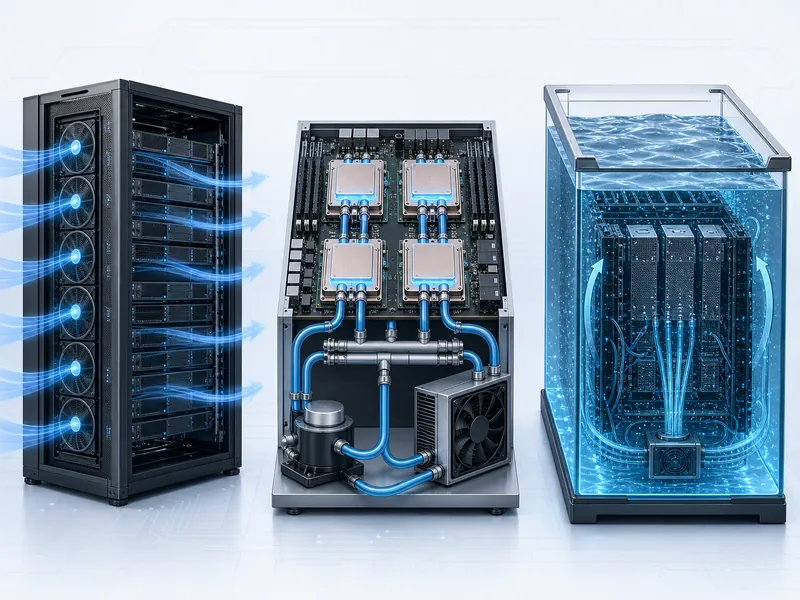
| Method | Best fit | Main trade-off |
|---|---|---|
| Air cooling | Lower-density racks; peripheral components | Loses capacity as rack density climbs |
| Cold plate (direct-to-chip) | High-density CPU/GPU racks; adapts to existing rooms | Cools the chip, not the whole rack; some air remains |
| Immersion | Very high heat flux | Submerges hardware in dielectric fluid; larger operational change |
Within cold plates, the split is single-phase against two-phase. Single-phase keeps the coolant liquid the whole way to the CDU, which keeps the loop simpler to service. Two-phase lets the coolant boil at the plate to absorb very high heat flux, which raises the ceiling but adds loop complexity. A single-phase loop covers common CPU and GPU densities; two-phase comes in when the processors’ heat flux exceeds what single-phase can hold.
Innovative Solutions for Cold Plate Cooling
The fixes for these challenges sit in two places: how the system is designed and how it is run. Both aim to make a liquid deployment expandable and maintainable.
Modular, scalable architecture answers the integration problem. A loop built to expand row by row lets a room grow into liquid without one disruptive overhaul, and it stays usable as processor generations change. Sizing the plate, channel, and flow path to the actual heat load is where cold plate design decides the outcome, because an oversized or undersized loop later shows up as wasted pump energy or hot chips.
Monitoring and predictive maintenance answer the reliability problem. Sensors on flow, temperature, and pressure let operators catch a developing leak or a fouling channel before it becomes downtime. Tying that data to maintenance scheduling cuts the manual watch a liquid loop needs. The monitoring plan should name which variable trips an alert and at what threshold, so the response is defined before a fault.
Best Practices for Implementing Cold Plate Cooling
A cold plate rollout is decided before installation, at assessment and pilot. The steps below front-load the choices that are expensive to reverse once piping is in the room.
- Assess load and headroom first. Size the system to current and near-future rack density, not today’s average, so the loop survives a hardware refresh.
- Pilot before scaling. Prove the design on a controlled row and measure real flow, temperature, and pressure before committing the hall.
- Design for expansion. Favor modular layouts so future rows or higher-density racks attach without reworking the core loop.
- Specify quality wetted components. Match pumps, piping, plates, and coolant to the same materials-and-chemistry logic, since leaks and corrosion start at the weakest wetted part.
- Plan maintenance and training. Set a schedule for leak, corrosion, and flow checks, and make sure staff can operate the loop.
Before committing the hall, confirm a short set of variables against design and supplier data instead of a generic checklist. Record each as a design value and a measured value so the gap is visible:
- Supply and return coolant temperature, against the CDU and plate design window
- Flow rate and pressure drop per plate, against the design point
- Chip temperature margin under peak load
- Leak-detection coverage and response state
- Material and coolant compatibility across every wetted part
- Heat balance from the CDU to the facility loop
Every limit in that list comes from the hardware, cold plate, CDU, and coolant supplier data. The framework is what to fill in, not a set of fixed numbers.
Heat rejection at the building edge is easy to underestimate. The CDU has to hand its load to a facility loop, and how that heat leaves the site, through data center chillers or a reuse circuit, sets the coolant temperatures the rack side has to live with.
Conclusion
Cold plate liquid cooling earns its place when rack density outgrows air, and the decision turns on fit and follow-through. The value sits on the chip-to-coolant path. Plate material and flow balance set how much heat you can pull, while integration, coolant chemistry, and heat rejection decide whether the deployment stays reliable and worth the retrofit. The point most often misread is that cold plates replace air cooling outright, when in practice they take the concentrated processor load and leave the rest of the rack on air.
For an operator weighing the move, three things come first: the target rack density, whether the room can convert a row at a time, and where the captured heat will go. Sizing cold plate design to that heat load, not to a headline efficiency number, is what keeps a loop working as processors change.
FAQ
Is cold plate cooling worth it if I cannot rebuild my whole data center?
Cold plate cooling can be retrofitted, but a contiguous row or pod converts more cleanly than a single rack. Racks that share a CDU and manifold keep their loop and maintenance boundaries together, so a block conversion avoids running two cooling systems across the same servers.
Should I choose cold plate or immersion cooling for a high-density AI rack?
Cold plate suits high-density CPU and GPU racks and adapts to existing rooms, cooling the chip while peripherals stay on air. Immersion fits very high heat flux and submerges hardware in dielectric fluid, a larger operational change. The split follows heat flux and how much change the site will accept.
Do I still need air cooling if I switch to cold plates?
Yes. Cold plates cool the processors, but memory, power components, networking, and condensation control still need airflow, so a hybrid room is normal.
How do I prevent leaks and corrosion in a direct-to-chip loop?
Match materials and coolant chemistry first. Mixed-metal loops invite galvanic corrosion, so inhibitors and coolant follow the wetted materials and supplier specs, with flow, temperature, and pressure monitored to catch faults early.
What rack density makes liquid cooling necessary?
Liquid cooling enters as racks pass the point where air becomes impractical, a rough planning reference near 20 kW per rack. The real threshold depends on the hardware, the room’s airflow, and the inlet temperature, so confirm it on site.
Further Reading
- LBNL Center of Expertise for Data Center Energy — U.S. Department of Energy national-laboratory program covering data center power and cooling technologies. A vendor-neutral hub for background on data center energy and cooling; consult it for orientation, not for site-specific sizing.
- Direct-to-Chip Cooling: Everything Data Center Operators Should Know — Data Center Knowledge, an industry publication. A plain-language operator overview of how direct-to-chip cooling works and where its trade-offs sit; background reading, not an engineering specification.
- Top Strategies for Data Center Liquid Cooling — ENCOR Advisors, a data center advisory firm. Covers liquid-cooling adoption and implementation strategy; treat any figures it cites as directional and verify them against your own site data.
Related Articles
- The Role of Innovative Liquid Cooling Technology in Enhancing EV Range — How liquid cooling manages battery temperature to protect EV driving range.
- Integration And Optimisation Of Intelligent Cooling Systems — How to integrate and tune intelligent cooling systems across a thermal design.
- Basic Principle of Liquid Cooling Plate — The working principle behind a liquid cooling plate and how it moves heat from the source.
- Revolutionizing Data Center Efficiency with Trumonytechs’ Liquid Cooling — How liquid cooling raises data center energy efficiency.
- IGBT Cooling Using Liquid Technology: Enhancing Electronic Efficiency — Using liquid cooling to manage heat in IGBT power electronics.