
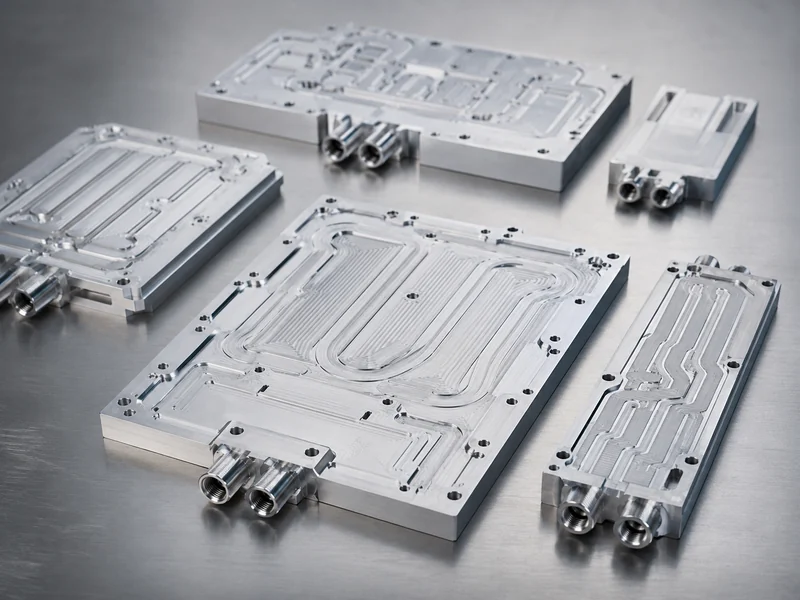
Three fit questions matter more than brand reputation when you pick a cold plate liquid cooling company: the cell format you are cooling, how the plate is built, and how much of the loop you expect the supplier to own. This comparison shortlists 11 liquid cold plate manufacturers and describes what each is known for, so a battery-pack thermal engineer or a sourcing lead can match a supplier to a specific pack instead of a generic spec.
The list is deliberately mixed. Some names are broad thermal groups that will also supply your manifolds, pumps, and a full liquid cooling system design; others are focused plate shops that hand you a cold plate and leave the hydraulic integration with you. Both models are valid, and the choice tracks one question: does your team want to own the loop or buy it pre-matched?
One scope note: this is a supplier shortlist for EV and energy-storage packs and adjacent power electronics, not a data-center-only ranking and not a teardown of any single product. Where a company’s own figures are cited, treat them as vendor-stated, and confirm them against a drawing and a sample before you design them in.
How this liquid cold plate company shortlist was built
Inclusion here rests on three practical checks: the company appears on buyer-facing supplier lists for liquid cold plates, cold plates are actually in its product line, and its region, construction methods, and application focus can be stated from its own material. The order carries no score and no ranking, so it is not a league table.
Trumonytechs is listed first as the publisher of this comparison. The remaining ten are grouped by manufacturing region — North America, then Europe, then China — and run alphabetically within each region, so you can weigh a supplier’s main service geography for yourself. Company details were verified in September 2026, and supplier profiles in this market shift, so re-check certifications and footprint at the time you buy. The pool spans US, European, and Chinese makers, so a US audience still sees every region; read each supplier’s main build region as one input to qualification.
Cold plate liquid cooling companies to know
Each entry below states what a company builds, the constructions and alloys it lists, and where its published focus sits, and then what to confirm before you shortlist it. Read them as sourcing starting points, since certifications, plant footprint, and product lines in this market change between quotes.
Trumonytechs
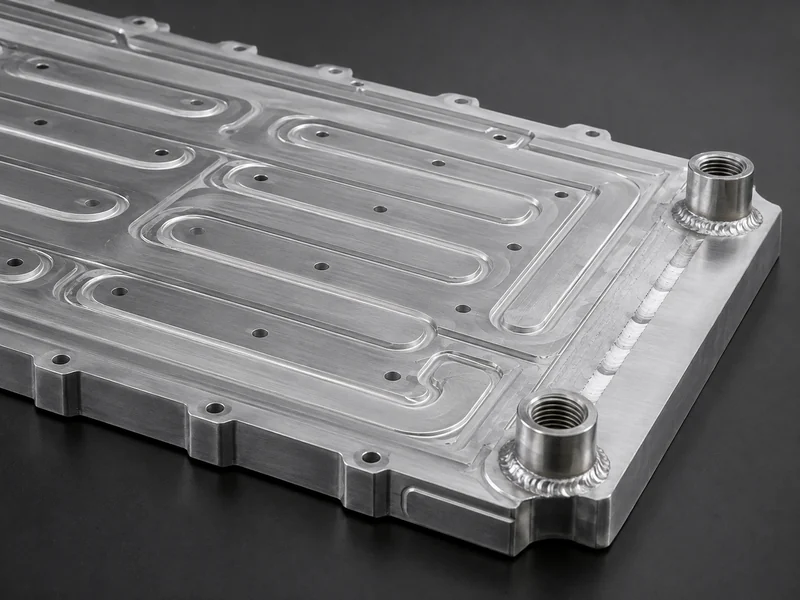
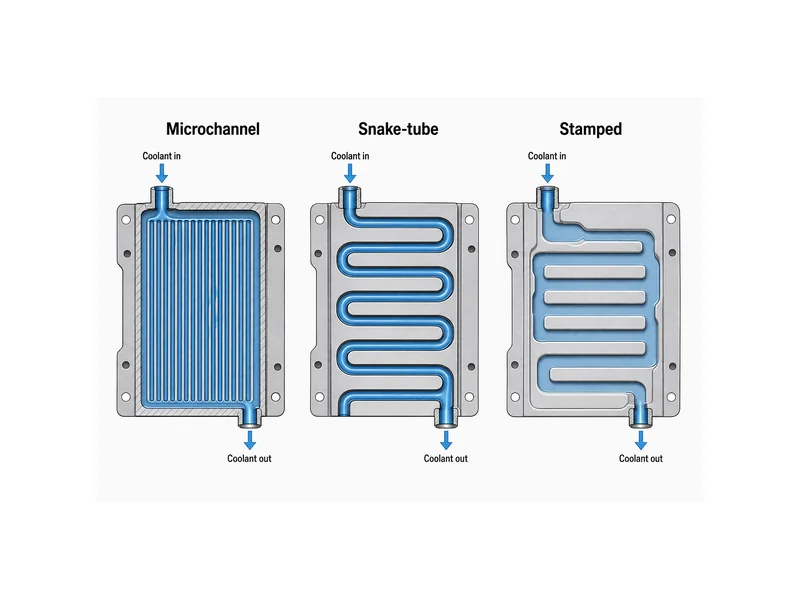
Trumonytechs manufactures aluminum liquid cold plates for EV and ESS battery packs. Its own material describes three constructions matched to cell format: microchannel plates for prismatic and pouch cells, snake-tube plates for cylindrical cells, and stamped plates for high-volume runs. The forming and joining methods it lists are friction stir welding, vacuum brazing, stamping, extrusion, and CNC machining. Its standard alloy is 3003 aluminum, with 6061, 1060, and copper offered where a conductivity or strength target changes. It pairs plates with thermal interface materials so it engineers the cell-to-coolant path as one stack, and because the plate, the interface material, and the cell interface are specified together, the flatness target and the gap the material has to close sit on the same drawing. On quality, the company describes 100% helium leak testing, CMM dimensional inspection, and hydrostatic burst-pressure testing. It states IATF 16949, RoHS, and REACH compliance, with a stated daily output above 400,000 pieces. Published heat-flux and temperature-uniformity figures are tied to particular plate sizes and do not transfer between designs, so confirm the exact alloy, flatness, and test method against the drawing for a specific model.
Boyd Corporation
Boyd Corporation offers aluminum liquid cold plates, two-phase cooling, and conduction cooling with thermal interface materials, and its battery work covers EV packs. Headquartered in Pleasanton, California, it manufactures across North America, Asia Pacific, and Europe. Boyd has consolidated earlier thermal brands — including Aavid and Lytron — under one name, and its catalog spans both standard and custom-engineered parts. Beyond EV packs, its stated markets include data center, aerospace and defense, and industrial cooling. One supplier can then cover cold plates, heat exchangers, and complete loops with regional build continuity.
Dana
Dana lists battery cold plates within its thermal-management line and positions itself as a global e-propulsion supplier, and it appears on more than one EV battery cold-plate supplier list. Its published detail centers on driveline and e-propulsion hardware, with battery cold plates presented as one element of that wider systems portfolio. Confirm the plate construction, alloy, and test regime Dana would apply to your specific pack before you shortlist it. Where a program already sources driveline thermal hardware from Dana, that portfolio can put battery cooling inside the same systems relationship.
Wakefield-Vette
Wakefield-Vette supplies liquid cold plates inside a broad thermal-management catalog that also lists heat sinks and other thermal products, and it is based in New Hampshire. Its published emphasis is custom electronics and power-electronics cooling. For a large EV or ESS pack, ask whether it will engineer to your cell layout and coolant scheme, since the catalog centers on electronics cooling. Source lists show the Wakefield name in more than one form — Wakefield-Vette and Wakefield Thermal — so check which entity and catalog a given quote refers to.
Valeo
Valeo brings a Tier-1 automotive footprint to battery cooling with a large battery liquid cooler engineered for prismatic and cylindrical Li-ion packs. For that product the company reports a thickness under 8 mm, a cell-to-cell temperature spread under 2–5 K, and a start of production in 2019. Those figures describe its XL battery cooler, not every plate it makes, so match them to your pack envelope. It manufactures in China, the U.S., and Europe across EV, plug-in hybrid, and hybrid platforms up to buses and trucks. That volume-automotive base fits high-volume programs that want a Tier-1’s tooling and validation cadence.
Wieland
Wieland reaches battery and power-electronics cooling through Wieland Electronics Cooling GmbH in Ulm, Germany, part of the long-established Wieland-Werke group. Its published cold-plate range covers single-phase and two-phase designs in defined 3000 and 4000 series plus immersion cooling, aimed at data centers, automotive, and power electronics. The listed series target standard electronic footprints and IGBT configurations, and its material does not name battery packs. Ask Wieland which series, if any, it validates for battery-pack duty before treating it as a pack cold-plate source.
Kingka
Kingka builds liquid cold plates in Dongguan, Guangdong, using copper and stainless-tube designs, friction stir welding over extruded channels, deep machining, vacuum brazing, and assembled constructions. The alloys it lists are 6061, 6063, and 7075 aluminum together with copper. The company markets to new-energy-vehicle, battery, and ESS work alongside power electronics, HPC and data-center, laser, and aerospace cooling. Its certifications appear only as images on the product page and are not machine-readable, so request the certificate names and scopes in writing.
RETEK
RETEK, whose cooling business was acquired by Shenzhen Cotran in 2020, builds brazed and roll-bonded liquid cold plates for energy-storage and EV battery duty. The plates use 3003 and 3003MOD aluminum in sizes up to 2,000 mm long and 1,100 mm wide at 0.8–3.0 mm thickness, produced through stamping-and-brazing, roll-bond, and extrusion. The company carries IATF 16949, ISO 9001, ISO 14001, and ISO 45001. After the acquisition there is no independent RETEK-branded site, so current material sits under Cotran. The brazed and roll-bond lines target ESS and EV plate programs bought at volume.
ToneCooling
ToneCooling is headquartered in Guangdong, China, and its own material describes friction-stir-welded, vacuum-brazed, and tubed liquid cold plates for GPU, CPU, and IGBT cooling, with ISO 9001:2015 certification. Its published process notes include vacuum brazing below 10⁻⁴ mbar and friction-stir-weld flatness to 0.02 mm, tied to its own plates and not a general standard. Its customer and volume claims are vendor-stated and not independently confirmed, so treat those achievement figures as unverified and ask for a sample and a test report against your geometry.
Winshare
Guangdong Winshare Thermal Technology, founded in 2009 in Dongguan, runs a plant of roughly 60,000 square meters plus a site in Thailand. It produces liquid cold plates in embedded-tube, brazed, friction-stir-welded, die-cast, and deep-hole-drilled constructions, along with heat sinks and vapor chambers. The company lists ISO 9001, IATF 16949, ISO 14001, and ISO 45001, and targets AI, automotive electrification, and power-battery applications. Its five plate constructions run under one certified plant, which gives a buyer several joining routes to weigh against a single quote.
Yinlun
Yinlun cools batteries through Yinlun TDI, the U.S. arm of the Yinlun Group, which gives a program a combined China-and-U.S. supply option. The company offers battery cooling plates in extrude-tube and stamped-plate designs and serves automotive, commercial-truck, off-highway, and recreational-vehicle markets, and its line also lists battery heating-and-cooling modules and heat exchangers. The two listed plate constructions — extrude-tube and stamped — suit different pack layouts, so match the construction to your cell format. The commercial-vehicle base and dual-region support fit automotive and truck packs sourced across China and the U.S.
Liquid cold plate manufacturers compared
The table condenses the same facts into the axes buyers screen on — where a supplier builds, how it joins the plate, and where it focuses. Read construction as the leading technical filter, and confirm every figure on a drawing before you rely on it.
| Company | Region / HQ | Cold-plate construction | Application focus | Verified detail |
|---|---|---|---|---|
| Trumonytechs | China | Microchannel, snake-tube, stamped; FSW, vacuum brazing, extrusion | EV & ESS battery packs | 3003 aluminum standard; 100% helium leak testing (vendor-stated) |
| Boyd Corporation | USA (Pleasanton, CA) | Aluminum plates, two-phase, conduction | EV, data center, aerospace/defense | Builds in NA/APAC/Europe; consolidates Aavid and Lytron |
| Dana | USA | Battery cold plates (line detail limited) | Automotive e-propulsion | Cold plates within driveline/thermal portfolio |
| Wakefield-Vette | USA (New Hampshire) | Custom liquid cold plates | General & power electronics | Cold plates within broad thermal catalog; name varies in sources |
| Valeo | France | Battery liquid cooler | EV/PHEV/HEV packs | XL cooler <8 mm; SOP 2019; China/US/Europe plants |
| Wieland | Germany (Ulm) | Single- & two-phase (3000/4000 series), immersion | Data center, power electronics | Wieland Electronics Cooling GmbH under Wieland-Werke |
| Kingka | China (Dongguan) | Tube, FSW, deep-machined, vacuum-brazed | NEV/battery/ESS, power electronics, data center | Al 6061/6063/7075 + copper; certs shown as images only |
| RETEK (Cotran) | China | Brazed, roll-bond, extrusion; 3003/3003MOD | ESS & EV packs | Acquired by Cotran 2020; up to 2000×1100 mm |
| ToneCooling | China (Guangdong) | FSW, vacuum-brazed, tubed | GPU/CPU/IGBT electronics cooling | ISO 9001:2015; process figures vendor-stated |
| Winshare | China (Dongguan) | Embedded-tube, brazed, FSW, die-cast, deep-hole-drilled | EV, AI, power battery | Founded 2009; ~60,000 m² plant + Thailand site |
| Yinlun | China / USA | Extrude-tube, stamped plate | Automotive & commercial EV | Yinlun TDI US arm; two plate constructions |
How to choose a cold plate liquid cooling company
Start the decision with the cell, not the supplier. Cell format sets the plate footprint and the flow path, so a prismatic pack, a cylindrical pack, and a pouch pack pull toward different constructions before you compare any vendor.
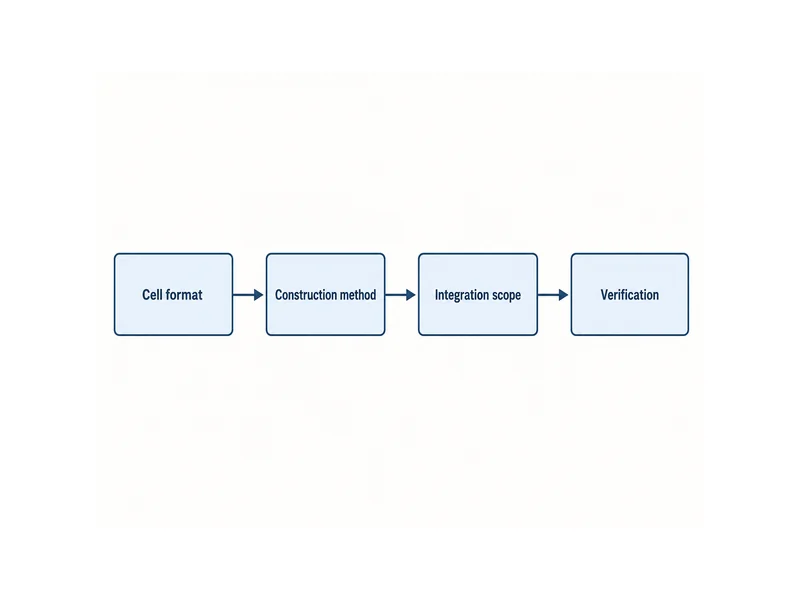
Construction method is the next filter, because under a given plate thickness, channel geometry, flow rate, and allowable pressure drop it shapes flatness, pressure drop, and weight together. Friction stir welding and vacuum brazing often go to tight-flatness, higher-pressure duty, while stamped and roll-bond plates fit weight and cost at volume. Microchannel cold plates can push heat flux higher for a given footprint but change the pressure-drop budget, and that budget has to close against your pump. Confirm each of these on the drawing and a validated process, not on a headline claim.
Integration scope is the third decision, and it changes who you shortlist. A supplier that builds manifolds, pumps, and a coolant distribution unit around its liquid cooling plates can consolidate hydraulic responsibility across the loop, but the interface matrix, acceptance scope, and contract set that responsibility, not catalog breadth alone. A plate-only shop leaves the loop integration with you, which works when your team owns the loop. Name the boundary in the RFQ — plate only, plate plus interface materials, or full loop — to filter the list faster than a spec sheet.
Verification is the last step before design-in. For any shortlisted supplier, put four things against a drawing and a physical sample: the joining method, the aluminum alloy and temper, the flatness tolerance, and the leak-test standard. Ask separately which quality certifications the plant actually holds. A published heat-flux or temperature-uniformity number tied to one plate size is a starting point for your geometry, not a guarantee. Put that check in writing in the RFQ, and ask for the test method behind each number — a flatness figure from an optical scan and one from a CMM are not the same claim, and a leak rate means little without its test pressure and standard.
Matching a supplier to your pack
By this point the shortlist is short, and the last call is about sequencing, not another round of comparison. Take the two or three suppliers that fit your cell format and integration scope, and put the same RFQ in front of each: the pack footprint and coolant, the operating pressure, the temper and joining method, and the flatness and leak-test limits you will accept. Rank the replies by which supplier will build a sample to your drawing soonest, then let the sample settle the choice on its measured flatness, its burst-pressure result, and its leak rate. A cold plate that closes the pressure-drop budget for your pump and holds flatness across your module will outperform a better-marketed plate that does neither.
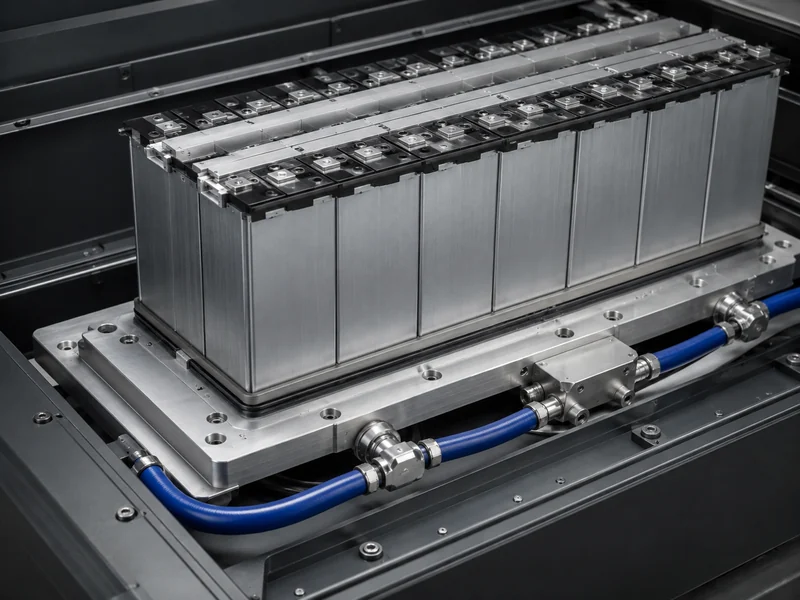
If two samples both pass, break the tie on the loop, not the plate: the supplier whose interface matrix and acceptance scope leave the fewest open hydraulic questions is usually the cheaper one to integrate, even when its unit price is not the lowest.
FAQ
Should I buy cold plates with the cooling loop or separately?
Buy them together when your team does not want to own hydraulic integration, and separately when it does. A supplier that also provides manifolds, pumps, and a coolant distribution unit can take responsibility for how the plate, distribution, and pump behave as one system, which concentrates accountability. A plate-only purchase gives more design freedom but leaves the loop integration, and its leak and pressure-drop risk, on your side.
What should I specify when comparing cold plate suppliers?
Specify the cell format and pack footprint first, then the coolant and operating pressure, the flatness tolerance, and the joining method. Add the aluminum alloy and temper, the leak-test standard, and the quality certifications you require. Those fields let suppliers quote the same plate instead of their nearest catalog part, and they show early whether a vendor is engineering to your geometry or adapting a standard design.
FSW or vacuum-brazed cold plate for a battery pack?
Flatness and pressure duty should drive the choice, since friction stir welding and vacuum brazing both suit tight-flatness, higher-pressure plates. The decision often turns on channel geometry, plate size, and the supplier’s validated process. Confirm the flatness tolerance and burst-pressure rating each method delivers for your specific plate size before you decide.
Who makes aluminum cold plates for prismatic versus cylindrical cells?
Match the construction to the cell, not the brand. Prismatic and pouch packs commonly use flat microchannel or stamped plates sized to the module face, while cylindrical packs often use snake-tube or channel plates routed between cells. Several suppliers on this list build more than one construction, so ask which one a company would apply to your cell format and why.
Further Reading
- Spherical Insights — Cold Plates Market company overview — Market-research overview of the cold plate supplier landscape; read its revenue and ranking figures as vendor-independent market estimates, not engineering data.
- DataCenterChill — cold plate manufacturer vendor landscape — Independent vendor-landscape analysis whose scope is data-center cooling, useful as adjacent context when you screen battery-pack cold plate suppliers.
Related Articles
- Data Center Chillers: Choosing Between Air-Cooled and Water-Cooled Plants — Weigh air-cooled versus water-cooled chiller plants when your cold-plate loop rejects heat to a chiller.
- What is a Rack Manifold? — See how a rack manifold distributes coolant across a loop before you decide who owns hydraulic integration.
- What Is a Tubed Cold Plate? — Understand tubed cold plate construction and where it fits among the plate types compared here.
- How Does Heat Pipe Cooling Work and When Should You Use It? — Compare passive heat pipe cooling with a liquid cold-plate loop for the lower-heat sections of a pack.
- What is a Coolant Distribution Unit? — Learn what a coolant distribution unit does when you buy a plate together with the full loop.