
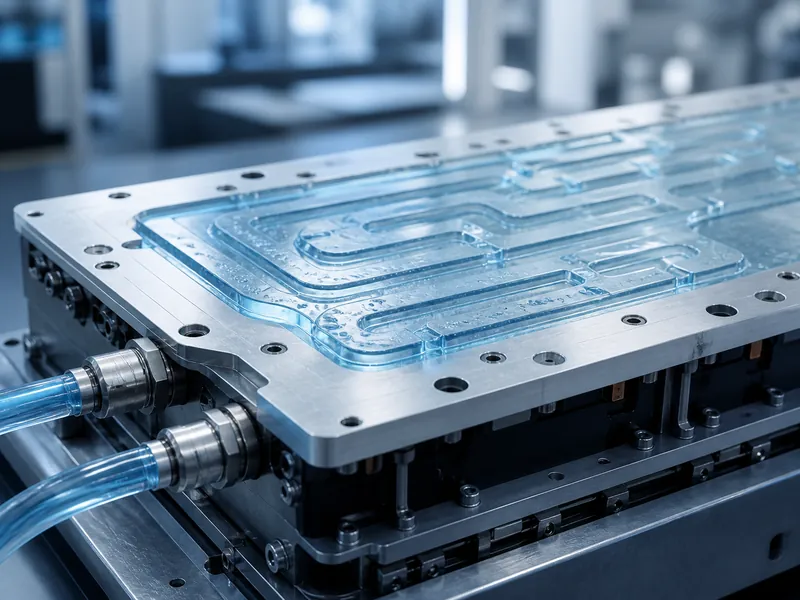
The best liquid for cooling is the one matched to your operating window, wetted materials, and heat load. There is no single winner. For most electric-vehicle and energy-storage battery packs that means water or a water-glycol blend running through a cold plate; a dielectric fluid enters the picture only when the cooling architecture puts the fluid in direct or near contact with energized parts. This article compares the common coolants, then walks through how battery-pack engineers actually narrow the choice. At Trumonytechs we design the cold plates and interface materials that sit between the cells and that coolant, so the fluid decision and the hardware decision are never separate.
Understanding Liquid Cooling Systems
A liquid cooling loop pulls heat away from cells far more effectively than air because a liquid combines a high heat capacity with dense, controllable flow past the hot surface. How much heat the loop actually moves depends on that fluid property together with mass flow rate, the allowable coolant temperature rise, and the plate and exchanger it runs through. No single property decides it.
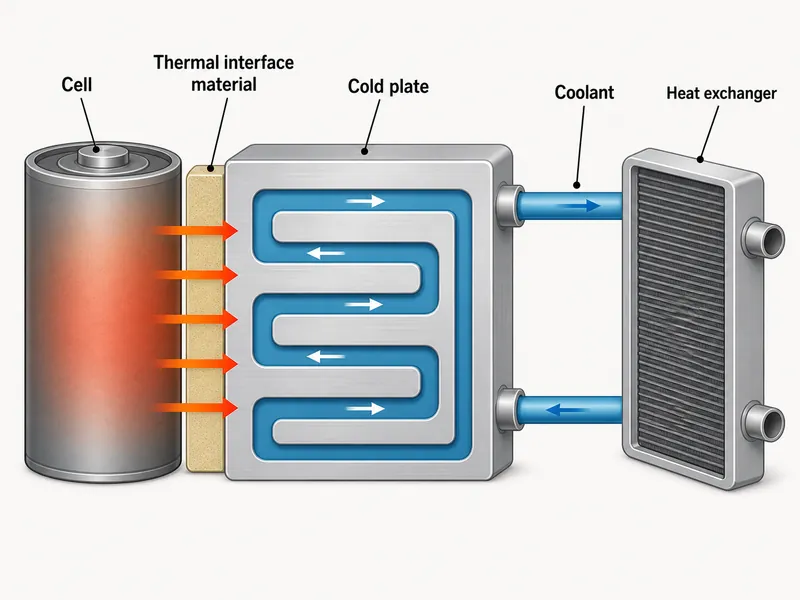
The core components of a battery cooling loop are:
- Coolant — the working fluid that absorbs heat at the cells and gives it up at the exchanger. Its thermal conductivity and specific heat set the ceiling on how much heat the loop can move.
- Cold plate — the conductive aluminum or copper part pressed against the cells or modules. A well-matched cold plate design is what actually efficiently transfers heat to the coolant, so the plate and the fluid have to be specified together.
- Thermal interface material — the gap filler that removes air between cell and plate. It is one series element in the cell-to-plate heat path, so liquid thermal interface materials and pads shape pack temperature spread alongside cell layout, contact resistance, and plate design, not on their own.
- Pump — moves the coolant continuously from the cells to the heat exchanger. A more viscous fluid makes the pump work harder for the same flow.
- Heat exchanger — rejects the collected heat to air or to a second loop.
- Tubing and reservoir — carry the fluid and absorb thermal expansion; their materials must be compatible with the chosen coolant.
Reading the chain this way keeps the fluid question grounded: a coolant is “good” only if it moves heat well and stays compatible with the plate, seals, and pump it runs through.
Comparative Analysis of Cooling Liquids
Three coolant families cover almost every battery and power-electronics loop: water, water-glycol blends, and dielectric fluids. Each trades thermal performance against temperature range, electrical safety, and maintenance, so the right pick follows from the constraint you cannot relax.
Water moves heat better than the alternatives but has the narrowest usable window. On a mass basis its specific heat is roughly four times that of air at ambient conditions, and its thermal conductivity is near 0.6 W/m·K. That combination is why water is the benchmark every other coolant is measured against. The limits are practical: at atmospheric pressure it freezes at 0 °C and boils at 100 °C, and untreated water can corrode the aluminum and copper common in cold plates. Deionized or distilled water with the right additives is used where those limits are acceptable. The corrosion risk is real enough that treating the fluid and controlling materials reduces risks of corrosion that would otherwise foul channels over time.
Water-glycol blends trade some cooling performance for a much wider safe temperature range. Ethylene-glycol or propylene-glycol mixtures lower the freeze point and raise the boil point, which matters for packs that see sub-zero storage or wide ambient swings, and glycol packages usually carry corrosion inhibitors. The cost is physical: a glycol blend is more viscous than water and carries somewhat less heat, and both effects grow with glycol fraction and change with temperature. Size the pump and pressure-drop budget from the candidate fluid’s concentration–temperature property curves, not a rule of thumb. This is the default fluid in most EV and ESS packs because the freeze protection is usually worth the performance it gives up.
Dielectric fluids buy electrical safety at a real thermal price. Because they do not conduct electricity, a leak onto energized parts carries less electrical risk, which is why they appear in immersion and direct-contact designs. Their thermal conductivity, however, is well below that of water, and properties, flammability, and material compatibility vary widely between fluids. A dielectric fluid is therefore a choice you make when the architecture demands isolation, then verify against that specific fluid’s data; a category assumption is not enough.
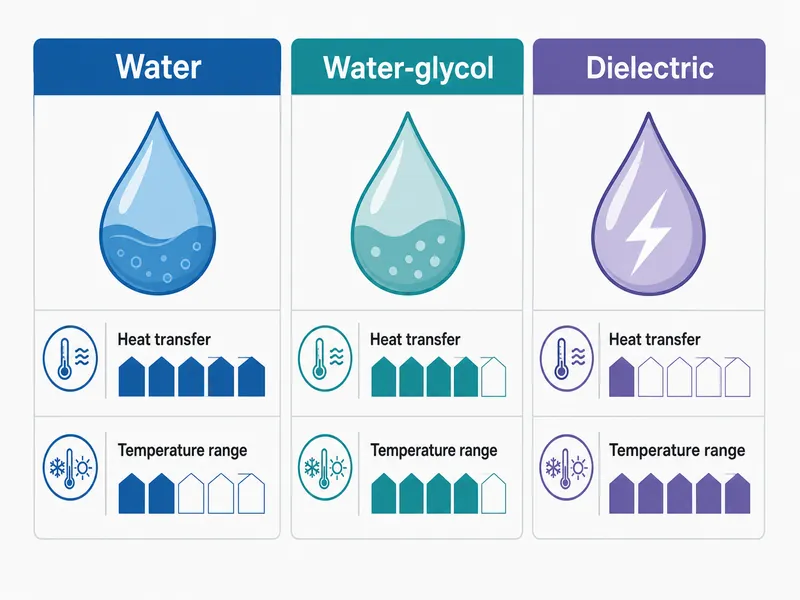
| Coolant | Relative heat transfer | Temperature window | Main watch-out |
|---|---|---|---|
| Water (DI/distilled) | Highest of the three | Narrowest (freeze/boil limited) | Corrosion without inhibitors and material control |
| Water-glycol blend | High, reduced with glycol fraction | Extended (formulation-dependent) | Higher viscosity → pump/pressure-drop cost |
| Dielectric fluid | Well below water | Formulation-dependent | Weak heat transfer; verify per specific fluid |
The ranking above is directional. Confirm any candidate against its own property and material-compatibility data, plus resistivity data for dielectric fluids, before committing.
Latest Advances in Liquid Cooling Technology
Newer cooling approaches mostly change how the fluid meets the cells, not the underlying physics of the fluids themselves. For battery and ESS work, two directions are worth tracking, each with a clear trade-off.
Immersion cooling submerges cells or modules directly in a dielectric fluid, which removes the plate-to-cell interface as a bottleneck and can improve temperature uniformity. The catch is the same low thermal conductivity noted above, plus added fluid volume, weight, and containment to design around. Immersion is chosen when uniformity or electrical isolation dominates, not for raw heat-transfer numbers.
Lower-global-warming-potential fluids are the other active area, aimed at replacing older formulations with options that carry less environmental burden. These are still evaluated on the same properties any coolant must meet: conductivity, viscosity, material compatibility, and stability over the pack’s life. A “greener” label does not by itself qualify a fluid for a given loop, so treat performance and compatibility data for any new fluid as something to verify against your own materials.
How to Select the Best Cooling Liquid
Selecting a coolant is an exercise in ruling options out against the constraint you cannot move, then optimizing within what remains. Work the variables in roughly this order for a battery pack.
Start with the temperature window, because it eliminates whole families fast. If the pack must survive sub-zero storage or hot ambients, plain water is out and a water-glycol blend or another extended-range fluid is in. The freeze point you need sets the minimum glycol fraction, and that fraction in turn sets your viscosity penalty.
Next decide the cooling architecture, because it sets whether a dielectric fluid is even in play. An indirect cold plate keeps the fluid physically separated from the cells, and a treated water or water-glycol blend usually stays the better performer. Direct-contact and immersion designs put the fluid against energized parts. There a dielectric fluid moves from option toward requirement, chosen against the leak consequence you can tolerate and validated on resistivity and material compatibility. Its weaker heat transfer is offset with added surface area.
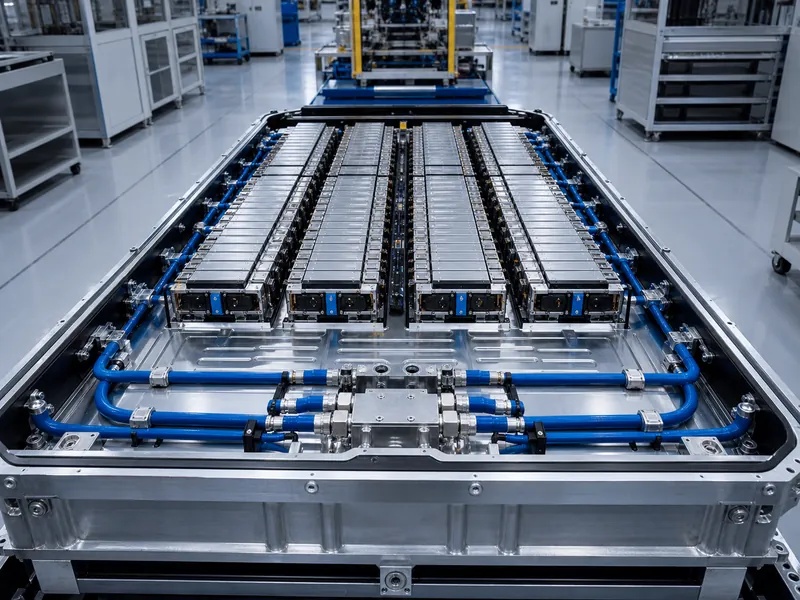
Then confirm material and seal compatibility. Verify the coolant against every wetted material: plate alloy, tubing, seals, and pump internals, and specify corrosion inhibitors rated for that combination. Mixed metals are the usual failure point, and a fluid that is fine with aluminum can still attack a seal.
Finally, size for viscosity and pressure drop, since a higher-viscosity blend raises pump power and can widen the temperature gradient if flow drops in the farthest channels. This is where fluid choice and hardware meet: the cold plate’s channel design, and where the loop rejects heat through a liquid-to-liquid cooling system or an air-side exchanger, have to be sized for the fluid you chose. Our liquid cooling panels for electric vehicles and ESS are built for this cell-to-coolant path, and the fluid should be matched to the plate and duty cycle, not specified on its own.
Cooling Liquid’s Effect on Battery Pack Efficiency and Life
The coolant you choose shows up downstream as temperature uniformity, cell life, and safety margin, not just as a heat number. A fluid that moves heat well but is left uninhibited, or one whose viscosity starves the far channels, can degrade a pack even when its headline conductivity looks good.
Temperature uniformity is where the fluid earns its keep, because cell degradation tracks not only peak temperature but the spread across the pack. Lithium-ion cells run best inside a temperature band that depends on their chemistry. The acceptable average and maximum cell-to-cell difference should be set from the cell’s datasheet, state of charge, C-rate, life target, and the OEM’s acceptance window, rather than a single generic figure. A coolant with strong heat transfer and enough flow in every channel is what makes a tight gradient achievable.
Longevity and safety follow from the same control. Keeping cells inside their band and closely matched reduces the thermal stress that ages them and preserves margin against thermal runaway, the failure mode that makes battery cooling a safety system, not just a performance one. That is why the fluid decision is verified against the pack’s real duty cycle, not a datasheet peak.
Conclusion
There is no universally best cooling liquid. The right answer is whichever fluid survives your hardest constraint and still moves enough heat within it. For most EV and ESS packs the practical sequence is short: fix the temperature window first, which usually points to a water-glycol blend; decide the architecture, bringing a dielectric fluid in only where the design puts the fluid against energized parts; then confirm material compatibility and size the loop for the viscosity you accepted. Get that order right and the “best liquid” question mostly answers itself.
The fluid and the hardware it runs through have to be specified as one decision. If you are matching a coolant to a specific cell format, cold-plate layout, or interface-material stack, contact the Trumonytechs team to work the variables through against your pack.
FAQ
Should I use water or a water-glycol mix for an EV or ESS battery cold plate?
Use a water-glycol blend if the pack faces sub-zero storage or wide ambient swings, and treated water only if the temperature window stays mild. Glycol lowers the freeze point and raises the boil point at a cost in heat transfer and higher viscosity, which most packs accept for the freeze protection. Confirm the glycol fraction against the coldest temperature you must survive.
Can I run plain tap water in a battery liquid-cooling loop?
No. Tap water introduces impurities that can corrode plates and clog channels. If water suits your temperature window, use deionized or distilled water and control water quality, corrosion inhibitors, and microbial risk to your OEM or coolant-supplier specification, verified against the full set of wetted materials. Treat untreated tap water as an avoidable corrosion and fouling risk, not a cost saving.
When do I actually need a dielectric fluid instead of water-glycol?
Choose a dielectric fluid when the cooling architecture puts the fluid in direct contact with cells or busbars, as in immersion designs, and a conductive coolant’s leak consequence is unacceptable. Its non-conductivity is the benefit; its much lower thermal conductivity is the price, offset with more heat-transfer surface. If an indirect cold plate keeps the fluid separated from the cells, water-glycol usually remains the better choice, so confirm against the specific fluid’s data.
Which coolant property matters most for temperature uniformity across a pack?
Adequate heat transfer combined with enough flow in every channel matters most, because uniformity depends on the coldest and hottest cells being close, not just on the average. A viscous fluid that under-flows the farthest channels widens the gradient even if its bulk properties look fine. Define the target average and maximum cell-to-cell difference from the cell and duty cycle, then size the pump and channel design for the fluid you actually selected.
Further Reading
- Choosing a Coolant for Liquid Cooling — Astrodyne TDI — Engineering technical article on coolant selection; supports the water versus water-glycol property trade-offs (thermal conductivity, boiling/freezing points, viscosity) compared above.
- How Battery Liquid Cooling Works — Neural Concept — Battery-cooling engineering explainer; supports the cell-to-coolant heat path and the lithium-ion operating-temperature discussion.
Related Articles
- Battery Liquid Cooling System Overview — A system-level view of how battery liquid-cooling loops are built and why air cooling fell short.
- Cold Plate & Welding: Thermal Management — How cold-plate construction and welding affect pack heat dissipation and temperature balance.
- Liquid To Air Heat Exchanger: Boost EV Cooling & Life — How liquid-to-air exchangers reject battery coolant heat to hold temperature and range.
- Why Electric Vehicles Need Lithium-Ion Batteries for Charging and Discharging? — Why EVs use lithium-ion cells and how cooling keeps them inside their operating band.
- Overcoming Thermal Management Challenges In The Electric Vehicle Industry: Comprehensive Guide — Broader EV thermal-management challenges beyond the coolant choice itself.