
Thermal management decides whether an electric vehicle’s battery delivers its rated range, charge rate, and service life. Temperature sets how much power the cells can deliver, how fast they will accept a charge, and how quickly they age. Cold, heat, and abuse each act through a different mechanism. As gas-powered cars give way to EVs, the engineering problem shifts from rejecting engine heat to holding the battery in range: a large lithium-ion pack, its power electronics, and its motor all have to stay inside a controlled window across fast charging, winter cold, and summer heat. For a battery-pack engineer, the question is not whether thermal management matters but which heat path and cooling architecture keep cell temperature uniform without adding weight, pressure drop, or leak points. This article covers why temperature governs performance, how heat moves from cell to coolant, and where the main cooling architectures differ. It does not cover cell chemistry selection or full-vehicle HVAC design.
Why a Thermal Management System Is Critical for Electric Vehicles
A thermal management system keeps the battery pack, power electronics, and motor within their usable temperature range. Those components dissipate substantial heat in operation, and each loses performance or fails outside its window. Industry BTMS references converge on an operating band of roughly 15–35 °C for lithium-ion cells, with a 20–30 °C sweet spot where calendar aging and internal resistance stay low. The exact window shifts with cell chemistry, so it should be confirmed against the cell supplier’s data, not assumed from a generic figure. Of the three loads, the pack is the hardest to manage, because its temperature directly sets charge and discharge efficiency, cycle life, and safety margin.
Cooling is only part of the job. The same loop often has to warm the pack in cold weather and reject heat from the inverters and motor as well. Liquid cooling has replaced simple heat conduction and passive air paths as the dominant approach in high-power EVs: a coolant circuit, usually water-ethylene glycol, carries heat from the cells to a heat exchanger far more effectively than air alone.
How Temperature Affects Electric Vehicle Performance
Ambient temperature has a direct impact on the efficiency of electric vehicles. It changes both how much energy the battery can deliver and how much energy the vehicle spends conditioning itself. Extreme cold and extreme heat both cut usable capacity, but they do so through different mechanisms, and cold is generally the more punishing of the two for range.
Recharge Range in Cold and Hot Weather
Cold weather reduces usable range mainly through cabin heating, not through permanent battery damage. Per AAA road testing at about 20 °F (-7 °C), low temperature alone trims range by roughly 10–12 percent, while running the cabin heater can push the loss toward 40 percent. At high ambient temperatures with the air conditioner on, the reduction is smaller. This matters for duty-cycle planning: a fleet operating in winter should size range around the heater-on figure, not the temperature-only figure. Cold itself does not accelerate capacity fade. The slower chemical activity that reduces available power at low temperature also slows the aging reactions that permanently shrink capacity.
Fast Charging and Heat
Fast charging is a heat problem before it is a convenience feature. Pushing high energy into a pack quickly generates heat, and that heat has to be removed to avoid damaging the cells. If it is not rejected fast enough, the battery management system derates the charge current to protect the cell internals, and charging slows. Low temperature adds a second limit: the pack must be warmed before it will accept high current safely, so cold-weather charging takes longer and the onboard system may cap current until the battery reaches a safe temperature.
How EV Batteries Are Heated and Cooled
EV batteries are held in range by moving heat along a defined path: from the cell, through a thermal interface material, into a cold plate, and out to the coolant. The system runs on a closed cooling circuit that both cools and, when needed, heats the pack, adjusting as internal and external temperatures change. The weakest link is usually the interface. Gaps and uneven contact between cells and the cold plate add thermal resistance, so a gap-filling thermal interface material is picked for its conductivity, compressibility, and tolerance for assembly variation, not for conductivity alone.
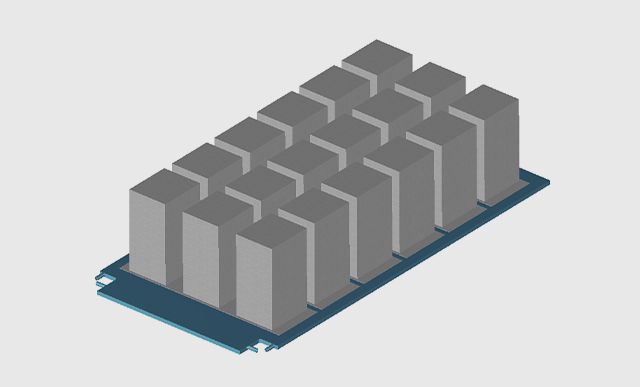
The cooling architecture is a design choice driven by cell format, heat load, and how tightly cell-to-cell temperature must be held. Forced liquid cooling offers convective heat-transfer coefficients roughly one to two orders of magnitude higher than forced air. That is why a battery liquid cooling system is standard on high-power packs, while air cooling survives in lower-power, lower-cost designs. The main options trade off as follows, for a representative design; real performance depends on flow rate, contact resistance, channel design, and coolant choice:
| Cooling method | Heat-transfer capability | Temperature uniformity | Typical fit |
|---|---|---|---|
| Air cooling | Low | Hard to hold across the pack | Low-power, cost-driven packs |
| Liquid cold plate | High | Good with well-designed channels | Most high-power EV and ESS packs |
| Phase change material | Moderate, buffers transient peaks | Even during the phase change | Peak-shaving, often hybridized with liquid |
| Immersion (direct) | Very high | Very even | High power density, specialized fluids |

Cell format also changes the available cooling interface. Depending on geometry and how cells are packed, a prismatic cell can present more flat surface for a cold plate to contact than a cylindrical one, which shifts the practical cold-plate layout. The architecture worth choosing is the one that meets the heat-load and uniformity targets at an acceptable weight, pressure drop, and leak risk, not the one with the highest headline heat-transfer number.
Thermal Runaway and Battery Safety Standards
Thermal management is also a safety barrier. A cell driven into thermal runaway generates heat faster than it can be rejected, and the failure can spread to neighbouring cells. A cooling system that holds cells in range and pulls heat away from a developing hot spot buys response time and can lower the risk of cell-to-cell propagation. The cold plate and interface path do double duty here: the same conduction route that manages everyday heat also carries heat away from a hot spot as it forms.
Safety is verified against published standards, and those standards address different objects and stages. UN 38.3 covers transport safety testing for lithium cells and batteries. IEC 62660 covers performance and reliability testing of cells for EV propulsion. UL 2580 addresses the safety of batteries used in electric vehicles. UL 9540A is a test method for thermal runaway propagation, most associated with stationary energy-storage systems. Which of these applies depends on the product and market, so a design is not automatically tested against all of them. Naming the standard a design has actually been tested against tells a procurement team more than any single temperature claim, because it defines the conditions under which the safety margin was shown.
Simulation-Led Cooling System Design
Simulation shortens cooling-system development by testing channel layout, coolant flow, and temperature uniformity before hardware exists. A thermal model of the pack exposes hot spots and pressure-drop problems in the design phase, which cuts the time and cost of physical debugging. The value is highest early, while cell arrangement and cold-plate geometry are still open and cheap to change.
Trumonytechs EV Thermal Management Solutions
Trumonytechs supplies thermal management components for electric-vehicle and energy-storage battery packs that sit on the cell-to-coolant heat path. The range covers liquid cooling battery packs with cold plates and the thermal interface materials that carry heat from cells into those plates. A matched cooling solution like those from Trumonytechs pairs a cold-plate architecture with an interface stack for a given cell format. Which combination fits a pack is an engineering question set by its heat-load, temperature-uniformity, and assembly constraints, so the selection follows the pack, not a fixed catalogue part.

Conclusion
The judgment to carry away is that EV thermal management is a heat-path problem, not a single-number one. Keeping cells near their 20–30 °C sweet spot depends on how well heat moves from the cell, through the interface material, into the cold plate, and out to the coolant. Cold-weather range loss, slower cold charging, and high-temperature aging are distinct effects the same system has to balance. Thermal runaway is a separate, abuse-driven failure that the cooling path can only help contain. The point most often misread is that a higher headline heat-transfer coefficient wins. In practice the architecture is chosen for temperature uniformity, weight, pressure drop, and leak risk against a specific cell format and duty cycle. Engineers weighing architectures should fix the cell format and heat-load target first, then match the interface material and cold-plate layout to it.
FAQ
Why is thermal management important in EVs?
Thermal management keeps the battery, power electronics, and motor within their usable temperature range, which protects range, charge rate, cycle life, and safety. Without it, cells run outside their 15–35 °C band, lose power and range in the cold, and age faster in sustained heat. The cooling path also helps contain a thermal runaway if one is triggered.
What temperature range is best for an EV battery pack?
Most lithium-ion packs perform best in a roughly 15–35 °C band, with a 20–30 °C sweet spot for low aging and internal resistance. The exact window depends on cell chemistry, so it should be confirmed against the cell supplier’s specification.
How does cold weather affect EV range and charging?
Cold weather reduces usable range mostly through cabin heating, not permanent battery damage; AAA testing shows temperature alone near 10–12 percent, with heater use pushing the loss toward 40 percent. Cold also slows charging, because the pack must be warmed before it accepts high current safely.
What cooling methods are used in EV batteries?
EV packs use air cooling, liquid cold plates, phase change materials, and direct immersion, chosen by heat load, temperature-uniformity targets, and cell format. Liquid cold-plate cooling dominates high-power packs because it moves heat far more effectively than air while holding cells uniform.
How does thermal management help prevent thermal runaway?
Thermal management pulls heat away from developing hot spots and holds cells in range, which lowers the risk of a failure spreading from one cell to the next. Designs are checked against test methods such as UL 9540A for propagation and IEC 62660 for cell reliability, so the safety margin is tied to defined conditions, not to temperature claims alone.
Further Reading
- Battery Thermal Management for EV Battery Packs — Wevolver — engineering technical reference. Supports the operating-temperature band and the differentiated safety-standard set (UN 38.3, IEC 62660, UL 2580, UL 9540A).
- How Temperature Affects EV Range — Recurrent — EV battery data research. Supports the cold- and hot-weather range-loss figures used in the temperature section.
Related Articles
- Why Battery Protection Matters Electric Vehicle — explains how the battery management system and protection circuits guard cells and modules that thermal management keeps in range.
- Thermal Interface Materials Battery — details how thermal interface materials build the heat path between cells and the cold plate.
- Exploring Types of Battery Cooling Systems: Comprehensive Guide — compares active and passive cooling systems for readers weighing an architecture.
- Battery Thermal Management Ensures Safety And Performance — shows how temperature uniformity affects lithium battery safety and service life.
- What Causes Thermal Runaway in Batteries? — explains what triggers thermal runaway and how cooling helps limit propagation.