

The best thermal paste for a CPU is the one that keeps temperatures stable under your specific workload. At Trumonytechs, we view paste choice as an interface decision, not a popularity contest. Even the strongest cooler and paste will fail if the contact quality is poor.
CPU and cooler surfaces are not perfectly flat. Microscopic voids trap air, which resists heat flow. Thermal paste works by displacing air, and thermal grease function is the same core idea expressed in a different term set.Thermal paste fills these voids, allowing heat to move into the cooler base more consistently.
Readers often ask “which thermal paste is best” because they want a simple way to lower temperatures. We will clarify what “best” really means, correct common misconceptions, compare paste families, and show you how to verify results without expensive lab equipment.
Which Thermal Paste Is Best?
You can only define the “best thermal paste” when you know your target outcome and constraints. We clarify this decision by separating peak temperature goals from stability, ease of application, and maintenance needs. A paste that tops a chart might still be the wrong choice for a laptop or a system you rebuild often.
First, define your workload pattern. Gaming loads are often bursty, while rendering and compiling create sustained heat. Label your load as “bursty” or “sustained” to decide what you value most.
Second, consider your mounting system and service style. A desktop cooler with repeatable mounting pressure is forgiving. Compact systems, however, often have limited pressure and are sensitive to paste consistency. We align the choice to your mount so the result is repeatable, not fragile.
Why “Higher W/mK” Can Be Misleading
A higher W/mK rating is not a reliable answer to “which thermal paste is best.” We correct this shortcut because published conductivity is rarely standardized.If the terminology feels inconsistent across stores and reviews, treat thermal paste vs grease as a naming and handling distinction rather than a performance guarantee. It may not match your bond line thickness and clamp pressure in a real PC. Some reviewers explicitly avoid using W/mK as the main deciding metric.When sellers use broader labels, thermal compound may describe multiple paste families, so you still need to map the term back to the interface and mount behavior.
Real performance depends on how the interface behaves under pressure. Spread, wetting, and resistance to movement during heat cycles matter just as much as conductivity. A paste that is too stiff for your mount can leave micro-voids, even if the specs look impressive.
Long-term behavior also changes the definition of “best.” Heat cycles can push paste away from the hottest contact region, a risk known as “pump-out.” We treat W/mK as a planning hint, but always verify the outcome on the actual system.

Types of Thermal Paste
Thermal paste families predict handling risk and long-term behavior better than brand names. We compare these types so you can avoid materials that conflict with your skill level or hardware. The goal is to match the paste to the interface you actually have.
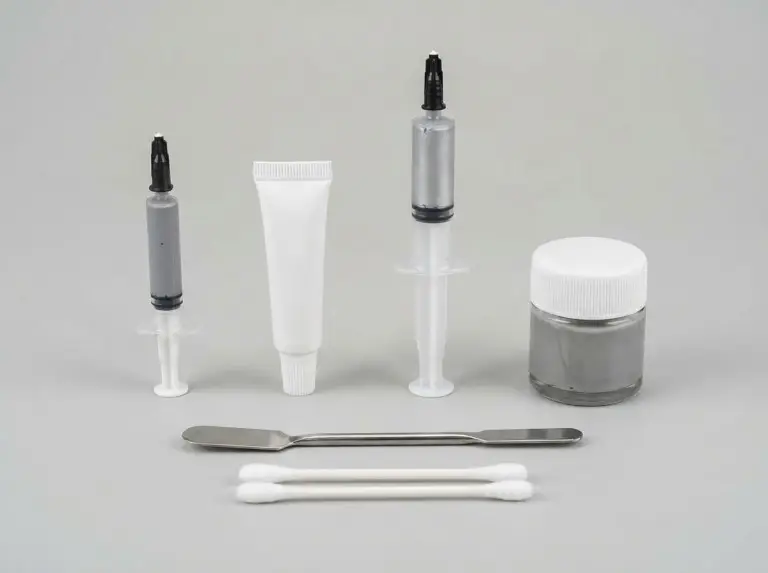
Ceramic-Based Paste for General Builds
Ceramic-filled pastes are usually the safest default for mainstream desktop builds.If you want a fast taxonomy beyond brand names, thermal paste types make it easier to connect material family to risk and long-term behavior. We use this family when priority is on low-risk handling and consistent results. Cleanup is straightforward, which supports repeatable testing.
Ceramic compounds offer a practical baseline for “best” when you want to avoid risk. While some ceramic formulas may not top every performance chart, the reliability often matters more than small temperature differences in daily use.
Carbon-Based Paste for Stable Performance
Carbon-filled pastes are often chosen for a balance of performance and stable handling. We evaluate this family for systems that run frequently and require long-term consistency. The deciding factor is how the paste spreads and stays uniform under your mount.
Carbon formulas are attractive when you want performance without high electrical risks. The right choice still depends on how your cooler pressure distributes across the contact area. We verify the outcome with a repeatable check rather than assuming the type alone guarantees results.
Metal Particle Paste for Experienced Users
Metal particle compounds can be effective, but mistakes are costly. We treat this family as an “experienced user” option because accidental spread and residue management are real risks. Your maintenance habits matter as much as the initial application.
Consistency varies widely in this family. A compound that is too runny can spread beyond the intended area. One that is too thick may not form a thin bond line under limited pressure. Use this family only if you can apply and clean with discipline.
Liquid Metal for Expert-Only Use Cases
Liquid metal is not the default answer for general readers. We place liquid metal at the boundary because electrical conductivity and material compatibility issues can turn a small gain into a high-cost failure. Many mainstream guides focus on standard pastes for this reason.
If you are not prepared to manage compatibility constraints and strict application control, liquid metal is not the right pick. We keep this discussion as a safety boundary, not a tutorial. A safe, repeatable recommendation usually stays within standard paste families.
Verifying Claims Without a Lab
You should verify any “best thermal paste” claim with a repeatable before-and-after test on your own system. We use consistent load steps, stable fan behavior, and careful notes about ambient temperature. This mirrors how serious reviewers control variables, but in a simplified form.
Start by fixing your variables before changing the paste.Use the same workload and logging method each time so your results reflect thermal paste in computers, not test drift from changing tools. Use the same fan curve, case configuration, and workload tool for every run. Let the system reach a stable temperature before recording results.
Use a delta-style reading whenever possible. Logging “CPU temperature relative to room” helps reduce errors if the room is warmer on one test day. Many published tests use this approach to compare results across different conditions.
Repeatability is more valuable than a single best run. If a paste gives similar temperatures but tighter consistency across re-mounts, that paste is likely “best” for your workflow. Judge based on stability, not one lucky result.
|
Decision Field |
What “Better” Looks Like |
Why It Matters for “Best” |
|---|---|---|
|
Electrical Risk |
Non-conductive or low-risk handling |
Reduces failure cost during service |
|
Application Ease |
Spreads reliably under pressure |
Prevents voids and bad contact |
|
Cleanup Effort |
Removes cleanly with wipes/alcohol |
Supports repeat tests and maintenance |
|
Long-Run Stability |
Holds performance through heat cycles |
Reduces drift from pump-out |
|
Value Framing |
Compare by price-per-gram |
Avoids paying for marketing over results |
Preventing Installation Mistakes
Thermal paste performance differences disappear when installation introduces errors. We prevent failures by standardizing cleaning, dosing, and mounting habits. A great compound cannot fix debris, uneven pressure, or trapped air.
Surface preparation must remove old compound and lint. Use a residue-safe cleaner and a lint-free wipe, then let both surfaces dry completely. Avoid materials that shed fibers, as fibers create new voids.If you are unsure whether a residue is normal, start from what thermal grease is and verify whether the material is designed to stay put or migrate under heat cycling.
Dosing and spread must fit the contact geometry. A small central deposit works well for many mainstream desktop CPUs, but larger heat spreaders need different coverage. Keep the method consistent across tests so you do not confuse a method change with paste improvement.
Mounting pressure and sequence are crucial. Tighten in a cross pattern and avoid twisting after contact. If you lift the cooler after touching down, treat it as a reset. Partial separation can introduce invisible voids.
Deciding by Scenario
The best thermal paste choice depends on the scenario because priorities change. We decide by mapping your scenario to selection priorities that match real constraints. This produces a useful outcome without simply listing brands.
Gaming Desktops: Consistency and safe handling are often best. Bursty loads and dynamic fans mean small paste differences can be masked by cooler mass and airflow. We prioritize compounds that mount reliably and stay stable.
Workstations: Long-run stability carries more weight than short-run charts. A paste that holds contact quality through long sessions and heat cycling is the better choice. We validate with long steady-state checks, not just quick stress bursts.
Laptops and Compact Systems: Mounting constraints dominate here. Limited pressure, uneven contact, and high heat can punish pastes that are too stiff or shift over time. Decide based on proven repeatability for that device type, not desktop rankings.
Frequent Rebuilds: Cleanup and repeatability define the choice. If you repaste often, a compound that cleans easily and behaves consistently saves time. We treat “service efficiency” as part of what makes a paste best.

Conclusion
Choosing the best thermal paste becomes easy when criteria, risk, and verification are clear. At Trumonytechs, we compare options by interface behavior, long-run stability, and repeatable outcomes, not by a single headline metric. Your mounting quality and workload are the real multipliers.
We can turn your situation into a shortlist using the scorecard above. We keep recommendations constrained to your load, cooler, and maintenance style. We do not promise universal winners because real interfaces vary.
FAQ
How Often Should I Replace Thermal Paste?
Replacement depends on temperature drift under the same workload and cooling setup. Repaste when logged temps rise gradually and cleaning the cooler does not help. If you remove the cooler for service, always repaste.
Does Thermal Paste Expire?
Shelf life depends on formulation and storage. Check for separation, unusual dryness, or inconsistent dispensing. If a paste does not dispense consistently, it is unlikely to create a consistent bond line.
Is Liquid Metal the Best Interface?
Liquid metal can be effective for experts, but it is not the default choice for most. We avoid it as a general recommendation because electrical risk and compatibility issues can cause severe failures. Standard pastes are safer and more repeatable.
What Application Method Is Safest?
The safest method is one you can repeat consistently. We often start with a controlled central deposit and an even cross-tightening sequence. Larger heat spreaders may need a coverage-focused approach, verified by consistent results.
Why Did Temps Get Worse After Repasting?
Worse temperatures usually indicate mounting or surface issues, not bad paste. Check for uneven pressure, debris, incomplete coverage, or cooler movement. Re-cleaning and re-mounting with a consistent method often fixes the problem.
How Do I Compare Value?
Frame value by price-per-gram and expected use, not just tube price. Factor in cleanup effort and the risk of needing a re-mount due to difficult application. Published guides often include these metrics for this reason.