
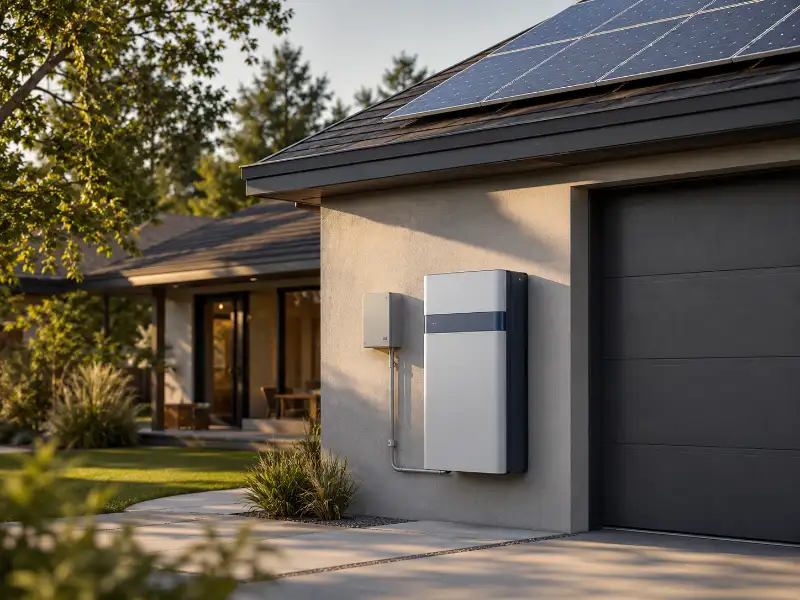
PV battery storage pairs photovoltaic (solar) panels with a rechargeable battery. Electricity made during the day is stored and used later, when the panels are not producing. Pairing the two addresses a basic limit of solar power: panels only generate while the sun is up, yet most homes and businesses use the most power in the evening. The sections below cover what PV battery storage is, what it is made of, the specifications that matter, and how to tell whether it fits your situation. Working out the right battery size or installed price for a specific property is a separate, project-level calculation that depends on your load profile, tariffs, and local rules.
What PV Battery Storage Is, and How It Differs From Grid-Tied Solar
PV battery storage is a solar installation with an added battery, and what sets it apart from a standard grid-tied system is where surplus daytime electricity goes. A grid-tied system without storage exports excess solar to the grid. Depending on the market, that export may earn a credit, a feed-in tariff, very little, or nothing if exports are capped. A PV battery storage system stores that surplus for your own use first. It can also run selected loads during an outage, but only with backup-capable inverters, islanding protection, and a protected-load circuit. A battery alone does not guarantee backup power. How much the stored energy is worth depends on the gap between your export and import rates, so check both before assuming a battery pays for itself. A general battery energy storage system can be charged from the grid alone. PV battery storage is charged mainly from solar, though many systems can also draw from the grid when tariffs and rules allow.
The Most Common Misconception: A Bigger Battery Is Not Automatically Better
Battery capacity is widely assumed to translate into savings or backup, but the benefit you actually get depends on usable capacity, your daily load shape, and how the battery is run. The headline kilowatt-hour figure alone does not decide it. Size a system to its nominal capacity without checking usable energy or daily usage timing, and it often cycles only partway. The savings the label implied never arrive. Temperature is the other quiet limit. The capacity a battery delivers and the cycles its cells last both fall as operating temperature drifts from the cells’ comfortable range, which is why how a system is cooled matters as much as the capacity on the spec sheet. Sizing to your real load, confirming usable capacity, and accounting for temperature give a far better estimate than the nameplate alone.
The Main Components of a PV Battery Storage System
A PV battery storage system is built from a few core parts, and which hardware you need depends on whether you are adding storage to existing panels or designing everything at once. The main components are:
- Solar (PV) array: generates DC electricity from sunlight; its size sets how much surplus is available to store.
- Inverter or inverters: convert between the DC that panels and batteries use and the AC that appliances and the grid use; type and number depend on the coupling configuration.
- Battery and battery management system (BMS): store energy and protect the cells by monitoring voltage, current, state of charge, and temperature.
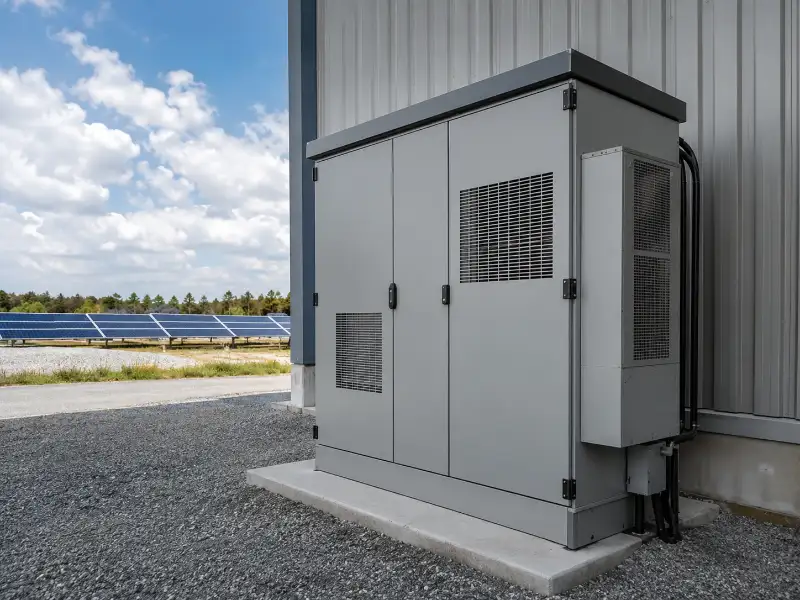
- Thermal management: keeps cells within a safe, efficient temperature band; smaller systems may use passive air, larger or hotter ones use active cooling, typically liquid cooling.
- Backup and control hardware: an islanding-capable inverter, backup gateway, and protected-load panel let the system run selected loads during an outage, while the control logic decides when to charge, discharge, or export.
Because deliverable capacity and cycle life depend on temperature, the cooling approach is matched to a system’s size and duty. Passive air suits most home systems, while larger battery cabinets in warm environments are where active cooling earns its place.

AC-Coupled vs DC-Coupled PV Battery Storage
AC-coupled and DC-coupled describe where the battery connects, and the better choice depends mostly on whether you are retrofitting storage or building everything together. In a DC-coupled system, the battery connects on the DC side and shares a hybrid inverter with the panels. This cuts conversion steps and suits new installs, but it needs compatibility across PV strings, battery voltage, and inverter. In an AC-coupled system, the battery has its own inverter on the AC side. That makes it the practical way to add storage to a solar array already running, including homes with microinverters. The trade-off is conversion efficiency versus retrofit simplicity, so a retrofit usually favors AC-coupling and a new, efficiency-focused build favors DC-coupling. An installer should confirm the choice against your existing equipment.
What to Check Before Choosing PV Battery Storage
Choosing PV battery storage comes down to a few decisions and specifications, and which matter most depends on whether your priority is savings, backup, or both. Savings sizing turns on how much surplus you would otherwise export cheaply; backup sizing turns on the loads you need during an outage. Households that already use most of their solar gain less from a battery. Time-of-use tariffs and interconnection limits also shift the math, so confirm them early.
When comparing products, a few specifications matter more than the headline number:
- Usable capacity (kWh): the energy you can actually draw, which matters more than nominal capacity.
- Depth of discharge (DoD): how much of the battery you can use without shortening its life.
- Round-trip efficiency: how much energy survives a charge-and-discharge cycle.
- Continuous and peak power (kW): continuous power sets how many loads run at once; peak power decides whether motors, pumps, or air conditioning can start.
- Cycle life: the rated number of cycles, which drives long-term value.
- Operating temperature range and backup (EPS) output: the conditions the battery tolerates, and whether it offers a dedicated backup output.
Many residential and commercial PV battery systems use lithium iron phosphate (LFP) chemistry for its thermal stability and cycle life. The right chemistry still depends on certification, climate, space, duty cycle, and budget. A system also has to meet its market’s safety and grid rules, and which apply depends on location. In North America, safety and fire commonly reference UL 9540 and the UL 9540A test for thermal runaway fire propagation, installation follows NFPA 855, and interconnection follows IEEE 1547. Internationally, IEC 62933 covers electrical energy storage systems. What a solar battery storage system costs varies widely by region and size and is a separate question from what PV battery storage is.
Conclusion
PV battery storage comes down to a few decisions: your reason for the battery, how your usage overlaps with your generation, how it connects to your system, and which standards apply where you live. The capacity on the label matters less than the capacity you can actually use and the conditions the battery runs in.
We work on the thermal side of battery and energy-storage systems, and one pattern stands out: deliverable capacity and cycle life track operating temperature closely. A battery chosen on its nameplate kilowatt-hours alone can underperform in a hot or poorly ventilated enclosure. How a system should be cooled, sized, and configured depends on its duty cycle, climate, and space, so those details are best settled at the project stage rather than from a spec sheet.
If you need ESS cooling solutions or thermal design for a storage system, you are welcome to share those requirements with our team for a technical review. A practical first step is to gather your annual electricity use, your existing solar and inverter details, and your goal of savings, backup, or both, since those few inputs shape most of what follows.
FAQ
Is PV battery storage the same as a solar battery?
PV battery storage and “solar battery” usually mean the same thing: a battery charged mainly by solar panels rather than only from the grid. The phrase “PV battery storage” emphasizes the photovoltaic source.
Do solar panels need a battery to work?
Solar panels do not need a battery to function; a grid-tied system runs without one by exporting surplus to the grid. A battery helps when you want to keep that surplus for evenings, outages, or to avoid buying expensive grid power back later.
Can a solar battery power my home during an outage?
A solar battery powers your home in an outage only if the system has backup-capable hardware: an islanding-capable inverter, a backup gateway or transfer switch, and a protected-load circuit. Without it, many grid-tied battery systems shut down during an outage for safety, so confirm backup capability before buying.
Can I add battery storage to an existing solar system?
Adding storage to an existing array is usually possible, most often with an AC-coupled battery that has its own inverter. Whether it is straightforward depends on your current inverter, space, and local interconnection rules, so an installer should confirm compatibility.
AC-coupled or DC-coupled, which is better?
Neither is better in every case; the choice depends on whether you are retrofitting or building new. DC-coupling suits efficiency-focused new installs, while AC-coupling is the simpler route for panels you already own.
How much battery storage do I need?
The right amount depends on your daily energy use, your solar generation, and whether your priority is savings or backup. Because those vary by site, sizing is a project-level calculation, not a single recommended figure.