
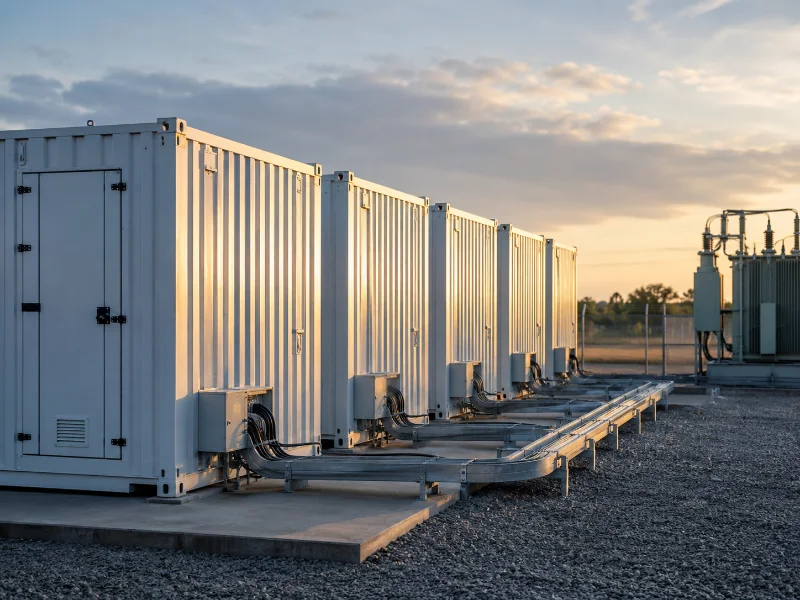
An ESS battery costs about $70/kWh as a bare pack, $117/kWh as a turnkey system, and $125/kWh as a finished utility project. Those are 2025 global averages, and the $125 figure excludes China and the United States. All three are correct. None of them is a quote. Which number applies to your project turns on three things: the scope you buy, the duration you specify, and where the system lands. Geography moves the total more than your supplier does. BloombergNEF’s 2025 cost survey put turnkey prices at $73/kWh in China and $219/kWh in the United States. Duties, labor, and grid connection are priced locally.
Why Do ESS Battery Quotes Range From $70 to Over $300 per kWh?
ESS battery prices span a four-fold range across published sources, because three different products all get called “the battery.” Each one is priced at a different point in the supply chain. The cell or pack is a commodity. A turnkey battery energy storage system is an integrated product. An all-in project is a construction contract. Read a number from one column into a budget built on another, and you have made the most common costing error in stationary storage.
| What is priced | What is inside it | Published reference point | Use this number when |
|---|---|---|---|
| Battery pack / DC block | Cells, modules, racks, BMS. | BNEF’s 2025 lithium-ion battery price survey. Stationary storage packs averaged $70/kWh, the lowest of any segment. The widely quoted $108/kWh is the all-application average. | You want to sanity-check a system quote, or compare cell suppliers. |
| Turnkey BESS | Pack, PCS, enclosure, thermal management, controls, delivered. | BNEF’s Energy Storage Systems Cost Survey 2025, from 596 projects. Global average: $117/kWh, down 31% year over year. By duration: $124/kWh at 2 hours, $110/kWh at 4 hours. By region: $73/kWh China, $177/kWh Europe, $219/kWh US. | You are comparing integrators on identical delivered scope. |
| All-in project capex | Turnkey system, EPC, civil works, grid connection. | Ember, October 2025 data. About $125/kWh for 4-hour-plus utility projects outside China and the US. Roughly $75/kWh is core equipment from China. About $50/kWh is installation and connection. | You are setting a project budget or building a financial model. |
| US utility-scale benchmark | Complete 4-hour system, modeled bottom-up. | NREL, Cost Projections for Utility-Scale Battery Storage: 2025 Update. A 2024 starting point of $334/kWh, in 2024 dollars, for mainland US. Its 2025 projections span $295–$350/kWh. | You are benchmarking a US project, subject to NREL’s own caveats. |
Two caveats on the NREL figure, both from NREL. It completed the analysis in January and February 2025. The figure excludes tariff changes made since. NREL also notes that its starting point sits inside the range of current pricing, but above many current estimates. Treat it as a modeled US ceiling, not a market price.
The scope gap is not a rounding error. Ember’s breakdown implies that about 40% of a project’s value never reaches a battery factory. It stays local, in engineering, civil works, and grid connection.
Set a budget from a turnkey headline without pricing that 40%, and nothing goes wrong during procurement. The shortfall arrives later, as a change order after you sign the EPC contract. The remedy is a schedule slip, not a discount.
How Much Does an ESS Battery Cost at Residential, C&I, and Utility Scale?
ESS battery cost per kWh falls as system size rises, because fixed costs for design, permitting, and labor spread across more stored energy. The premium a small system pays is a soft-cost premium, not a battery premium. It survives however well you negotiate on cells.
| Scale | What you are actually buying | What drives the per-kWh premium |
|---|---|---|
| Residential | Wall or floor unit, inverter, consumer-grade enclosure, installer labor. | Fixed design, permit, and labor costs spread over very little capacity. Public databases do not benchmark this tier. Only local installer quotes do. |
| C&I / containerized | Integrated cabinet or container, PCS, thermal system, commissioning. | Site works, switchgear, and fire code compliance. Also whether the utility demands an interconnection study. |
| Utility-scale | Containerized DC blocks, central or string PCS, substation-side balance of plant. | Grid connection, civil works, and duties. Also the augmentation plan across the contract term. |

Trumony’s guide to residential solar battery storage pricing covers the home tier. There, installer, inverter, permit, and backup-panel costs dominate. The rest of this article stays with commercial and grid-connected systems.
Two rules make the tiers comparable. A per-kWh figure without a stated scope is unusable, and one email fixes it: does this include the PCS, the installation, and the grid connection, or only the DC block? Always cite duration alongside the price. NREL makes the point plainly. Inverters scale with power and cells scale with energy, so a $/kWh figure with no duration attached tells the reader almost nothing.
Where Does the Money Go Inside a Battery Energy Storage System?
A BESS cost stack has eight layers, and their weight shifts with project scale and jurisdiction rather than with your supplier. The ordering matters more than the percentages. It shows where you can negotiate and where you cannot.
| Layer | What it covers | Why it moves the total |
|---|---|---|
| Cells, modules, cabinets | LFP or NMC cells, racks, BMS, fire suppression, thermal management. | The largest single line. NREL’s 2024 model puts battery cabinets at $210/kWh of a $334/kWh total. Also the line priced most transparently. |
| PCS / inverter | DC-to-AC conversion and grid control. | Sized in kW, not kWh. Short-duration systems feel this line hardest. |
| Enclosure and thermal management | Container, coolant loop, cold plates, thermal interface materials. | Small and largely invisible on day one. Sets the cell temperature that sets the degradation curve. |
| Balance of plant | Switchgear, transformers, conductors, protection, SCADA. | Scales with power rating and site layout, not with stored energy. |
| EPC and civil works | Foundations, site prep, installation labor. | Local labor rates dominate. This is where US and European projects part ways with Chinese tenders. |
| Grid connection and studies | Interconnection application, system impact study, utility upgrades. | Ember puts grid connection fees anywhere from $30/kWh to $100/kWh. The longest tail in the stack. |
| Compliance and documentation | System listing, fire test reports, hazard mitigation analysis. | Regime-dependent. North American and IEC packages differ, and jurisdiction decides which one applies. |
| O&M and augmentation | Monitoring, maintenance, capacity top-ups. | Ember assumes about 2% of capex per year, near $2.5/kWh annually. It compounds across a 15-year life. |
Which compliance regime applies is set by jurisdiction, not by product. In North America, UL 9540 is the system-level safety certification for energy storage systems and equipment. UL 9540A is the test method for thermal runaway fire propagation in a BESS, run at cell, module, unit, and installation levels. NFPA 855, the standard for installing stationary energy storage systems, uses that data to set separation distances and hazard mitigation requirements. Test data describes how fire spreads once it starts. System-level thermal runaway prevention is a separate design problem. IEC-aligned markets work from a different pair. IEC 62619 covers safety requirements for secondary lithium cells and batteries in industrial and stationary use. IEC 62933-5-2 covers grid-integrated electrochemical storage systems. Which package your authority having jurisdiction (AHJ) accepts belongs in the quote scope, not in a footnote.
Two BNEF findings show where the negotiating room sits. DC-side systems built on 300Ah-or-larger cells came in around 50% cheaper than systems using smaller cells. Container-level DC blocks of 4MWh or more were about 39% cheaper than 2–4MWh blocks. Cell format and block size move the number. Haggling over the cell price does not.
Which Line Item Gets Cut First?
Thermal management is one of the smallest hardware lines in a containerized system, and one of the first a bidder trims when two bids land close together. The reason is visibility. NREL’s cost model folds thermal management and fire suppression inside the battery cabinet line, next to cells, racks, and the BMS. On most quotes, liquid cooling for ESS is not a row you can see. So it is a row a bidder can shave, and the comparison sheet will not notice.
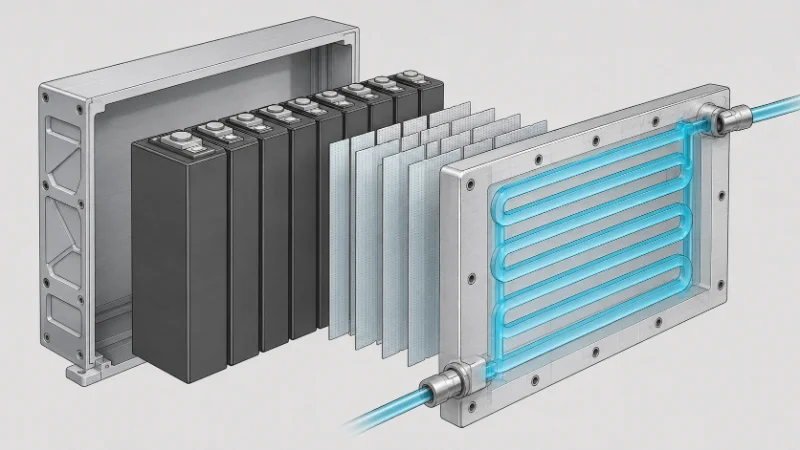
Three consequences follow, and you can check all three before you buy. NREL defines round-trip efficiency to include losses from the cooling system, and assumes 85%. A thermally undersized system burns part of its own output every cycle. NREL also takes its fixed O&M from the high end, on purpose, so it covers enough augmentation to offset degradation. That assumption holds at roughly one cycle per day, and NREL says it may not hold under much heavier cycling. How long an energy storage system lasts is therefore a duty-cycle question, not a datasheet number.
The third consequence is the quiet one. Specify a thermal system against container inlet air rather than worst-case cell temperature, and the shortfall shows up as cell-to-cell imbalance, not as an outright fault. That is why it passes commissioning and appears at the first capacity test.
On containerized systems cycling more than once a day in hot climates, the coolant loop and the cell-to-plate interface are where a de-rated system usually declares itself. Ask for three numbers: the de-rating curve above the site’s design ambient temperature, the top guaranteed cell temperature, and the widest cell-to-cell spread at rated power. One email, before the contract.
Which Cost Variables Should You Lock Down First?
Discharge duration and interconnection scope are the two cost variables to lock first, because each one prices components you cannot swap later. Everything else can be revisited without repricing the project.
Duration comes first because it fixes the ratio of energy to power, and that ratio decides how much of the budget goes to cells and how much to the PCS. The effect is easy to see. BNEF’s survey found 2-hour systems averaging $124/kWh against $110/kWh at 4 hours. Ember estimates that shorter-duration systems run 10–15% higher per kWh, because several components are sized to megawatts rather than megawatt-hours. Change your mind late, and both hardware lines requote.
Interconnection scope comes second because it is the hardest to undo. Ember’s range for grid connection alone spans $30/kWh to $100/kWh. The top of that band beats any discount a supplier will offer, and no amount of negotiation removes a utility upgrade once the study returns it.
The catch is that most buyers do the opposite. They settle chemistry, enclosure type, and supplier early, because those are the conversations vendors are eager to have. LFP versus NMC does change the price, but it also changes the safety case and the cycle life, so decide it against the duty cycle. Supplier choice is the last variable, not the first. Pick a supplier before you define the duty cycle, and that supplier sizes the system to their standard product.
There is a version of this decision where the honest answer is no battery. Say a site needs only short outage ride-through, and the tariff carries no real demand charge or time-of-use spread. A generator or a demand-response contract covers that for a fraction of the capital. Storage earns its price where a recurring price spread, a demand charge, or a reliability obligation exists to sell into. Without one of those, the cheapest ESS battery on the market is still the wrong purchase.
Will ESS Battery Costs Keep Falling Through 2027?
BESS costs through 2027 turn on factory overcapacity, cell prices, and trade policy, and those three do not point the same way in every market. BNEF recorded a 31% year-over-year fall in turnkey system prices in 2025. Europe fell faster than China, 37% against 29%, as Chinese oversupply reached the European market. Oversupply corrects.
Policy is what decouples markets. BNEF notes that US import tariffs on Chinese batteries are set to rise. It also flags changes to the investment and production tax credit rules, which exclude projects that take material assistance from foreign entities of concern, China among them. NREL’s model already carries Section 301 tariffs and general duties inside its US cell line. Verify any tax credit you assume against current guidance for your commercial operation date, not against a figure quoted in an article.
In practice, though, waiting is a hedge rather than a forecast, and it should be priced as one. NREL’s near-term survey shows how wide the uncertainty runs. Across the literature it collected, projections for 2026 ranged from a 10% rise to a 23% fall. Delay a year to catch a lower cell price, and a tariff step or a credit expiry can cost more than the cell ever saved.
How to Read an ESS Battery Quote Before You Sign
The costliest mistake in ESS battery procurement is comparing two quotes that were written to different scopes, durations, and design ambient temperatures. Overpaying on the sticker is not the real risk. Mismatched scopes are. Correcting that costs nothing: hold every bid to one scope line and one warranted capacity curve, and the cheap quote either stays cheap or shows what it left out.
Duration and interconnection scope are the two variables to fix before the rest. Everything downstream of them can be revisited. They cannot. We compare the de-rating curve against a site’s design ambient envelope before we compare prices, because that comparison decides which price is real. Our own ESS Cooling Solutions sit in one row of the cost stack, and that row quietly sets the degradation curve everything else is modeled against.
Before you request revised quotes, check these eight lines against your own load profile rather than against a supplier datasheet.
- Energy and power, stated separately. Give kWh at beginning of life and kW continuous. Add the C-rate the pair implies.
- Duration and daily cycle count. State warranted throughput at a named ambient temperature.
- Guaranteed end-of-warranty capacity. Say whether augmentation is included, optional, or excluded.
- Scope line. DC block only, AC-coupled turnkey, or delivered and commissioned with grid connection.
- Design ambient envelope and cooling type. Include the de-rating curve above the design temperature.
- Safety documentation. Give the UL 9540 listing status, or the IEC package. Name the level at which UL 9540A testing was run.
- Interconnection responsibility. Name who pays for the study, the transformer, and any utility-side upgrades.
- Duties and incoterms. Name who carries tariff risk between quote date and delivery.
Bring that list, your load profile, and your site’s ambient extremes to the next quote review. Once those eight lines are filled in, how much an ESS battery costs is answerable to within a few percent. Before that, it is barely a question.
FAQ
How long should an ESS battery quote stay valid?
Ask for the validity date in writing, then ask which lines inside the quote are indexed. Cell pricing, freight, and duties move on different clocks than engineering labor does, so a quote that fixes the DC block but leaves duties open is not a fixed price. Get three things on paper: the expiry date, the indexed lines, and the party carrying tariff risk between quote date and delivery.
Does UL 9540A testing mean an ESS is certified?
No. UL 9540A is a test method, and it produces a report rather than a listing. Two details decide whether that report helps you. Ask at which level the test was run, because a cell-level result tells an AHJ little about a full installation. Then remember what the method measures: how fire spreads once thermal runaway begins. It does not judge whether the design keeps runaway from starting. UL 9540 is the system-level certification, and NFPA 855 uses the test data to set separation distances.
Does a cheaper ESS battery cost less over fifteen years?
Not reliably. Levelized cost of storage divides lifetime cost by lifetime energy delivered. Ember puts well-run utility projects near $65/MWh on that basis, a figure shaped as much by round-trip efficiency, degradation rate, and project life as by the sticker. A system that degrades faster hits its augmentation trigger sooner, and augmentation is a capital event. This article prices the asset. What the asset earns, meaning the revenue stack, capacity payments, and payback modeling by market, is a separate exercise with different inputs.
When is NMC worth its price premium over LFP?
NMC earns its premium when floor space or weight, rather than price, is the binding constraint. LFP has become the default for stationary storage, because iron and phosphate avoid the cobalt and nickel exposure that makes NMC pricing swing. NMC still packs more energy into the same footprint. The two chemistries also behave differently in thermal runaway, and that difference feeds straight into the fire protection scope your AHJ will require. Price the package, not the cell.
Should augmentation be inside the purchase price?
Augmentation belongs in the same spreadsheet as the purchase price, whether or not it sits inside the quote. It is the capacity top-up a system needs once it falls below its warranted energy. Suppliers treat it three ways: included, priced as an option, or excluded. Ask which one you are being quoted. Then ask what capacity retention is warranted, at what ambient temperature, and at what cycle rate. Those last two answers set the date the first one triggers.