
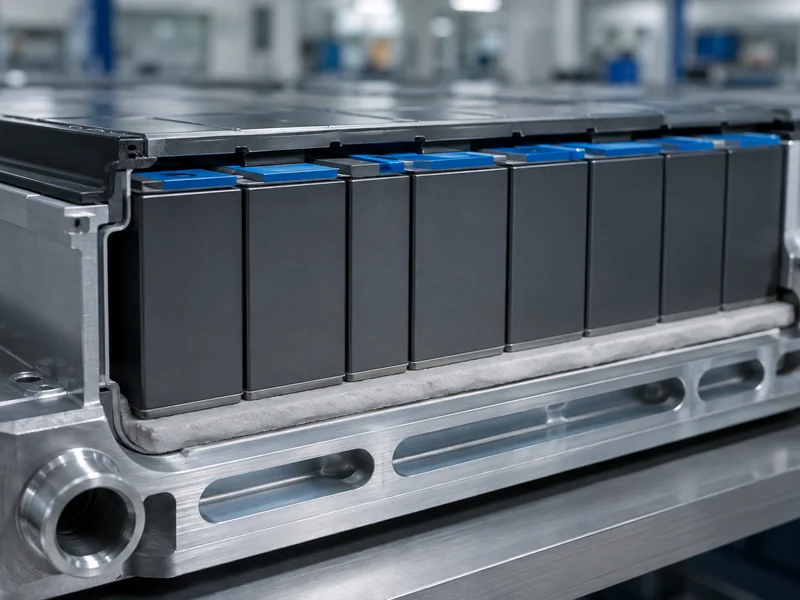
Choosing a thermal interface material (TIM) for a battery pack is a fit decision before it is a conductivity decision. The material with the highest published W/mK rarely wins on its own. The gap it has to fill, the assembly stress it can tolerate, whether it must insulate, how it cures, and how it dispenses on a line usually decide more than the number on the datasheet. This comparison walks the main TIM classes side by side, then maps them onto the cell-to-coolant heat path in an EV or energy-storage pack. That lets a thermal or product engineer narrow the field by constraint rather than by headline spec.
Why the interface, not the datasheet rating, sets the heat path
The largest thermal penalty in most assemblies comes from the air trapped between two imperfect surfaces, not from the bulk material you pick. No machined cell can, cold plate, or module wall is perfectly flat, so the real contact area is a fraction of the apparent area, and the remaining micro-gaps fill with air. Air conducts heat poorly, so those gaps dominate interfacial thermal resistance until a conformable material displaces them. That is the job a TIM exists to do. It is also why a mediocre-conductivity material that wets and conforms often beats a high-conductivity one that bridges instead of fills.
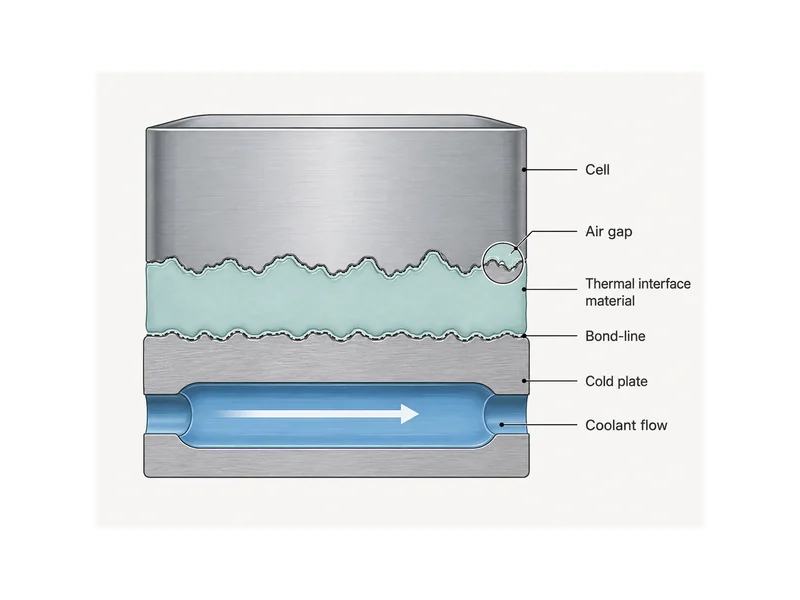
Bulk thermal conductivity and installed thermal resistance are not the same thing, and treating them as interchangeable is the most common selection error. A pad rated at a high W/mK still adds resistance if it cannot deflect into the surface profile under the available clamping load. A lower-rated grease or gel that spreads to a razor-thin, void-free layer can present a lower total resistance across the joint. The variable that ties them together is the achievable bond-line: conductivity only helps once the material has closed the gap it was asked to close. Verify the interface by looking at gap, flatness, and mounting pressure together, not at the conductivity figure alone.
Main thermal interface material types and where each fits
Most TIM decisions come down to six families, each trading conformability, conductivity, handling, and permanence differently. The practical way to read the list below is by the gap each one is meant to close and the assembly method it suits.
Thermal grease and paste
Grease and paste give the thinnest bond-line and the lowest interface resistance on flat, well-clamped joints, which is why they persist where a chip sits directly against a spreader. Published conductivities commonly fall in the low single digits, up to roughly 8 W/mK depending on filler loading. Exact figures are product-specific and should be read from the supplier’s data. The tradeoffs are process and durability: paste is messy to apply evenly, is effectively single-use, and can pump out or dry over repeated thermal cycling. That matters in a pack that will see years of duty. Reserve it for small, flat, high-flux interfaces that stay under steady clamping force.
Thermal gap pads
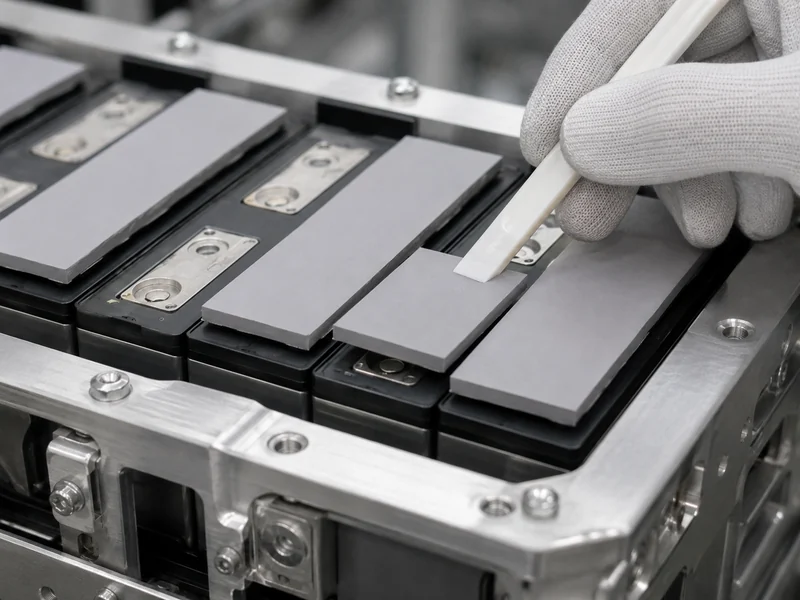
Gap pads are pre-cut, compressible sheets that trade some conductivity for clean, repeatable handling and, in the right grade, electrical isolation. They suit fixed, known gaps and are easy to place, cut, and rework. The gap pad thermal conductivity is set mainly by the filler system. The installed figure also depends on how well the pad seats under load, so the rated number and the achieved number can differ. The limit is conformability: a solid sheet cannot fully close microscopic roughness, so it typically shows higher interface resistance than paste on the same flat joint. It also needs enough deflection under load to seat properly. Match pad thickness and hardness to the tolerance stack-up, not only to the nominal gap.
Dispensable gap fillers and gels
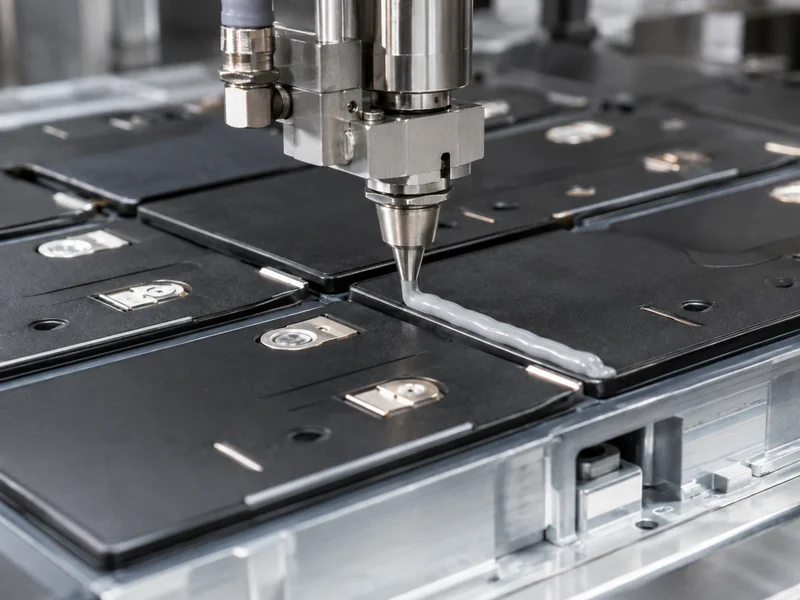
Dispensable gap fillers earn their place where gaps are large, variable, or shared across several components at different heights. Applied as a one- or two-part fluid by syringe or robot nozzle, they conform to uneven surfaces and cure or stay soft depending on chemistry. One dispensed bead can cover a range of stack-up conditions that a single pad thickness cannot. Available conductivities span a wide range across products, so read each candidate against the gap and the required cure behavior; the class is not inherently low-performance. The tradeoff is process control: dispense rate, mix ratio, and cure need to be qualified for the line.
Phase change materials
Phase change materials (PCMs) behave like a solid pad for handling and like grease once the joint reaches operating temperature. They are typically solid at room temperature and soften around 50–65 °C. At that point they flow into surface roughness and reach a grease-like interface resistance without the room-temperature mess. They favor interfaces that see a defined temperature rise and can hold clamping force through the first thermal cycle. Their limit is that they need that pressure and heat to work as intended, so they are less suited to loose, unclamped, or large-gap joints.
Thermally conductive adhesives
Thermally conductive adhesives add structural bonding to the heat path, which is why they appear where a design wants the interface to bond as well as conduct. They fix components in place and can carry both heat and mechanical load, often with good dielectric strength. The tradeoff is permanence: a cured adhesive joint is not meant to be reworked, and its gap-filling range is narrower than a dispensed filler. Use them where the design genuinely wants the interface to also be a bond, and confirm rework and repair implications before committing.
Thermal tapes and films
Tapes and films handle light, thin-gap jobs where mechanical fastening is inconvenient, trading conductivity for a self-adhesive, low-profile install. They mount small components and heat spreaders cleanly, but their conductivity and gap-filling range are modest, so they serve as a supporting option, not the primary path for a high-flux cell interface. Graphite films are a related case, valued for spreading heat in-plane instead of for closing a thick gap.
Comparing thermal interface materials across the variables that matter
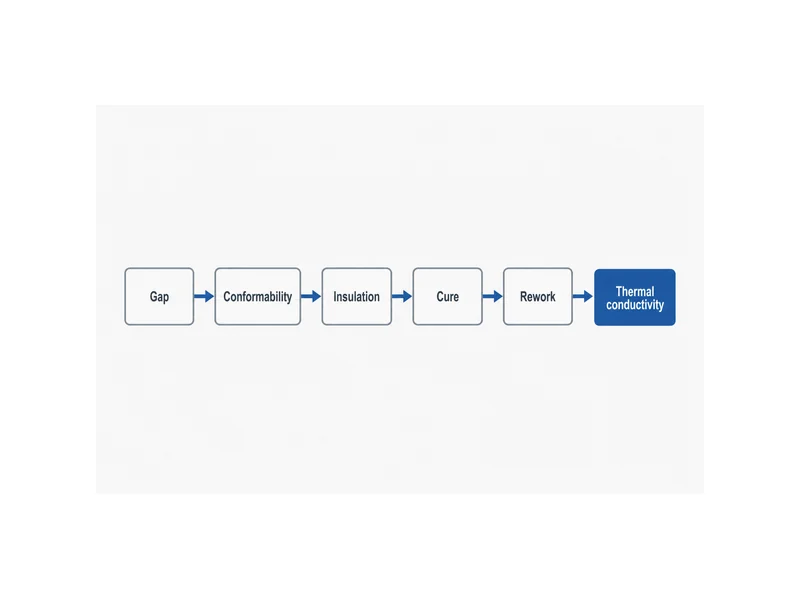
The materials only sort cleanly when they are compared on the variables that actually drive a battery-pack joint: gap, conformability, insulation, cure, and reworkability, alongside conductivity. The table below is a selection aid, not a spec sheet; treat every conductivity range as product-dependent and confirm figures against supplier data.
| TIM type | Typical gap | Conformability | Electrical role | Cure / permanence | Rework |
|---|---|---|---|---|---|
| Grease / paste | Thin, flat | High (fills micro-roughness) | Grade-specific; verify datasheet | None; single-use | Poor |
| Gap pad | Fixed, known | Moderate (deflects under load) | Insulating grades available | None; reusable initially | Good |
| Dispensable gap filler | Large, variable | High | Formulation-dependent | Cure or stay-soft options | Limited once cured |
| Phase change material | Thin, defined ΔT | High above softening point | Grade-specific; verify datasheet | None; softens above transition temperature | Grade-specific |
| Thermal adhesive | Thin to moderate | Moderate | Insulating grades available | Permanent bond | Poor |
| Tape / film | Very thin | Low–moderate | Grade-specific | Adhesive; semi-permanent | Moderate |
Read the table by starting from the constraint that cannot move. If the gap is large and variable, conformability and dispensing rule out thin pastes and thin tapes before conductivity is even discussed. If the joint must isolate a live surface from a cold plate, insulation moves ahead of the W/mK number. If the pack must be serviceable, a permanent adhesive is disqualified regardless of its bonding appeal.
Matching the interface material to battery-pack integration
In a battery pack, the TIM choice follows the pack architecture and the assembly method more than any single performance number. Cell format and module geometry set the gap and the tolerance stack-up. Cylindrical arrays, prismatic modules, and pouch stacks present different flatness and gap-variation profiles. A material that seats well on one can bridge or over-compress on another. Where cells sit above a cold plate with a real, varying gap, dispensable gap fillers usually win on coverage; where a defined, repeatable gap and clean handling matter more, pads compete. Selecting across Trumonytechs thermal interface materials then follows the same gap and assembly constraints that govern the cold-plate side of the joint.
The shift from modular to structural packs changes which TIM class fits, and it is worth designing around. In cell-to-pack modular designs the interface is often a gap filler, while cell-to-chassis structural designs increasingly ask the interface to bond the cell to the load-bearing structure. That points toward structural adhesive TIMs. When the interface also carries mechanical load, adhesion, curing, and rework rise in weight alongside thermal conductivity, because the material can no longer be peeled back easily. Decide early whether the interface in your architecture is purely thermal or thermal-plus-structural, because that answer removes whole material families from consideration.
Automation and throughput are decision variables in their own right, not afterthoughts. Two-part dispensed fillers and adhesives can suit volume lines, but they add mix-ratio, dispense-equipment, and cure qualification that has to be verified for the specific product and cycle time. Pre-cut pads simplify the process at the cost of gap flexibility. Sensitive electronics near the pack can also constrain chemistry, since silicone outgassing is a known concern, and silicone-free formulations address it. Confirm dispense method, cure window, and outgassing limits against the assembly plan before locking a material in.
Failure modes and what to verify before you commit
Most TIM problems in the field trace back to a handful of failure modes that are predictable at selection time. Pump-out, where a fluid material is squeezed out of a cycling joint, and dry-out or aging of greases are the classic reasons a thin, high-conductivity paste degrades over years of duty. Silicone migration can contaminate nearby sensors or optical parts, which is why some designs specify silicone-free chemistry. A cured adhesive that bonds well also removes the option to rework, and that consequence is fixed at assembly, not after cycling. Aging effects such as grease dry-out and pump-out appear only over thermal cycles, so a first-build temperature check will not reveal them. Loss of reworkability, and contamination of nearby parts, can show up much earlier.
Verify the interface against the joint it will actually live in, not against a bench coupon. Confirm the achievable bond-line under real clamping pressure and worst-case gap. Check the material’s behavior across the pack’s full temperature range, not at a single point. Validate cure and dispense on representative hardware before committing to a line. This article covers material-class selection and does not substitute for qualification testing on your specific stack-up, cell format, and assembly process, which remain the final arbiter.
Turning the comparison into a choice
The core judgment is an ordering, not a ranking: define the gap and the assembly stress first, screen out any class that fails the insulation, cure, or rework requirement, and only then compare thermal conductivity among the survivors. The common misread is treating the highest W/mK as the best material, when a lower-rated material that conforms and closes the actual gap under the actual load can present the lower installed resistance once its improved contact outweighs the conductivity difference. Match the interface material to the heat path and the process, verify it under the real gap and clamping pressure, and let conductivity break the tie.
FAQ
Gap filler or gap pad for a module with tolerance stack-up?
A dispensable gap filler usually fits better when the tolerance stack-up makes the gap large or variable across the module, because it conforms to each local gap instead of holding one nominal thickness. A pre-cut pad competes when the gap is repeatable and clean, low-mess handling matters, and electrical isolation is needed. Decide by how much the real gap varies part-to-part, then confirm the filler’s dispense and cure or the pad’s deflection under your clamping load.
Do I need an electrically insulating TIM between cells and a cold plate?
You need an insulating TIM whenever the interface must keep a live cell surface electrically separated from a conductive cold plate. Insulating grades exist among gap pads, gap fillers, and dielectric films, some carrying a UL 94 V-0 flammability rating. Whether a given grease or phase change material insulates has to be confirmed grade by grade, not assumed. Treat insulation as a hard filter applied before conductivity, and confirm the required dielectric strength for your voltage against the specific grade and thickness.
Which TIM suits a large, variable gap that also needs rework?
A soft, non-curing dispensable gap filler or gel is the usual answer for a large, variable gap that must stay serviceable, since it conforms to the gap without forming a permanent bond. A cured adhesive is the wrong choice there because it trades reworkability for structural bonding. Confirm that a non-curing filler stays reworkable after aging and thermal cycling, and that it still meets the conductivity you need at the installed thickness. For a cure-in-place product, check how it releases once cured.
How do I avoid pump-out under thermal cycling?
Avoid pump-out by matching the material’s format to how the joint moves, not by chasing conductivity. Thin greases are among the most prone to being squeezed out of a cycling, clamped interface. Instead of ranking whole classes for durability, screen the specific product on its thermal-cycling data, the interface’s movement, the clamping load, and how its bond-line changes over cycles. Validate the candidate on representative hardware across the pack’s temperature and clamping range before production, because pump-out only appears over cycles.
Further Reading
- Thermal Interface Materials (US Patent 6,451,422) — granted US patent (US Patent and Trademark Office). Supports the point that a TIM exists to displace trapped air and lower interfacial contact resistance across an imperfect joint.
- Properties for Thermally Conductive Interfaces with Wide Band Gap Materials — peer-reviewed paper (NCBI/PMC). Supports the point that interfacial contact resistance, not bulk rating alone, governs the achievable heat path.
Related Articles
- Thermal Interface Materials Types & Characteristics — A primer on the main TIM families and their defining properties, useful before weighing one class against another.
- Thermal Paste Alternative: Engineered Options and How to Choose — Walks through when a pad, gel, or gap filler serves better than paste and how to choose among them.
- What Is Liquid Thermal Compound? — Explains how dispensable liquid compounds flow into uneven gaps, the behavior behind the gap-filler class discussed here.
- What Does Thermal Grease Do? — Details how grease thins the bond-line on a flat, clamped joint, the case this comparison reserves for paste.
- What is Thermal Gel Used For? — Covers where soft, conformable gels fit, complementing the dispensable gap filler discussion.