

Read commercial building solar energy storage system case studies as engineering evidence, and their headline numbers become a checklist instead of a promise. Demand-charge reduction, load-shifting behavior, and years of reliable operation trace back to two things: how the system was sized against the building’s load, and the operating conditions the battery runs under. Of those conditions, temperature control is one of the most consequential. This article summarizes three publicly reported projects and reads each for what its numbers actually prove. For battery-pack and ESS engineers, the useful move is to separate what a case study demonstrates from what it quietly leaves out, especially the thermal design at the cell-to-coolant path.
What Commercial Solar-Plus-Storage Case Studies Actually Show
Storage earns its keep in these projects by shifting solar energy in time, not by generating more of it. Solar output peaks near midday while commercial demand often peaks later, so pairing a battery energy storage system with the array lets a building discharge stored solar into its own afternoon or evening peak. The U.S. Department of Energy describes this as time-shifting midday generation to the later demand peak, which is the mechanism behind most reported demand-charge and peak-shaving savings.
Reported financial outcomes vary widely because they depend on the local rate structure, not on the hardware alone. Facilities on time-of-use and high demand-charge tariffs show the strongest returns; sites without meaningful demand charges see thinner economics from the same equipment. When two case studies report different savings, the variable worth isolating is the rate structure and load profile that produced each result, because that is what you can compare against your own site.
Resilience is the second recurring theme, and it is easy to under-weight. Many commercial and institutional projects justify storage partly on outage ride-through, keeping critical loads energized when the grid drops. That benefit comes with a tradeoff: it depends on how the system is configured for islanding and how much capacity is held in reserve for backup instead of arbitrage. A case study that claims both maximum savings and full backup deserves a closer look at how the two were balanced.
How System Sizing Tracks a Building’s Load Profile
System size in a credible case study follows the building’s load profile, which is why headline kW and kWh figures do not transfer as rules of thumb. Publicly reported commercial projects span a wide range, from arrays in the hundreds of kilowatts to multi-megawatt installations, paired with battery banks from roughly one hundred kWh to several hundred kWh. What sets the ratio between solar and storage is when the building draws power, how peaky that draw is, and what the utility charges for peak demand. Copy another site’s kWh without its load curve, and the case study stops predicting anything about your own.
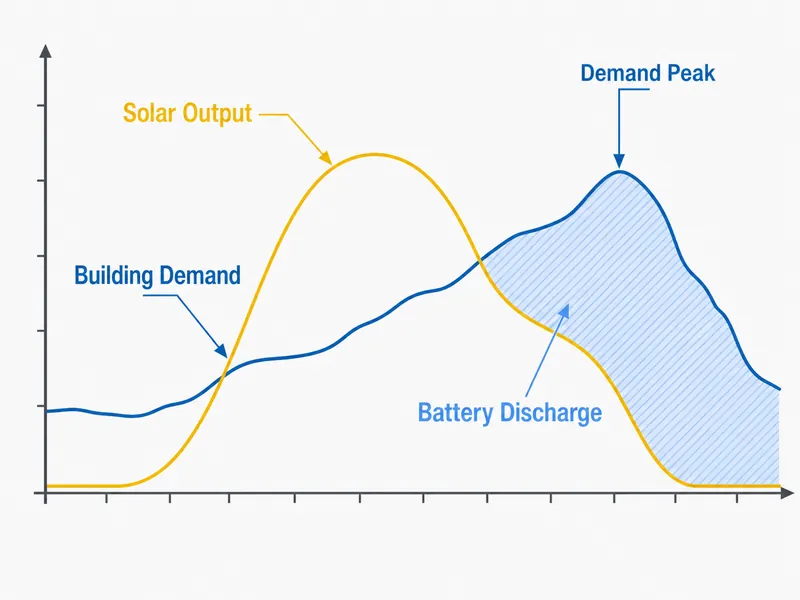
The sizing logic runs from a measurable variable to a design choice to a verification step. Demand-charge exposure, in dollars per kW of monthly peak, drives how much discharge power the battery needs; the depth and duration of the afternoon peak drives how much energy in kWh it must hold. One billing cycle is enough to check whether the modeled discharge actually clips the recorded peaks. Confirming payback is a longer exercise: it needs a full year of load and rate data plus assumptions about degradation and O&M, because seasonal load swings and tariff rules do not show up in a single month.
Chemistry and round-trip efficiency also shape how much usable energy a given nameplate delivers. A published review in *Micromachines* reports pack-level round-trip efficiency for lithium-ion systems in the range of 82 to 89 percent, so some stored solar is lost on every cycle before it offsets a peak. That loss is modest but real, and it is one reason engineers size for the load they must shift, with the battery’s nameplate treated as a ceiling, not a working figure.
Three Commercial Solar-Plus-Storage Projects, and What Their Numbers Prove
The three briefs below come from public developer and installer reports, each a single source that has not been independently verified. Treat the figures as reported claims with site-specific conditions, not as portable benchmarks, and note that none of these reports discloses the thermal design behind the storage.

Commercial building
A California commercial building, in a case its storage integrator reports publicly, paired a 297 kW solar PV array with a 109 kWh battery system and cut a large share of its grid draw. The developer reports annual savings near USD 152,000 and a payback close to four years, driven by demand-charge reduction. Those economics are specific to that building’s rate structure and load, so the payback figure should not be read as typical. The same report gives no data on cell temperatures, duty cycle, or capacity retention over time.
Industrial facility
Sycamore International, an electronics site in West Grove, Pennsylvania, built a solar-plus-storage microgrid to avoid downtime, as reported by its installer. The system pairs 115 kW of rooftop solar with a 75 kW / 400 kWh iron-flow battery rated by its maker for long-duration cycling. Iron-flow chemistry behaves differently from lithium-ion on temperature sensitivity and cycle life. That is exactly why the chemistry choice, not the building label, should drive the cooling and duty-cycle analysis for any site copying this design.
Institutional and educational
UC Merced, according to its project developer, combined about 5 MW of carport and rooftop solar with a 483 kW / 900 kWh storage system to advance a campus sustainability commitment. Campus load is seasonal and schedule-driven, so storage utilization swings across the academic year, and the public report frames the outcome around clean-energy goals more than demand-charge math. What it does not describe is how the storage is kept within its temperature window through both high-demand terms and long breaks, which is the open question for anyone benchmarking against it.
Why Thermal Management Is a Key Factor in Storage Reliability
Thermal management ranks as one of several factors that decide how a storage system ages, and the case reports above are silent on all of them. Capacity retention over a project’s life is also shaped by cell chemistry, the state-of-charge window, depth of discharge, C-rate and daily throughput, calendar aging, BMS and EMS strategy, the enclosure and ambient environment, and maintenance practice. Treating temperature as the single cause of long life would misread the engineering; treating it as a controllable lever that the public numbers ignore is the accurate reading.
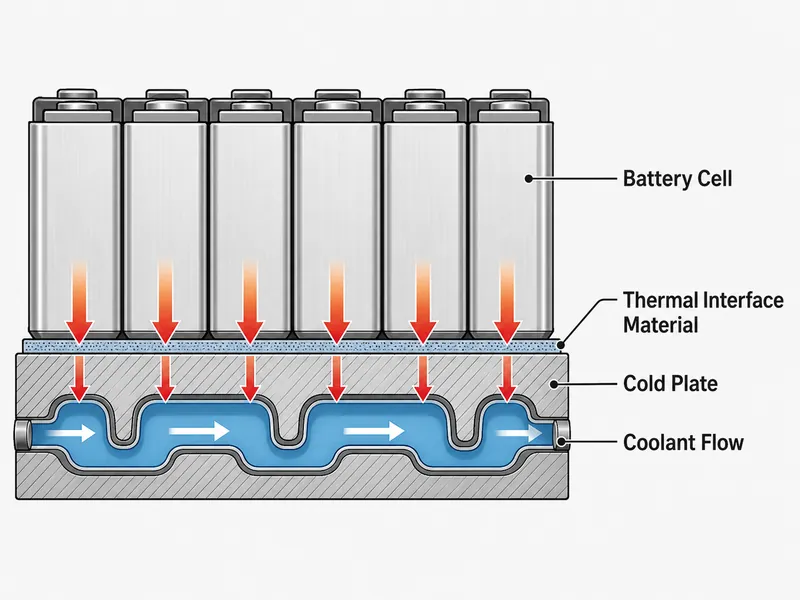
Where temperature does its damage, uniformity matters alongside the average. Peer-reviewed testing in *Communications Engineering* found that a large intra-pack thermal gradient produced roughly 65 percent more usable-capacity loss than a small one over 2,000 cycles, at the same mean temperature. That result comes from parallel-connected pack testing, so it speaks to gradients between cells rather than to whole-system field life; still, it shows why holding every cell in a narrow band is a real reliability variable, not a cosmetic one.
Moving heat evenly from the cell to the coolant is where component choices enter, and their value depends on the design target. A liquid cooling plate can hold tighter temperature uniformity than air when heat-flux density is high, the uniformity target is strict, and the design can accept the plate’s pressure drop and parasitic pumping power. Where those conditions are relaxed, well-designed air cooling may meet the same target. The plate also performs only if heat can cross the gap between cell and plate, which is the job of thermal interface materials. Their conductivity and their ability to fill the real assembly gap and stress set how much of the plate’s capacity reaches the cell. Specifying a cold plate without matching the interface material to the measured gap leaves cooling capacity on the table.
Uneven cooling also raises the failure risk of the whole installation, not just its capacity. Local hot spots are where degradation accelerates and, in the worst case, where thermal runaway can start. Reading a case study for its thermal management design, and for the variables it omits, is how you judge whether its reported reliability is likely to hold on a different site.
What Long-Term Operation Reveals in These Case Studies
A case study’s most honest signal comes years after commissioning, in what it reports about operation, and most of the projects above report almost nothing there. A system that keeps delivering usually reflects several things going right together: a chemistry suited to the duty cycle, a sensible SOC window, and a thermal design that held cells uniform and avoided early hot-spot maintenance. Attributing that outcome to any single factor, temperature included, overstates what the public numbers can support.
Request capacity-fade data, because it exposes problems that first-year savings hide. Heat and thermal gradients are among the significant drivers of lithium-ion aging, so a pack held in a tight temperature band tends to fade more slowly than one that runs hot or uneven and can extend its usable lifespan, other conditions being equal. When a project quietly re-rates its capacity after a few years, the cause could be thermal, but it could equally be an aggressive DoD or a chemistry mismatch. That is why the retention data matters more than any single explanation.
The maintenance load a case study omits often decides its real cost of ownership. A well-managed pack needs fewer thermal interventions and cell replacements, which lowers the total cost beyond the initial payback math. For an engineer reviewing these projects, the concrete step is to ask for the temperature-uniformity and capacity-retention records, since those two datasets tell you whether a reported success is repeatable on your own site.
Conclusion
The core judgment to take from these commercial solar energy storage case studies is that their headline savings prove the sizing worked, not that the storage will last. Sizing to the building’s load profile earns the first year of returns; keeping the pack cool and uniform, through the right cold plate and an interface material matched to the actual gap, is one of the levers that decides whether those returns erode. The point most often misread is that average temperature is not the whole story, since the gradient between cells quietly sets part of the pace of capacity fade.
For engineers deciding whether a published project maps to their own system, the useful next step is to read past the savings figure and request the load-matching, temperature-uniformity, and capacity-retention data behind it. Where the thermal path is the open question, Trumonytechs can help specify cold plates and interface materials against your cell format, gap, and duty cycle; contact Trumonytechs to review the thermal design behind your storage case.
FAQ
How do commercial solar-plus-storage case studies actually save money?
Most reported savings come from time-shifting solar and shaving demand charges, not from extra generation. The battery stores midday solar and discharges it into the building’s later peak, cutting both energy bought at peak prices and the monthly demand charge measured in dollars per kW. How much this is worth depends on the local rate structure, so identical hardware performs very differently under different tariffs.
What size battery does a commercial building actually need?
Battery size follows the building’s load profile and demand-charge exposure, with no fixed ratio to the solar array. Discharge power in kW is set by how high and sharp the peak is, while energy in kWh is set by how long that peak lasts, and both should be validated against a full billing cycle of recorded load before any payback number is trusted.
Why does temperature uniformity matter more than average temperature alone?
Cells at different temperatures inside one pack age at different rates and drag down the whole bank. Peer-reviewed testing in *Communications Engineering* found a large intra-pack gradient caused about 65 percent more usable-capacity loss than a small one over 2,000 cycles at the same mean temperature, in parallel-connected pack testing. Holding every cell in a narrow band is therefore a measurable reliability variable, though field life also depends on chemistry, duty cycle, and controls.
Is liquid cooling necessary for a commercial BESS?
Liquid cooling is not mandatory; it becomes the stronger choice as heat-flux density and duty cycle rise. It can remove heat closer to the cells and hold tighter uniformity when the uniformity target is strict and the design accepts its pressure drop and pumping power. Lighter-duty systems in stable ambient conditions can meet their temperature targets with well-designed air cooling, so the decision should follow the thermal target, not the building type.
How much of a storage system’s lifespan comes down to thermal management?
Thermal management is one of the significant drivers of lifespan, but not the only one. Heat and thermal gradients accelerate lithium-ion aging, yet chemistry, state-of-charge window, depth of discharge, throughput, and maintenance all shape capacity retention as well. The temperature-retention record is a useful predictor of long-term value, and it should be read alongside those other variables, not in place of them.
Further Reading
- U.S. Department of Energy — Solar Integration: Solar Energy and Storage Basics — Government (T1). Supports the time-shifting and peak-shaving mechanism behind commercial solar-plus-storage economics; applies to grid-tied behind-the-meter systems.
- A Review of Potential Electrochemical Applications in Buildings for Energy Capture and Storage (*Micromachines*, 2023) — Peer-reviewed (T1). Supports the lithium-ion round-trip efficiency range used in the sizing section; a review of building-scale storage, not a single project.
- Degradation in parallel-connected lithium-ion battery packs under thermal gradients (*Communications Engineering*, 2024) — Peer-reviewed (T1). Supports the temperature-uniformity claim; based on parallel-connected pack testing, where the gradient, not the mean temperature, drove the extra capacity loss.
Related Articles
- Energy Storage Battery Packs in EV Charging Stations — Shows how storage packs handle the high, spiky loads of EV charging, a useful contrast to the steadier commercial-building duty cycle in these case studies.
- Innovative Applications of Energy Storage Battery Packs in Data Centers — Covers storage used for backup and load regulation where cooling and uptime are critical, extending the thermal-reliability theme to another building type.
- Optimizing Thermal Management of Industrial Energy Storage — Goes deeper on the passive and active cooling choices that decide how long industrial storage holds its capacity.