
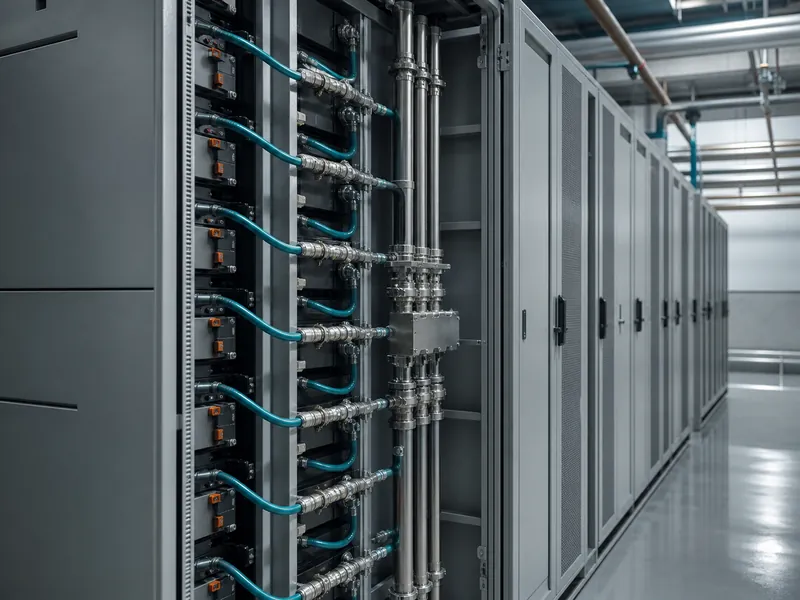
Optimizing thermal management of industrial energy storage means holding cells inside their allowed temperature window while keeping cell-to-cell differences small, at the lowest sustainable auxiliary-energy cost. An industrial battery energy storage system generates heat every time it charges and discharges, and how well that heat is removed and evened out shapes the pack’s aging rate, its behavior under load, and how much usable capacity it keeps.
The figures in this article apply to lithium-ion BESS specifically. It defines the discipline, explains why cell-to-cell uniformity matters as much as peak temperature, compares air, liquid, and immersion cooling, and works through matching an architecture to a system. It does not cover cell-chemistry selection or fire-suppression system design, which sit alongside thermal management as separate decisions.
What Thermal Management of Industrial Energy Storage Means
Thermal management is the active control of cell and pack temperature within a target band throughout charge and discharge, not just heat removal when an enclosure feels warm. For lithium-ion cells, NREL puts the best operating range at roughly 15–35 °C. The usable band for any given system is ultimately set by the cell supplier’s allowed range, the chemistry, and the duty cycle, not by a single industry figure. Above the band, side reactions speed up; below it, available power drops and charging has to be derated.
Scale and density are what make this harder in industrial storage than in a phone or laptop. Hundreds or thousands of cells sit packed together, so heat that would dissipate on its own in a small device has to be moved out deliberately. That is why thermal management matters as a design problem in its own right, not a bolt-on accessory.
Why Temperature Uniformity Matters as Much as Peak Temperature
A pack can hold the right average temperature and still age quickly when its cells disagree with each other. The ohmic share of the internal heat rises roughly with the square of current, so high C-rate operation concentrates it, though total cell heat also depends on internal resistance, state of charge, chemistry, and reversible entropic effects. That is why heat load should be measured over the full duty cycle instead of estimated from current alone. The cells running hottest age fastest, and because a series string is limited by its weakest member, a pack effectively ages at the rate of its hottest cells, which is part of why a battery pack overheats unevenly under load.
The temperature-versus-life relationship is steep enough to design around. Figures published by NREL and repeated across engineering sources put lithium-ion lifetime loss near 20% at a sustained 30 °C, closer to 40% at 40 °C, and roughly half the 20 °C baseline at 45 °C. These are directional figures for lithium-ion cells, not a guarantee for any specific cell, and they describe a degradation risk, not a fixed outcome. Narrowing the cell-to-cell delta is one lever for slowing that risk, and how much liquid cooling can extend the ESS lifespan depends on whether it actually holds that delta under real load.
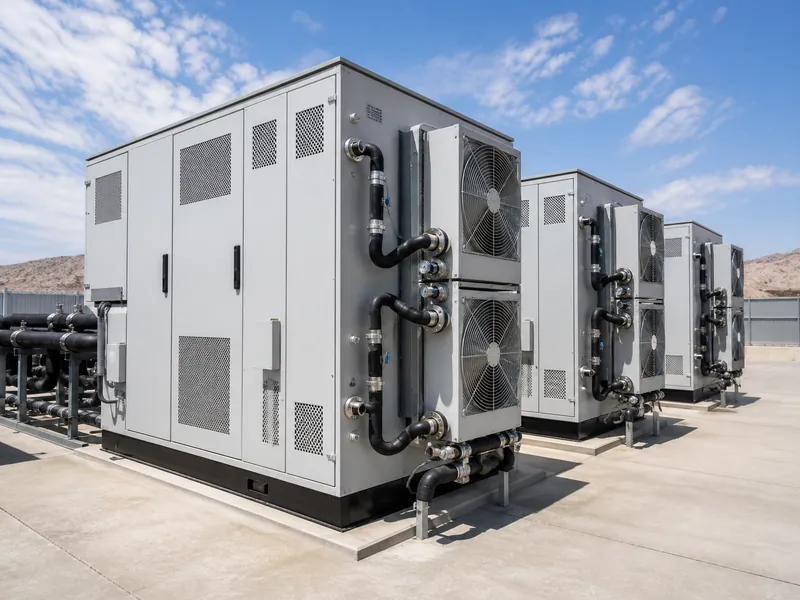
Cooling Methods for Industrial Energy Storage: Air, Liquid, and Immersion
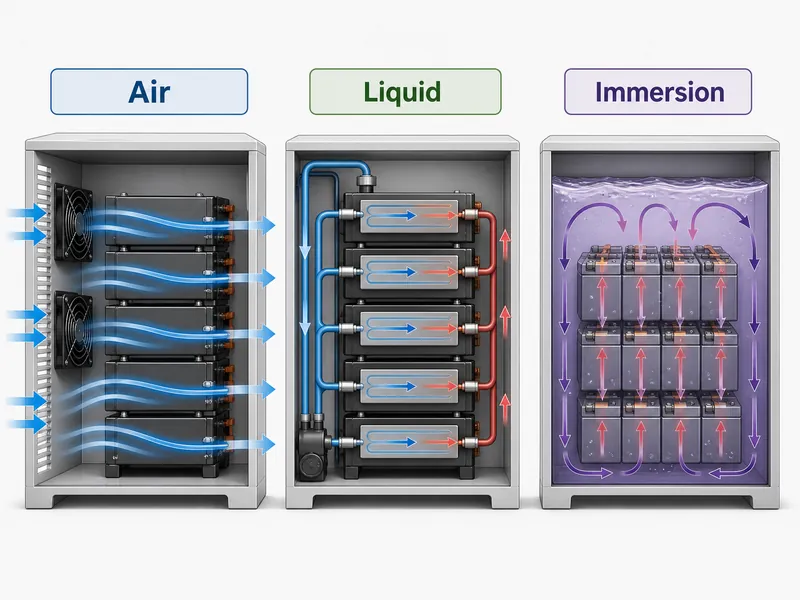
Three cooling families dominate industrial energy storage, and each trades heat-transfer capacity against cost, complexity, and packaging. Air cooling spans passive and active cooling designs, from natural convection at one end to fans or forced ventilation at the other. Liquid cooling circulates a water-glycol mix through cold plates in contact with cells or modules, and immersion cooling submerges cells in a dielectric fluid. Liquid carries heat far better than air, since water’s thermal conductivity is roughly an order of magnitude higher, which is one reason denser, higher-power systems tend to move toward liquid or immersion as loads climb.
| Method | How it moves heat | Where it tends to fit | What changes the result |
|---|---|---|---|
| Air | Conditioned air across modules | Lower C-rate, less dense systems | Duct and flow design, ambient temperature, cabinet density |
| Liquid (cold plate) | Coolant through plates in contact with cells | Higher-density, higher C-rate systems | Flow rate, contact resistance, coolant choice, leak management |
| Immersion (dielectric) | Cells submerged in dielectric fluid | Very dense, demanding duty | Fluid selection, handling, serviceability |
The table shows tendencies, not fixed rankings. Which method actually wins on a given pack depends on the heat exchanger, flow rate, contact resistance, control strategy, redundancy, maintenance access, and the specific coolant, so higher-rate systems that lean toward ESS liquid cooling still have to prove the loop against their own duty cycle.
Matching the Cooling Architecture to Your System
The objective is optimum cooling, not maximum cooling, and that distinction drives the whole selection. Overcooling is not free: it raises auxiliary energy draw, and in humid outdoor cabinets it pushes surfaces below the dew point and invites condensation. The right architecture holds the target band and delta with the least parasitic load, so the decision is driven by variables, not by a blanket preference for the most powerful method.
Five variables carry most of the decision, and each maps to a verification step before you commit:
- C-rate and heat load — higher sustained charge/discharge rates tip the balance from air toward liquid; check against the worst-case duty cycle, not the nameplate average.
- Energy density and footprint — tightly packed or space-constrained installations lose the air channels that air cooling needs; confirm the packing still leaves a viable heat path.
- Ambient and climate — hot or wide-swing sites push toward liquid, but the trigger is the worst-case ambient combined with internal heat load, not a fixed temperature threshold; cold sites may also need heating.
- Pressure-drop and uniformity targets — a cold-plate loop has to hit its flow and delta-T targets across every module; verify at the intended flow rate, not an idealized one.
- Auxiliary-energy budget — every watt of cooling is a watt not exported; confirm the control strategy can ease off when load drops instead of running flat out.
Pin those variables first, and the architecture usually follows from the pack instead of forcing the pack to fit a generic cooler.
The Cell-to-Coolant Heat Path: Cold Plates and Interface Materials
Most cooling discussions stop at the coolant loop, but the heat still has to cross the gap between the cell and the cold plate, and that interface often sets the real limit. A cold plate can carry away plenty of heat and still leave cells hot when the path into it has high resistance. That path runs cell → thermal interface material → cold plate, and the interface material is where many otherwise sound designs lose their margin. Selecting one is its own decision, driven by the gap it fills, the flatness and assembly stress it sees, whether it must bond or only conduct, and whether it also has to insulate electrically; a material chosen for a large, uneven gap behaves differently from one chosen for a thin, controlled one.
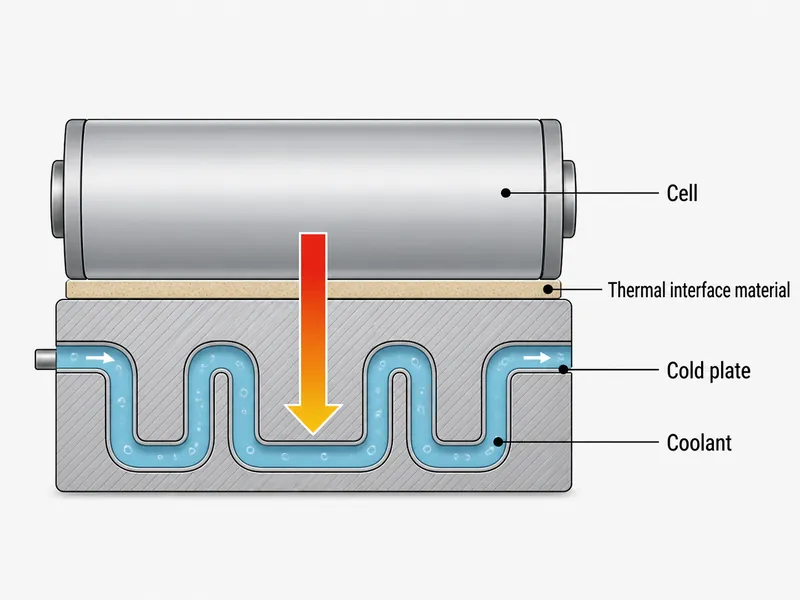
Trumonytechs supplies liquid cold plates and thermal interface materials for this cell-to-coolant path. Matching the two is a project-level integration decision, not a fixed pairing: the plate’s capacity is only realized when the interface material suits the gap, stress, and cure conditions of the actual stack. Specific conductivity, insulation, and gap values belong to the individual product datasheet and should be verified for the format in question, not inferred from a model suffix or generalized across a series.
Thermal Management, Thermal Runaway, and BESS Safety Standards
Good thermal management can lower some overheating and hot-spot risk, but it does not by itself control thermal runaway or satisfy installation codes. Runaway can also start from an internal short, mechanical damage, or electrical abuse, causes that cooling does not address, so temperature control is one input to safety, not a substitute for it.
Two US standards frame the safety review, and both are worth naming precisely. UL 9540A is the Standard Test Method for Evaluating Thermal Runaway Fire Propagation in Battery Energy Storage Systems; per UL Solutions, it runs at cell, module, unit, and installation levels, and its data informs separation distances and fire-protection design. NFPA 855, the Standard for the Installation of Stationary Energy Storage Systems, governs how those systems are installed. Neither outcome can be judged from cooling design alone: propagation testing, fire-suppression engineering, project specifications, and authority-having-jurisdiction review all sit outside what thermal management controls.
Conclusion
Optimizing thermal management of industrial energy storage rests on one judgment: keep lithium-ion cells inside their allowed band, keep the cells close to each other, and spend the least auxiliary energy doing it. The most common misread is treating peak temperature as the only target; cell-to-cell uniformity often drives the degradation risk more than a couple of degrees on the peak, and overcooling trades one problem for condensation and parasitic load. Air, liquid, and immersion each fit a different combination of C-rate, density, and climate, and the interface between cell and cold plate deserves as much attention as the loop itself. Anyone specifying a system is better served by pinning those variables and verifying them against real duty cycles, cell-supplier limits, and the relevant standards than by reaching for the most powerful cooler available.
FAQ
Do I need liquid cooling for a high C-rate industrial BESS, or is air cooling enough?
Cooling choice depends on sustained heat load and packing density, not on the label. Air cooling can serve lower C-rate and less dense systems, while high C-rate and high-density installations usually justify liquid cooling because it holds a tighter cell-to-cell delta; verify against the worst-case duty cycle rather than the average.
What cell-to-cell temperature difference should I target in a pack?
Aim for the smallest delta the architecture can hold economically, because the hottest cells set the pack’s aging rate. No single number fits every chemistry and format, so set the delta target against the specific cells and verify it at the intended flow rate and worst-case load.
Can I judge UL 9540A results or NFPA 855 compliance from thermal management design alone?
No. Thermal management can lower some overheating and hot-spot risk, but UL 9540A test results and NFPA 855 compliance are determined by the specific system, its test data, and the applicable regulations and jurisdiction review, not by cooling design on its own.
Is more aggressive cooling always better for battery life?
No. Beyond the target band, extra cooling raises auxiliary energy use and, in humid outdoor cabinets, risks condensation as surfaces drop below the dew point. The aim is optimum cooling that holds the band and delta, not the coldest possible cells.
Where does the heat in an energy storage system actually come from?
Most of it is generated inside the cells during charge and discharge. The ohmic share rises roughly with the square of current, but total heat also depends on internal resistance, state of charge, chemistry, and reversible entropic effects, so size the coolant loop and the cell-to-coolant interface against measured or verified heat load over the full duty cycle, not against current alone.
Further Reading
- UL 9540A Test Method for Battery Energy Storage Systems — UL Solutions (standards body). Defines the cell/module/unit/installation test levels referenced above and how their results inform separation and fire-protection design.
- Understanding UL 9540A, NFPA 855 and Large-Scale Fire Testing for BESS — UL Solutions (standards body). Explains how UL 9540A and NFPA 855 fit together for stationary energy storage installation, supporting the safety-standards section.
Related Articles
- Commercial Building Solar Energy Storage System Case Studies — How commercial solar-plus-storage projects are configured, for readers scoping a building-scale energy storage deployment.
- Innovative Applications of Energy Storage Battery Packs in Data Centers — Where energy storage battery packs fit into data-center power, relevant when thermal design has to serve high-density loads.
- Energy Storage Battery Packs in EV Charging Stations — How storage packs support fast-charging sites, useful when cooling must handle high C-rate duty.