
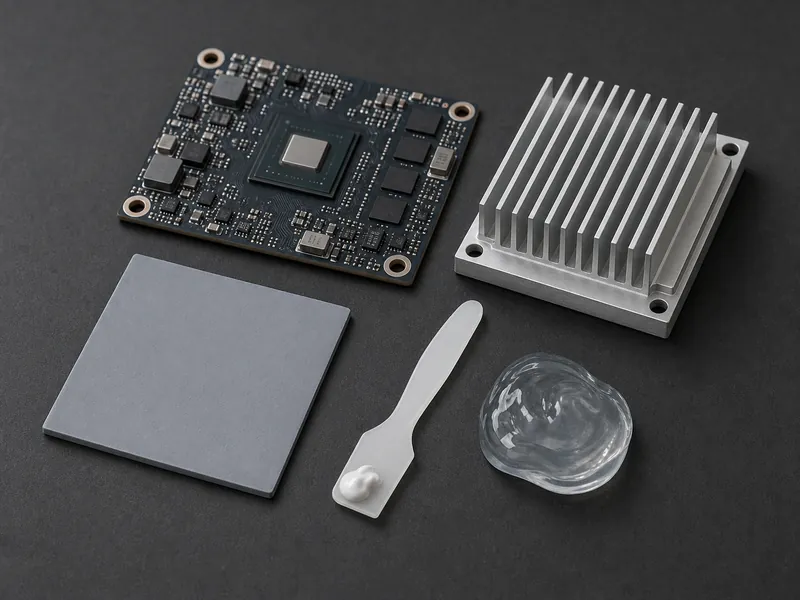
No single material is the “best” heat dissipator for every board or battery pack. The right choice follows the gap you have to fill, whether the joint must stay electrically insulating, and how the assembly is built and serviced. As chips, power modules, and EV/ESS battery packs push more watts through smaller footprints, heat has to cross the interface between a heat source and its heat sink or cold plate faster than ever. This article compares four families in common use — silicone film, silicone grease, gel, and potting adhesive — the same families Trumonytechs supplies. It is not a full interface-material taxonomy, so gap fillers, phase-change materials, tapes, and solder TIMs sit outside its scope. It also does not cover active liquid-cooling loop design or any specific model’s datasheet numbers.
Why Thermal Interface Materials Beat the Air Gap
A bare metal-to-metal joint runs hot because of the trapped air, not the metals themselves. Even a machined heat sink and a flat component meet only at microscopic high points, so only a fraction of the nominal contact area actually touches and the rest stays an air-filled void. Air conducts heat at only about 0.024 W/(m·K), so those voids dominate the thermal contact resistance and choke the path from junction to coolant. A thermal conductive material displaces that air and bridges the two surfaces, lowering the interface resistance the trapped air created.
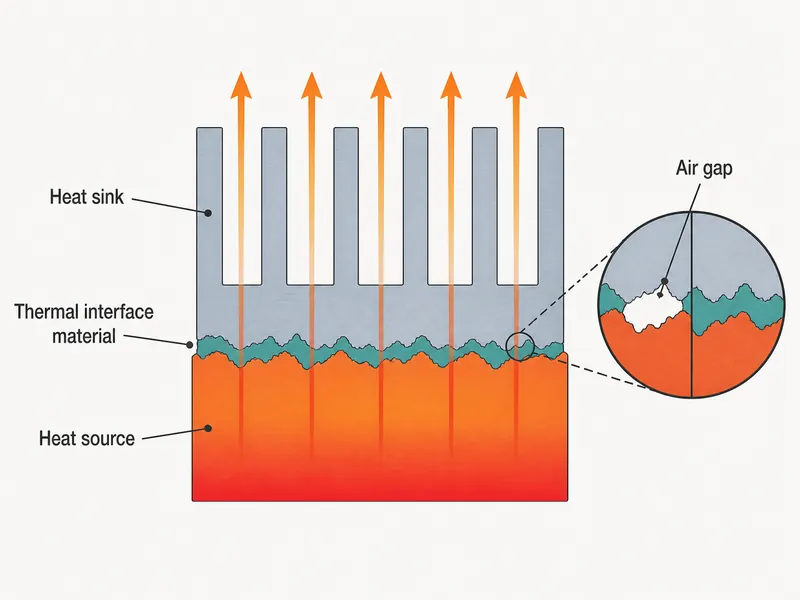
Conductivity is the headline number, but it should be read as a comparison made under a common method, not a guarantee. Vendors typically report values measured per ASTM D5470, which fixes how thermal impedance and apparent conductivity are derived. Without that shared basis, two materials with the same rating can behave differently in a real joint. What the reader controls is the total resistance across the bondline. A thin, well-wetted layer at moderate conductivity can outperform a thick, poorly seated layer of a higher-rated compound, so verify the real bondline and surface condition before trusting a spec sheet.
Four Interface Materials and Where Each Fits
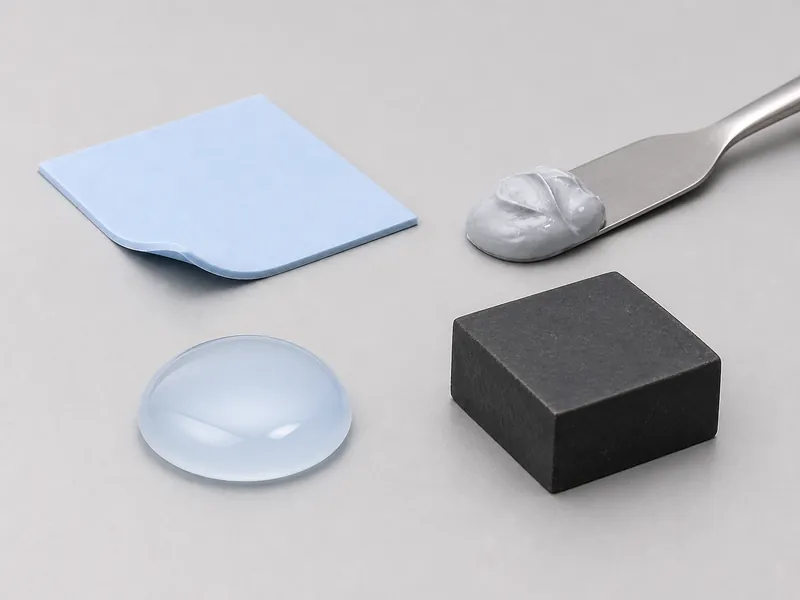
The four families compared here split by form factor, and form factor is what maps a material to a joint. Films and pads are pre-formed solids, grease is a flowable paste, gel is a soft non-flowing semi-solid, and potting adhesive cures into a rigid protective mass. These four are the families this article covers, not the full range of interface materials on the market. The table is a first filter; the section after it turns these into a selection order.
| Material | Form | Typical fit | Watch-out |
|---|---|---|---|
| Silicone film / pad | Pre-formed sheet, cut to size | Repeatable assembly; pre-cured pads commonly cover ~0.25–5 mm gaps | Needs the right compression window |
| Silicone grease | Flowable paste, very thin bondline | Flat, high-flatness joints like CPU/GPU or power-module lids | Pump-out and dry-out over cycling |
| Thermal gel | Soft, non-flowing semi-solid | Uneven voids and stacked-tolerance gaps without hard clamping | Dispense volume; cure control for curable grades |
| Potting adhesive | Cures rigid, commonly epoxy-based | Sealing, fixing, and protecting assemblies | Little to no rework once cured |
Thermal Conductive Silicone Film
Repeatability across many units is where a pre-formed film or pad earns its place. As a category, a silicone sheet loaded with metal-oxide fillers can be cut to size and set by hand or automation, which keeps bondlines consistent from unit to unit. Pre-cured pads commonly cover roughly 0.25–5 mm gaps. A pre-formed layer only performs inside its compression window, so treat mounting pressure as a design input and confirm each specific product’s rating rather than reading it from the category. Trumonytechs supplies this form as a thermal conductive silicone film.
Thermal Conductive Silicone Grease
Grease answers the flattest, thinnest joints, where a nearly bondline-free layer can be seated. As a category, a silicone-based paste fills microscopic roughness and conducts at very low thickness, which is why it appears under CPU, GPU, and power-module lids. The known limit is time and motion. In a vibrating or vertically mounted joint, low-viscosity grease can pump out across thermal cycles and thin films can dry out, so confirm orientation and cycling duty before choosing it. Trumonytechs supplies this as a thermal conductive silicone grease, and the difference between grease and paste is mostly formulation and filler, not a separate class of material.
Thermal Conductive Gel
Uneven gaps that cannot be clamped hard are the case a gel handles well. As a category, gel behaves like a non-flowing paste with higher viscosity than grease, so it fills irregular voids and holds components with low assembly stress. Process control is the trade to verify per product: dispense volume, rheology, and, for curable grades, cure behavior all have to be dialed in so the joint is repeatable. Trumonytechs supplies a thermal conductive gel in this family.
Thermal Conductive Potting Adhesive
Structural and environmental protection, not heat transfer alone, is what pushes a design toward potting. As a category, a potting compound, commonly an epoxy filled with heat-conductive powder, cures into a rigid mass that seals, fixes, and mechanically protects components while moving heat out. The deliberate trade is reworkability: once cured, the assembly is effectively permanent. Treat potting as a decision to protect rather than to service, matched to the shock, moisture, or vibration the unit will see. Trumonytechs supplies a thermal conductive potting adhesive in this family.
Matching a Thermal Material to Gap, Insulation, and Assembly
Start the selection from the gap, not the conductivity number. Measure the interface: a thin, flat joint points to grease or a thin film, a measurable and repeatable gap points to a pad, and an uneven or tolerance-driven gap points to a gel or dispensed filler. Commercial greases and gap fillers commonly fall in roughly the low-single-digit to low-teens W/(m·K) band, so treat conductivity as one screen among several. A layer that cannot seat to the real bondline will not deliver its rated value. Lock the mechanical fit first, then compare conductivities only within the shortlist that fits.
Decide the insulation requirement next, because it can override everything else. When a cell or a live component must stay electrically isolated from a metal cold plate or chassis, the layer has to provide dielectric strength as well as heat transfer. That means whether a given pad conducts electricity is a property to specify and verify, not assume. Filler chemistry can make an otherwise insulating material electrically conductive, so check each candidate material or model against its dielectric strength, withstand voltage, and test conditions before shortlisting on conductivity.
Finish with assembly, service, and duty cycle. Automated lines favor die-cut pads or dispensable gels for repeatability, hand assembly can tolerate grease, and anything that must survive vibration, vertical mounting, or long thermal cycling should be screened for pump-out, dry-out, and delamination. If the part also needs sealing or mechanical anchoring, potting trades reworkability for protection.

Conclusion
The best material for dissipating heat in electronics is the one that matches your gap, insulation need, and assembly method, not the one with the highest headline conductivity. Define the interface first, rule out anything that cannot meet the mechanical fit or dielectric requirement, and only then compare conductivity and long-term reliability within that shortlist. In EV and ESS packs, that discipline matters most where vibration and thermal cycling attack the joint over years of service. Trumonytechs supplies silicone films, greases, gels, and potting adhesives across that decision and can help match a material to the specific gap and duty in your cell-to-coolant path.
FAQ
What is a thermal interface material, and why not just bolt the parts together?
A thermal interface material fills the microscopic air gaps that remain even when two surfaces are clamped tightly. Because trapped air is a strong insulator at about 0.024 W/(m·K), those gaps dominate contact resistance; the material displaces the air so heat can move from the source into the heat sink or cold plate.
How is thermal grease different from thermal gel?
Grease is a flowable paste for very thin, flat joints, while gel is a softer, non-flowing semi-solid for uneven gaps. Grease conducts well at minimal bondline but can pump out under vibration; gel tolerates irregular surfaces and holds parts in place without hard clamping, at the cost of dispense volume and, for curable grades, cure control.
When should I choose a potting adhesive over a pad or gel?
Choose potting adhesive when the assembly needs sealing, fixing, and mechanical protection alongside heat transfer. It cures into a rigid, protective mass suited to power supplies, batteries, transformers, and inductors, but it gives up reworkability, so it is a protect-not-service decision.
Which material resists pump-out in a vibrating pack?
A pre-formed or cured material such as a pad or a cured gel resists pump-out better than low-viscosity grease. In vertically mounted or vibrating assemblies, grease can migrate out of the joint over thermal cycles, so screen the interface for orientation and cycling duty before selecting it.
Further Reading
- Recent Advances in Thermal Interface Materials for Thermal Management of High-Power Electronics (Nanomaterials, 2022) — Peer-reviewed review. Supports the air-gap mechanism and the conductivity ranges behind interface-material selection.
- Recent Advances in Design and Preparation of Polymer-Based Thermal Management Material (Polymers, 2021) — Peer-reviewed review. Background on how filler choice and polymer matrix set the conductivity and insulation behavior of these materials.
Related Articles
- Enhancing Pcb Performance With Trumonytechs’s Advanced Thermal Pads — How thermal pads keep printed circuit boards within safe temperatures.
- What is Phase Change Material? — Explains a thermal interface family this article lists as out of scope.
- What is Thermal Grease? — A closer look at how thermal grease fills the micro-gaps between a processor and its heat sink.