
The engine cooling system is the core of vehicle thermal management, ensuring the engine operates at optimal temperatures and preventing damage from overheating. In both traditional internal combustion engines (ICE) and electric vehicles (EV), cooling technology has evolved from simple air cooling to advanced liquid cooling systems. As a manufacturer of EV liquid cooling plates, Trumonytechs recommends that effective cooling can improve efficiency, extend lifespan, and reduce pollutant emissions. This article will detail the cooling principles, components, type comparisons, common issues, and innovative EV solutions, providing practical maintenance advice to help readers better understand and maintain their vehicles.
Key Role of Cooling Systems in Vehicle Engines
As experts in liquid cooling solutions for electric vehicles, Trumonytechs understands that engine cooling is a core aspect of vehicle maintenance. We focus on manufacturing liquid cooling plates for electric vehicle systems and recognize the importance of effective engine cooling. When the engine starts cold, its components are more prone to wear, emit more pollutants, and reduce efficiency. The primary function of the cooling system is to ensure the engine maintains an ideal temperature range, typically 90-105°C, to optimize performance. According to reports, proper thermal management can reduce pollutant emissions by up to 20% and improve fuel efficiency by 5-10%. In one of our EV projects, by optimizing the cooling plate design, we helped clients control battery temperature fluctuations within ±2°C, avoiding potential thermal runaway risks.
Why Engines Need Cooling
The engine generates a significant amount of heat during operation, and if this heat is not managed effectively, it can lead to severe damage. The role of the cooling system is to regulate the engine temperature, prevent overheating, and ensure the engine runs at optimal performance. Effective cooling is not only crucial for extending engine lifespan but also for avoiding expensive repair costs.
According to industry statistics, overheating is one of the main causes of about 25% of engine failures. For example, in high-temperature environments, if the engine is not cooled, it may reach destructive temperatures within minutes, causing metal parts to expand, increase friction, and even trigger catastrophic failures. Trumonytechs’ research shows that in electric vehicles (EV), improper battery thermal management can reduce battery lifespan by up to 20%.
-
Temperature Regulation: The cooling system helps the engine maintain a stable operating temperature, avoiding damage to key components due to overheating.
-
Preventing Catastrophic Failures: By controlling engine temperature, the cooling system prevents the engine from reaching critical temperatures (such as exceeding 120°C), thus avoiding permanent damage.
Whether in traditional internal combustion engines or electric vehicles, the cooling system is the core safeguard for ensuring safe and efficient operation of the engine and battery.
Consequences of Inadequate Cooling
If the cooling system is insufficient or fails, the engine may face a series of serious consequences due to overheating. These consequences not only affect the engine’s performance but can also lead to irreversible damage or even complete scrapping.
-
Cylinder Head Gasket and Block Damage: Overheating can cause the head gasket to rupture, failing to seal the cylinders effectively, leading to gas leaks or coolant seeping into the combustion chamber. If the problem worsens, the engine block may crack due to thermal expansion and contraction, resulting in complete engine failure.
-
Piston Seizure: When heat cannot be dissipated in time, the pistons may expand due to high temperatures and “weld” to the cylinder walls, preventing movement. This situation directly causes the engine to stop running and requires expensive repairs or replacements.
-
Metal Component Expansion and Increased Friction: Excessively high temperatures cause metal parts to expand beyond design tolerances, leading to increased friction and wear, and potentially causing parts to seize or break.
-
Oil Performance Degradation: Overheating causes the oil to break down, losing its lubricating properties, thereby accelerating internal engine wear and damage. This creates a vicious cycle that further deteriorates the engine’s operating condition.
-
Chain Reactions from Cooling System Issues: Cooling system leaks and corrosion are common causes of overheating, accounting for 30% of repair cases. Once coolant is insufficient or flow is obstructed, heat cannot be dissipated effectively, and the problem escalates rapidly.
Inadequate cooling not only leads to reduced engine performance but can also cause catastrophic failures such as engine block cracking or piston seizure. Regularly checking the cooling system’s status and promptly repairing leaks and corrosion issues are key to avoiding these consequences. Effective cooling system maintenance not only extends engine lifespan but also avoids high repair costs.
Working Principle of Engine Cooling Systems
The engine cooling system is key to maintaining optimal engine temperatures, preventing overheating, and extending engine lifespan. By circulating coolant to absorb and dissipate heat, the system achieves efficient thermal management. Modern cooling systems can achieve heat transfer efficiencies of up to 85%, and in Trumonytechs’ EV cooling projects, we have found that precise temperature control can reduce energy consumption by 10%, especially in high-load scenarios.
Heat Transfer Process
The core mechanism of the cooling system is to capture and dissipate heat through the circulation of coolant, preventing excessive engine temperatures. Here are the specific steps:
- Heat Absorption: The coolant (usually a mixture of water and antifreeze) is pumped into the engine’s block and head passages, absorbing heat generated from combustion and friction.
- Heat Transfer: The heated coolant flows through a temperature-sensitive thermostat. When the engine reaches operating temperature, the thermostat opens, allowing the coolant to enter the radiator (heat exchanger). In the radiator, heat is dissipated through thin tubes and fins into the air.
- Airflow Assistance: During high-speed vehicle travel, natural airflow provides sufficient circulation; at low speeds or when stationary, the cooling fan activates to enhance airflow through the radiator.
- Circulation Loop: The cooled liquid returns to the engine to restart the cycle. The system also includes pressure control elements to enhance the coolant’s heat resistance and an expansion tank to handle volume changes due to temperature fluctuations.
In Trumonytechs’ EV cooling systems, we have designed similar closed loops for battery thermal management. By evenly distributing heat, local hotspots are avoided, significantly improving battery lifespan.
Temperature Regulation Mechanisms
The cooling system works through multiple mechanisms to ensure the engine operates within the optimal temperature range:
- Thermostat: As the primary regulator, the thermostat opens and closes based on coolant temperature, ensuring the engine warms up quickly and maintains stable temperatures.
- Cooling Fan: During idle or low-speed operation, the fan activates to provide additional airflow through the radiator, enhancing heat dissipation.
- Pressure Cap: System pressure is maintained by the pressure cap, and the high-pressure environment raises the coolant’s boiling point, improving cooling efficiency.
- Expansion Tank: Handles volume changes in the coolant due to heating and cooling, preventing leaks and maintaining system balance.
In Trumonytechs’ EV cooling systems, these principles are further optimized to meet the unique needs of batteries. The ideal battery temperature range is 20-40°C, with a focus on low temperatures and uniformity to prevent degradation. According to statistics, EV cooling systems emphasize more precise temperature control and heat distribution compared to traditional internal combustion engines (ICE).

Main Components of Engine Cooling Systems
Understanding the main components of the engine cooling system helps in fully grasping the principles of vehicle thermal management. These components work together to ensure the engine operates within the optimal temperature range, improving efficiency and extending service life. Below are the key components of the cooling system and their functions:
Radiator
The radiator is a key component of the engine cooling system, responsible for dissipating heat from the coolant to the atmosphere. It is typically located at the front of the vehicle, designed to maximize airflow through fins and tubes. High-quality radiators can handle heat loads up to 200kW.
Water Pump
The water pump is another essential component, responsible for circulating coolant through the engine and radiator. It is usually driven by the engine’s serpentine belt or an electric motor, ensuring continuous coolant flow.
Thermostat
The thermostat plays a key role in regulating the engine’s operating temperature. It acts as a valve, controlling the flow of coolant into the engine based on temperature, ensuring the engine quickly reaches optimal operating temperature.
Supporting Components (Hoses, Fans, Reservoir)
In addition to core parts, the cooling system relies on multiple supporting components to ensure efficient operation:
-
Coolant Hoses: Flexible connections between the engine, radiator, and other parts, ensuring smooth coolant transmission.
-
Cooling Fan: Enhances airflow through the radiator at low speeds or when stationary to accelerate the cooling process.
-
Coolant Reservoir: Handles volume changes due to thermal expansion and contraction of the coolant, while maintaining system pressure balance.
-
Heater Core: A small heat exchanger that uses engine waste heat to provide warmth inside the vehicle.
| Component | Function | Importance |
|---|---|---|
| Radiator | Dissipates heat from coolant | High |
| Water Pump | Circulates coolant | High |
| Thermostat | Regulates engine temperature | High |
| Hoses | Transports coolant | Medium |
| Cooling Fan | Enhances airflow | Medium |
| Coolant Reservoir | Accommodates volume changes | Medium |
| Heater Core | Uses waste heat to heat interior | Medium |
Comparison of Air-Cooled and Liquid-Cooled Engine Systems
In the field of engine cooling, air cooling and liquid cooling are two main technologies, each with its own advantages and disadvantages. The choice depends on engine power, design complexity, and operational requirements. Air cooling systems dissipate heat through air circulation, with a simple structure and lower cost, without the need for radiators, coolant, or pump systems. They are commonly used in small vehicles or situations where simplicity is prioritized. However, their efficiency is lower in high-temperature and high-load conditions, limiting engine power output.
In contrast, liquid cooling systems absorb engine heat through coolant and transfer it to the radiator for dissipation, offering more efficient heat transfer capabilities. Water is commonly used as the cooling medium due to its high heat capacity, capable of controlling temperature fluctuations within 5°C, providing precise temperature management. Additionally, liquid cooling allows for more compact engine designs, with cooling passages integrated into the engine block, saving space and improving operational efficiency. According to EPA data, liquid cooling can extend component lifespan by 15%. Specialized coolants further enhance system performance, with antifreeze, anti-corrosion, and improved heat transfer properties.
Liquid cooling has become the mainstream technology in modern automobiles, especially as engine power increases and emission regulations become stricter.
Continue reading:Types of Battery Cooling Systems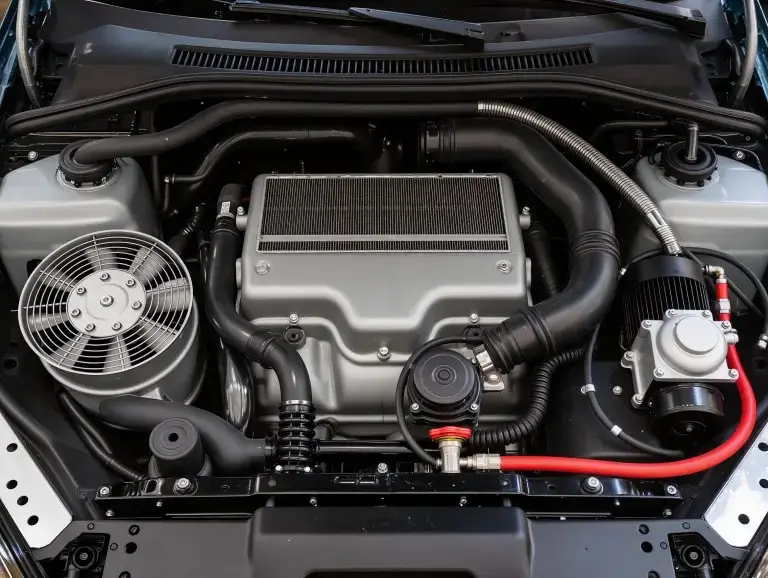
Conclusion
At Trumonytechs, our in-depth research on engine cooling systems highlights the importance of thermal management in modern vehicles. Whether for traditional internal combustion engines or electric vehicles, effective cooling systems are key to improving performance, efficiency, and extending lifespan. We have witnessed the evolution of cooling technology from simple air cooling to advanced liquid cooling solutions, and through our EV cooling plate technology, we have successfully addressed the unique thermal management challenges of electric vehicles. As the electric vehicle market grows rapidly, cooling technology will continue to play a key role in driving industry innovation. Want to learn more about our innovative EV cooling solutions? Feel free to contact us!
FAQ
What is the main function of the radiator in a vehicle’s cooling system?
The radiator acts as the primary heat exchanger, dissipating heat from the hot coolant to the surrounding air, thereby regulating the temperature of the vehicle’s internal combustion engine. According to reliable sources, it can handle most of the engine’s waste heat.
How does the water pump contribute to the cooling process?
The water pump circulates coolant through the engine block, cylinder head, and radiator, ensuring continuous flow to absorb and dissipate heat, maintaining the engine’s operating temperature. In EVs, electric water pumps provide more flexible control.
What role does the thermostat play in temperature regulation?
The thermostat regulates engine temperature by controlling the flow of coolant into the radiator, allowing the engine to reach its optimal operating temperature and preventing overheating. It is key to system efficiency.
What is the difference between air-cooled and liquid-cooled engine systems?
Air cooling uses airflow to dissipate heat directly from the engine, while liquid cooling utilizes coolant to absorb heat and transfer it to the radiator, providing more efficient temperature regulation.
Can a faulty cooling system cause damage to a vehicle’s engine?
Yes, inadequate cooling can lead to overheating, damaging the engine block, cylinder head, and other key components, resulting in expensive repairs or engine failure.
How often should I check my coolant level?
It is recommended to check the coolant level regularly, ideally during routine maintenance, to ensure it is at the recommended level and top it off as needed to prevent overheating.