
In today’s world, controlling heat is key for miniaturized, high-performance electronics. At Trumonytechs, we lead in battery pack thermal management solutions. We know how vital it is to keep devices at the right temperature for reliability and longevity.
Thermal management is about controlling heat from electronic components. It uses various methods to dissipate excess heat. This prevents overheating and keeps devices running smoothly.
As devices shrink and grow more powerful, cooling and heat management become more critical. At Trumonytechs, we’ve developed specialized solutions for thermal management.
Understanding the Basics of Electronics Thermal Management
Managing heat effectively is crucial as electronic devices grow more complex. At Trumonytechs, we grasp the importance of thermal management in electronics. The second law of thermodynamics shows that energy usage leads to waste heat.
Modern processors have millions of transistors, leading to more heat. Electronic circuits also have resistors that control current flow. These resistors convert energy into heat, adding to the device’s thermal energy.
The physics of heat generation in electronics is simple. Electrical energy turns into heat due to resistance. This is especially true for processors with millions of transistors.
| Component | Heat Generation Mechanism | Impact on Device |
| Transistors | Switching and amplification | Increased heat with more transistors |
| Resistors | Resistance to current flow | Conversion of energy into heat |
| Processors | High-density transistor integration | Significant heat generation |
Effective thermal management is key for device performance, reliability, and lifespan. Without it, devices can suffer from thermal throttling, reduced efficiency, and component degradation. At Trumonytechs, we consider thermal management a critical design aspect.
Even small temperature drops can greatly extend component life. Proper thermal management keeps devices at peak performance, even under heavy loads.
- Enhances device reliability and lifespan
- Prevents thermal throttling and system failure
- Maintains peak device performance
- Reduces the risk of component degradation

The Fundamentals of Heat Transfer in Electronics
Heat transfer mechanisms significantly affect electronic device performance and longevity. Effective thermal management is essential for maintaining device reliability and efficiency.
Conduction: How Heat Moves Through Solid Materials
Conduction is the method through which heat is transferred by direct contact between materials. The rate of heat transfer varies based on the material’s thermal conductivity. Metals, for instance, are highly effective due to their high thermal conductivity. At Trumonytechs, we employ materials with high thermal conductivity for applications like heat sinks and thermal interface materials.
| Material | Thermal Conductivity (W/m-K) |
| Copper | 386 |
| Aluminum | 237 |
| Silicon | 150 |
Convection: Transferring Heat Through Fluid Movement
Convection involves the transfer of heat through fluid movement, such as air or liquids. This process can be natural, relying on density differences, or forced, using fans or pumps to enhance fluid movement. Effective convection is crucial for cooling electronic components.
Radiation: Heat Transfer Through Electromagnetic Waves
Radiation is the transfer of heat through electromagnetic waves, particularly in the infrared spectrum. It does not require a medium but is less significant in electronics cooling compared to conduction and convection. Nonetheless, it is crucial in certain applications.
At Trumonytechs, we utilize our knowledge of these heat transfer principles to design effective thermal management solutions. We optimize all three mechanisms to enhance device performance and longevity.
Common Challenges in Thermal Management of Electronics
As electronic devices become more compact and powerful, thermal management challenges intensify. At Trumonytechs, we encounter and resolve complex thermal management challenges in modern electronic systems daily. One major challenge in aerospace or automotive electronics is dissipating heat from the increasing heat densities they generate.
Increasing Power Densities in Smaller Devices
The trend towards miniaturization in electronics has led to increased power densities within smaller devices. This concentration of heat in a limited space poses significant challenges for thermal management. Without effective cooling solutions, the excess heat can cause temperature spikes, leading to performance degradation and reduced device lifespan.
Managing Different Temperature Thresholds Within Systems
Different components within a system have distinct temperature limits for optimal performance and longevity. Managing these varying temperature thresholds is a complex task, requiring sophisticated thermal management techniques. These techniques ensure that each component operates within its ideal temperature range.
Space Constraints and Design Limitations
Compact devices such as smartphones, wearables, and automotive electronics face significant design limitations due to space constraints. These limitations make it challenging to implement effective cooling solutions. Often, this results in thermal bottlenecks that can lead to hotspots and reduced device performance.
The challenges in thermal management are multifaceted, requiring innovative design strategies and advanced materials. At Trumonytechs, we approach these challenges by balancing thermal performance with size, weight, and cost considerations. Our expertise in battery pack thermal management systems, where power density and safety are critical, has provided valuable insights into overcoming these challenges.
| Challenge | Description | Impact |
| Increasing Power Densities | Concentration of heat in smaller devices | Performance degradation, reduced lifespan |
| Different Temperature Thresholds | Varying optimal temperatures for components | Complex thermal management, component failure |
| Space Constraints | Limited space for cooling solutions | Thermal bottlenecks, hotspots |
Essential Thermal Management Solutions for Electronics
Modern electronic devices generate a lot of heat. Advanced thermal management solutions are crucial to handle this heat. They ensure the reliability, performance, and longevity of electronic systems.
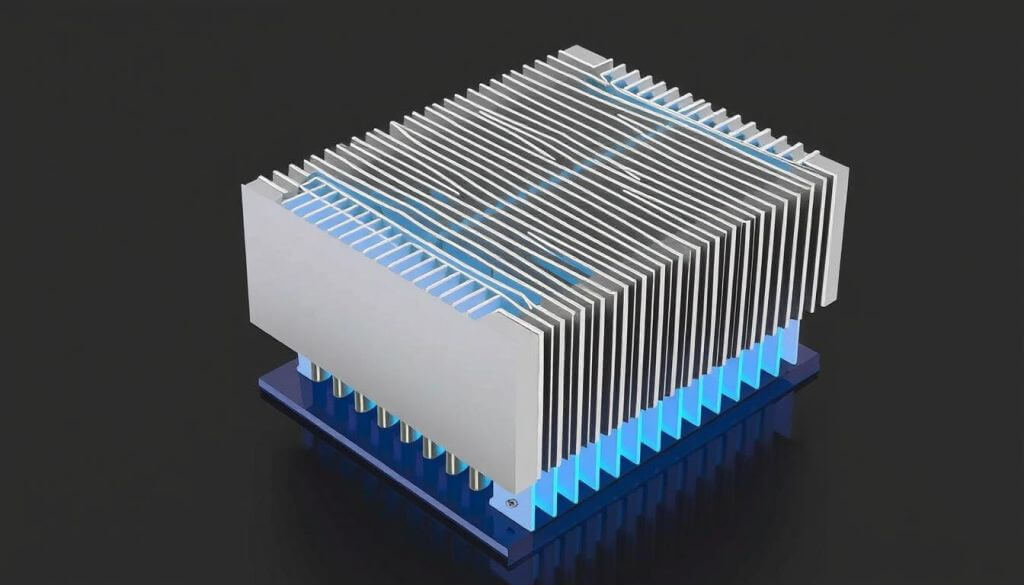
Heat Sinks: Heat sinks are key in managing heat. They absorb and dissipate excess heat from electronic components. The design focuses on materials with high thermal conductivity and surface area optimization for better heat dissipation.
Thermal Interface Materials (TIMs): Thermal interface materials (TIMs) are essential for improving heat transfer. They fill air gaps and enhance thermal conductivity. This significantly boosts the efficiency of thermal management solutions.
Air Cooling Systems: Air cooling systems, including fans and natural convection, are versatile for managing heat. The choice depends on heat load, space, and noise requirements.
Liquid Cooling Solutions: Liquid cooling solutions offer superior heat conductivity, ideal for high-heat applications. At Trumonytechs, we specialize in advanced liquid cooling plates for demanding environments.
Understanding thermal management solutions and selecting the right cooling techniques enhances electronic system efficiency and reliability. At Trumonytechs, we offer comprehensive solutions, focusing on interface materials and liquid cooling plates.
Battery Pack Thermal Management: Our Specialty
At Trumonytechs, we focus on battery pack thermal management, a key area in modern electronics. It requires precise temperature control for optimal performance and safety. Our expertise ensures the reliability and efficiency of battery systems through effective thermal management.
Challenges in Battery Thermal Management
Battery thermal management faces unique challenges, like maintaining uniform temperatures and preventing thermal runaway. Temperature affects battery performance, efficiency, charging rates, cycle life, and safety. Different battery types, from cylindrical to pouch cells, need specific thermal management solutions.
- Maintaining uniform temperatures across cells to enhance performance and longevity
- Preventing thermal runaway conditions that can lead to safety issues
- Addressing the specific thermal management needs of different battery chemistries and form factors
Optimizing Battery Performance and Safety
Our innovative solutions include advanced interface materials and liquid cooling plates for battery applications. These enhance battery performance and safety through precise temperature control. We consider the entire thermal system, from cell to pack level, for comprehensive management.
- Advanced interface materials for enhanced heat transfer
- Liquid cooling plates for efficient heat dissipation
- Comprehensive thermal management solutions from cell-level to pack-level design
By focusing on battery pack thermal management, we improve battery performance, efficiency, and safety. This benefits applications like electric vehicles, energy storage systems, and portable electronics.
Industry Applications of Thermal Management Technologies
Thermal management technologies are crucial in various industries for device reliability and performance. At Trumonytechs, we serve diverse industries with our thermal management expertise, focusing on automotive applications.
Automotive Electronics and EV Battery Systems
In the automotive sector, thermal management is vital for electronic devices’ performance, safety, and longevity, especially in EV battery systems. Our solutions optimize range, charging speeds, and battery life. Effective heat management in EVs is critical to prevent overheating, which can reduce battery lifespan or pose safety risks.
Consumer Electronics and Computing Devices
Thermal management is essential in consumer electronics and computing devices, where user comfort, noise constraints, and aesthetics add complexity. For instance, GPUs and CPUs require efficient cooling for gaming or data analytics. Our thermal solutions ensure devices operate safely within temperature ranges, maintaining user comfort.
Industrial Equipment and Power Electronics
In industrial equipment and power electronics, reliability under continuous operation and harsh environments is critical. Thermal management prevents overheating, which can cause equipment failure or reduced lifespan. Our solutions are tailored for industrial applications, ensuring efficient and safe operation.
At Trumonytechs, we tailor our thermal management approaches to meet each industry’s specific needs. This helps manufacturers optimize their products’ performance, safety, and longevity. Our expertise in thermal management has been applied across various sectors, showcasing our versatility and innovation.
Lessons learned in one industry inform innovative approaches in others, highlighting the cross-pollination of thermal management technologies. As electronic devices evolve, the demand for effective thermal management solutions will grow, driving further innovation.
Advanced Thermal Management Techniques and Innovations
At Trumonytechs, we’re advancing thermal management with cutting-edge techniques and innovations. Our approach leverages the latest in simulation and modeling, material science, and smart technologies. This creates more efficient and reliable electronic systems.
Simulation and Modeling in Thermal Design
Simulation and modeling are key in thermal design, allowing engineers to optimize cooling solutions before prototyping. We use computational fluid dynamics (CFD) and other tools to predict heat transfer and fluid flow. This reduces development time and improves performance.
Material Innovations for Enhanced Heat Transfer
Material innovations are crucial for better heat transfer in electronic devices. Advanced composites, phase change materials, and nanomaterials with superior thermal properties are being explored. These advancements help in developing more efficient thermal management solutions. They enable better heat dissipation, enhancing the reliability and lifespan of electronic components.
Smart Thermal Management Systems
Smart thermal management systems dynamically adjust to changing thermal loads. They use sensors, controls, and variable cooling to optimize performance. These systems are vital in applications with varying thermal loads, such as automotive and industrial electronics.
Trumonytechs is dedicated to delivering superior performance and reliability through advanced thermal management techniques and innovations. Our R&D efforts focus on developing cutting-edge solutions that meet the evolving needs of the electronics industry.
Selecting the Right Thermal Management Solution for Your Application
At Trumonytechs, we understand the importance of selecting the right thermal management solution for specific applications. Our expertise guides clients through the process of identifying the optimal thermal management strategy for their unique needs.
Key Factors to Consider in Your Thermal Design
When designing a thermal management system, several key factors must be considered to ensure effective heat dissipation. These include:
- Heat load calculations to determine the amount of heat that needs to be dissipated
- Space constraints and the available volume for thermal management components
- Environmental conditions such as ambient temperature and humidity
- Noise requirements and limitations on fan usage or other noise-generating components
- Budget limitations and the need for cost-effective solutions
By carefully evaluating these factors, designers can develop a thermal management plan that balances performance, cost, and reliability.
Working with Thermal Management Experts
Collaborating with thermal management experts like Trumonytechs can significantly enhance the effectiveness of your thermal design. Our team brings specialized knowledge and experience to complex cooling challenges. This ensures that our clients receive tailored solutions that meet their specific needs.
We work closely with our clients throughout the design process, from initial thermal assessment through solution design, testing, and implementation. This collaborative approach enables us to identify the most effective thermal management strategies and implement them efficiently.
Conclusion
Thermal management is crucial for the continued advancement of electronic devices. As devices shrink in size while increasing in performance, effective heat management becomes a significant challenge. Emerging trends in thermal management include new materials, advanced cooling techniques, and integrated design approaches. At Trumonytechs, we’re committed to advancing the future of electronics thermal management through continuous innovation and expertise, particularly in battery thermal management.
Our focus is on developing innovative thermal management solutions that enable our clients to push the boundaries of what’s possible in their electronic designs. With a growing emphasis on energy-efficient cooling solutions, we’re positioned at the forefront of these developments. Partner with Trumonytechs for your thermal management needs and experience our customer-focused approach.
FAQ
What are the most common causes of overheating in electronic devices?
Overheating in electronic devices is often caused by high power densities, inadequate heat sinks, poor airflow, and inefficient thermal interface materials.
How does heat sink design impact the overall cooling efficiency of a system?
A well-designed heat sink can significantly enhance cooling efficiency by increasing the surface area in contact with the coolant, whether it’s air or a liquid, thus facilitating better heat dissipation.
What role do thermal interface materials play in enhancing heat transfer?
Thermal interface materials (TIMs) fill the microscopic gaps between two surfaces, ensuring better contact and thus more efficient heat transfer between components like CPUs and heat sinks.
Can liquid cooling solutions be used for all types of electronic devices?
While liquid cooling is highly effective for many applications, its suitability depends on the specific requirements of the device, including its power consumption, size constraints, and operating environment.
How do engineers determine the most appropriate thermal management solution for a given application?
Engineers consider factors such as the device’s power density, operating temperature range, available space for cooling components, and the desired lifespan of the device when selecting a thermal management solution.
What advancements are being made in thermal management technologies?
New tools for simulation and modeling are emerging. These tools help in understanding thermal dynamics better. Additionally, materials with superior thermal properties are being developed. There’s also a focus on smart thermal management systems. These systems can adjust to changing conditions, enhancing performance.
Why is thermal management crucial for battery performance and safety?
Thermal management is key to keeping batteries safe and efficient. It ensures they operate within a safe temperature range. This is vital for their performance, longevity, and safety.
How can poor thermal management affect the lifespan of electronic components?
Running electronic components at high temperatures speeds up degradation. This can significantly shorten their lifespan. It may even lead to catastrophic failures.