
Thermal Interface Materials: Five Families, 21 Datasheet Models
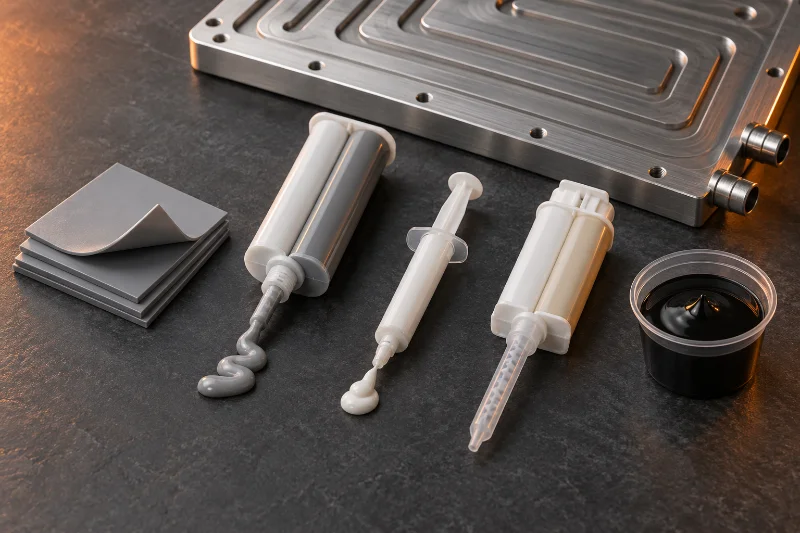
Trumonytechs supplies thermal interface materials in five families: pads, two-component gels, potting compounds, structural adhesives and silicone grease, across 21 datasheet models. EV and energy storage (ESS) battery packs are the main applications, and the same materials are supplied for other applications as well. Which family fits depends on the gap across the joint, whether the joint carries load, and whether it must insulate.
Send the gap thickness between the heat source and the cold plate or heat sink with your expected volume, and we will propose a model to discuss.
What a Thermal Interface Material Does, and When a Simpler Joint Is Enough
A TIM sits between a heat source and the cold plate, heat sink or housing, where it carries heat across the joint; in a battery pack, that is between the cells or modules and the cold plate. Depending on the family, the same layer also insulates, fills open space or bonds the parts in place.
datasheet models across six series, with test methods listed for measured properties
- 01The photovoltaic laminating pad is not a heat path.
The high-strength silicone pad in the 30101 range made for photovoltaic panel lamination has poor thermal conductivity and cannot be used as a thermal interface material.
- 02Some grease models do not insulate.
Only 30108-0350 is listed as insulating; 30108-0380 and 30108-0500 are not, so those two are ruled out wherever the joint must isolate.
- 03Heat-only joints can skip the seven-day cure.
Both structural adhesive series, 30104 and 30107, list a seven-day cure, so where a joint only moves heat and needs no bond or seal, a pad or gel avoids that wait.
We also make the piastre di raffreddamento a liquido on the other side of this joint. Because the TIM fills whatever gap the plate leaves, the gap figure sent with an inquiry should reflect the current plate design. Pack-level cooling choices sit on the gestione termica del pacco batterie pagina.
Compare Thermal Interface Materials by Family
Thermal interface materials split into five families by form and cure: pre-formed pads, dispensed gels, poured potting compounds, structural adhesives and non-curing grease. Because each family is applied differently, the assembly method on your line can rule some families out regardless of their conductivity.


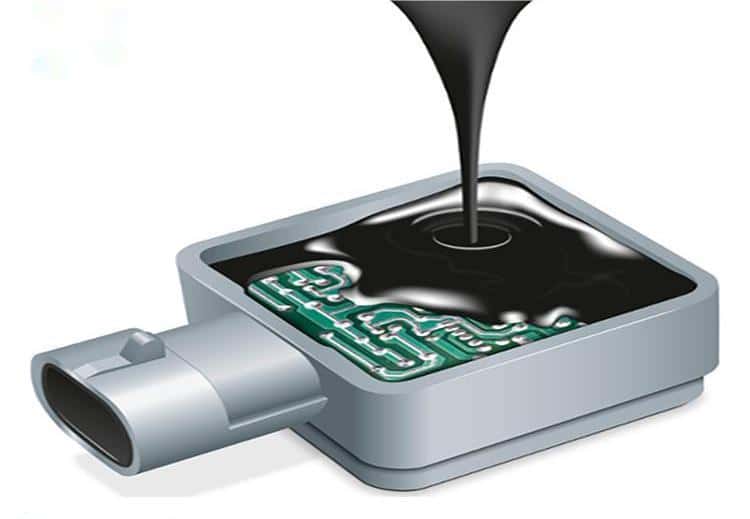
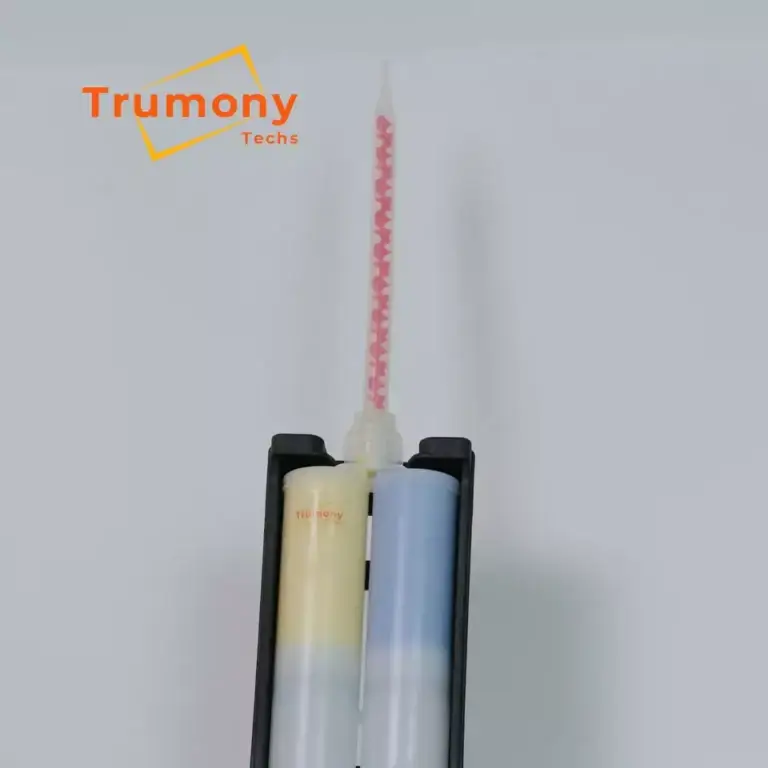

The two structural adhesives are measured by different methods, so their conductivity figures should be compared with that difference in mind. Hardness also runs on different scales: pads span Shore 00 5–80 by model, cured gels read Shore 00 60, potting compounds read Shore A 20–50, and the adhesives read on Shore D.
Match the TIM Family to Your Cell-to-Cold-Plate Joint
In EV and ESS battery packs, the main applications, four joint types map onto four TIM families, depending on whether the gap is set by a sheet, dispensed, load-bearing or filled around parts. Each card follows an application scenario listed in the datasheets.
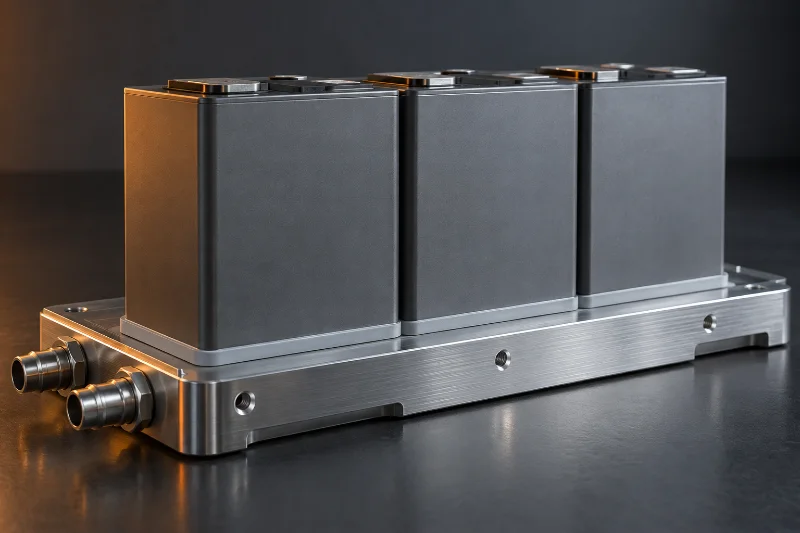
Cells on a cold plate with a set gap → pad
Pads are listed for prismatic cells, cylindrical cells and serpentine cold plates, with PI-reinforced structures for larger sheets.
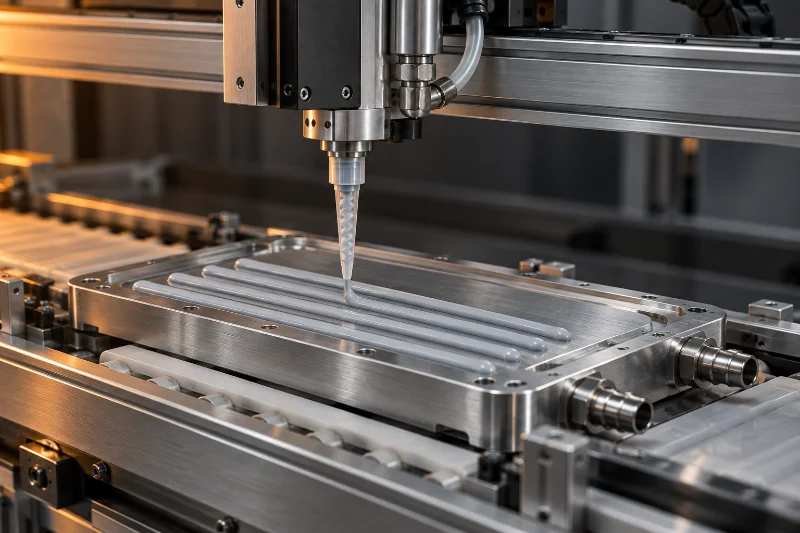
Dispensed on an automated line → gel
The two-component gel is dispensed automatically under low assembly stress and conforms closely to the interface.

Cells bonded to the cold plate → polyurethane adhesive
The polyurethane adhesive fixes cells to the cold plate once cured and is aimed at high-load, bonding and sealing joints.
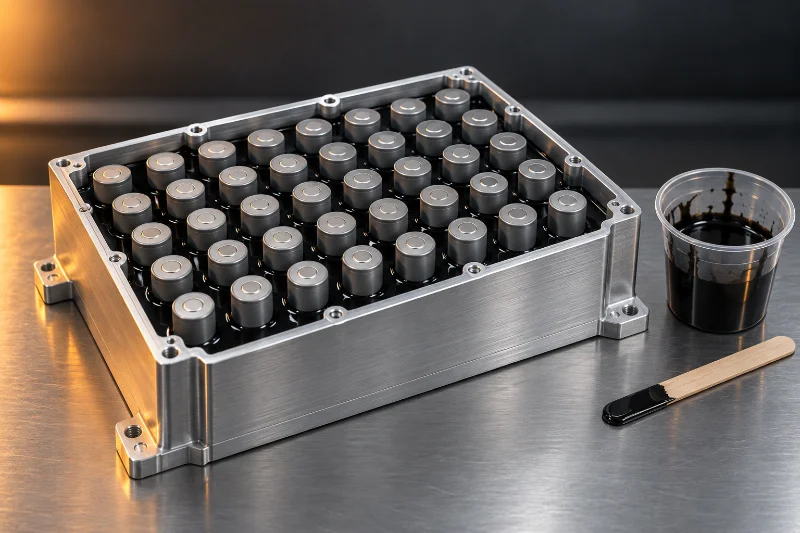
Module filled, insulated or potted → potting compound
Mixed by hand and poured, the potting compound fills, insulates and pots the module, then damps vibration once cured.
A thin interface points to grease instead, with a category-level bond line below 50 μm. Grease is non-curing, so the parts must be clamped to keep the layer in place. Where the choice is still between a pad and a dispensed material, the battery pack TIM selection guide works through gap, assembly stress and cure in that order.
Silicone, Polyurethane or Epoxy TIM: Chemistry and Insulation
TIM chemistry follows the family: pads, gels, potting compounds and grease are silicone formulations, while the structural adhesives are epoxy (30104-0120) or polyurethane (30107). Insulation and siloxane data differ by model, and the table below shows the listed range for each family.
| Family | Chimica | Dielectric strength, kV/mm | Resistività volumetrica, Ω·cm | D4–D10 siloxane content (GC) |
|---|---|---|---|---|
| Pad · 30101 | Silicone | >6 to >12 by model | >10¹¹ to >10¹² | <100 ppm, all 5 models |
| Gel · 30102 | Silicone | 8 | >10¹² | <100 ppm for 0150, 0200, 0350; not listed for others |
| Potting · 30103-0080 | Silicone | 10 | >10¹² | <100 ppm |
| Structural adhesive · 30104-0120 | Epoxy | 12 | >10¹² | Non elencato |
| Structural adhesive · 30107-0120, 30107-0200 | Polyurethane | 16 (30107-0120); 14 (30107-0200) | 1.5 × 10¹³ (both models) | Non elencato |
| Grease · 30108 | Silicone | Not listed; insulating: 0350 only | Non elencato | Non elencato |
No silicone-free pad, gel, potting compound or grease is listed in the current data. The two structural adhesives are epoxy- and polyurethane-based, and their datasheets do not state silicone or siloxane content.
Three TIM Model Choices to Settle Before Quoting
Three model choices in the TIM data are worth settling before a quote: insulation against conductivity in grease, strength within the polyurethane adhesive, and reinforcement in pads. In grease and pads a gain in one property costs another, while the two polyurethane models share one conductivity value and differ in strength.
30108-0500 lists 5.0 W/m·K, the top of the grease range, but is non-insulating, while 30108-0350 is the insulating model at 3.5 W/m·K. Where the grease layer must isolate, 0350 is the only grease model marked insulating, at 1.5 W/m·K less; its datasheet gives no breakdown value, so ask for one against your working voltage.
30107-0120 and 30107-0200 both list 2.05 W/m·K, yet 0120 lists 11 MPa Al/Al shear and 14% elongation against 8 MPa and 8% for 0200. Where the bond carries the load, the shear figures are what separate the two models.
Pads carry the third trade-off. The unreinforced pad leads the four pad structures on conductivity and compression rebound at lower cost, yet it is weak, tacks poorly and is harder to place without trapping bubbles. PI film, PI tape and glass-fiber reinforcement add body strength at higher cost, and glass fiber also gives up some conductivity. The recommended sheet size grows from 300 × 200 mm to 500 × 420 mm with PI reinforcement.
What Sets TIM Pricing and What to Send for a Quote
TIM pricing is not published on this page; quotes are set by model, volume and packaging form. Within the pad family, reinforced structures cost more than the unreinforced pad, so the structure is worth settling before a pad price is requested.
What to send with an inquiry:
- Heat load of the cells, module or component
- Gap thickness, contact area and clamping pressure
- Target temperature
- Whether the joint must bond, seal or insulate
- Operating environment
- Family or model of interest and expected annual volume
What a quote includes, payment terms, pre-shipment inspection, packaging and shipping documents are not listed here, so they are worth raising as questions in the RFQ. Freight time and import requirements depend on the destination port and are confirmed at quote stage.
Settled on a family? Send the gap thickness and heat load with it for a model-level quote.
How TIM Datasheet Values Are Measured and Which Documents to Request
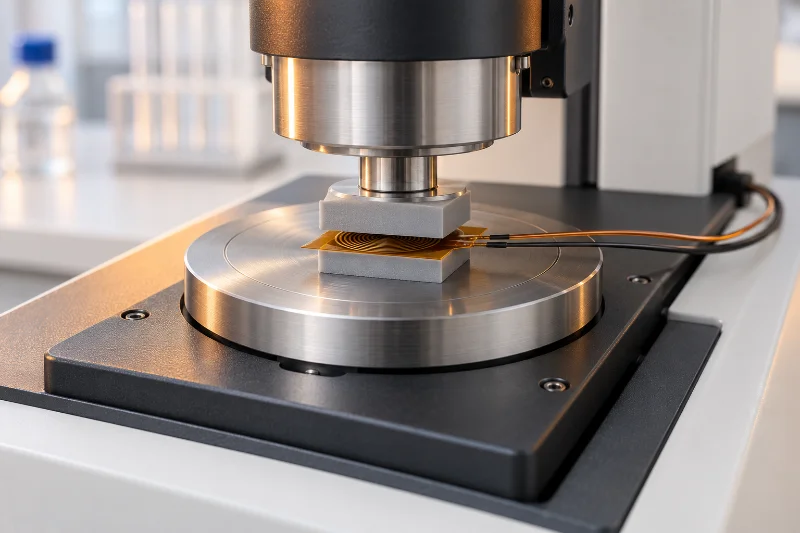
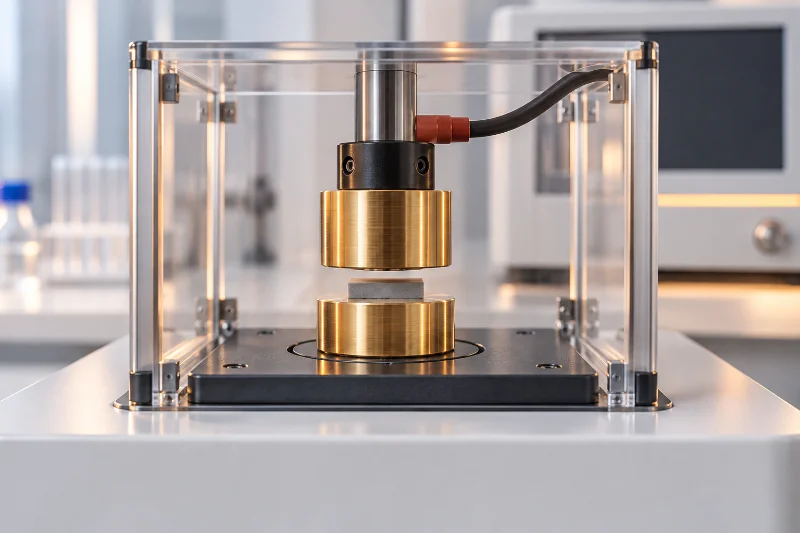
The conductivity, dielectric and flame figures on this page come from model datasheets that name their test method, so incoming material can be checked against the same standard. Acceptance limits for incoming inspection are not part of the datasheets and still have to be agreed for each model.
ISO 22007-2 for pads, gels, potting compounds, grease and 30104-0120; ASTM D5470 for 30107.
Dielectric strength to ASTM D149 and volume resistivity to ASTM D257; GB/T 1408.1 and GB/T 31838.2 for 30107.
UL 94 vertical burn test, listed as V-0 on the datasheets that report flammability.
Hardness to ASTM D2240 and density to ASTM D792, with GB/T methods for 30107; tensile strength to ASTM D412, or GB/T 528 for both structural adhesives.

No project references appear on this page, so the checkable evidence is the datasheet values and methods above. The gel, potting, grease and 30104-0120 data describe RoHS-compliant formulations; test reports, certificates and batch records are not part of this page. Warranty terms are not published on this page. Ask for them, and for any documents your market requires, with your RFQ.
Thermal Interface Materials FAQ
What do thermal interface materials do in a battery pack?
Heat transfer is common to every family here, so the second job the joint needs decides the choice. Pads and gels also insulate and damp vibration, potting compounds fill and insulate, the structural adhesives add a structural bond, and grease forms a thin non-curing layer.
Should a battery line use pads or dispensed gel?
Pads arrive as pre-formed sheets and are placed by hand, so the line needs no mixing equipment for them. The two-component gel is mixed and dispensed automatically, is surface-dry after 90 min and fully cured after 24 h at 25 °C, and its data describe cured performance as equivalent to a pad.
Which substrates can the structural adhesives bond?
The epoxy 30104-0120 is described as bonding a range of metals, PET, PC, ABS and PET film, and its datasheet lists 9 MPa aluminum-to-aluminum lap shear. The polyurethane 30107 is described for bonding cells to the cold plate; other substrates are not listed for it, so other pairings need their own bond test.
Are these materials UL certified?
No UL certification or yellow card is claimed for them. The pad, gel, 30103-0080 and structural adhesive datasheets list a UL 94 V-0 flame rating, which is a material flammability rating from the UL 94 test. The specimen thickness behind that rating is not stated and is worth requesting if your design depends on it.
What temperature range is recommended for each material?
Pads, gels and potting model 30103-0080 list a recommended range of −40 to +150 °C, and the epoxy 30104-0120 lists −10 to +120 °C. No range is listed for the polyurethane 30107 models, the grease, or potting models 30103-0200, 0300 and 0400, so those ranges have to be confirmed before specifying them.
Is thermal resistance published for these models?
No model on this page has a published thermal resistance value; conductivity is the listed thermal figure. In any assembly, resistance also depends on bond-line thickness and clamping pressure, which vary with each design, so those two values belong in the RFQ alongside your gap and heat load.
What are the MOQ, sample terms and lead time?
MOQ, sample terms, production lead time, supply capacity and after-sales support terms are outside what this page publishes. Ask for all of them in your RFQ, together with your expected annual volume, delivery schedule and destination port and the family or model you are considering.