
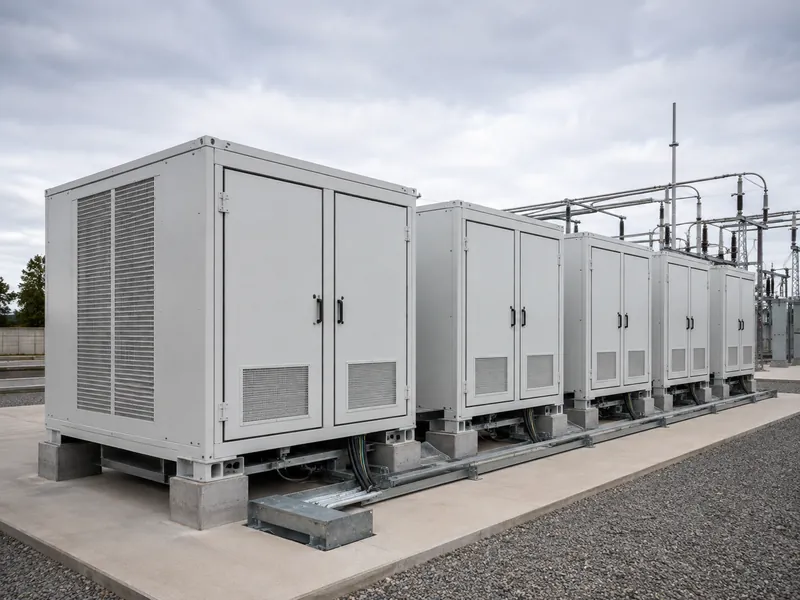
A battery energy storage system solution is an integrated package — cells, battery management system, power conversion system, energy management software, thermal management, and fire safety hardware — sized against a specific duty cycle, not a capacity number. The configuration that fits depends on three things you can determine before contacting any supplier: your power-to-energy ratio, your site’s ambient and space constraints, and the discharge frequency your application demands. Chemistry follows from these, not the other way around. Two projects with identical megawatt-hour ratings can require different cooling architectures and different fire-protection budgets.
Vad en BESS-lösning inkluderar utöver batterierna
Six interdependent subsystems make up a batterienergilagringssystem solution; on high-power or space-constrained projects, the thermal limit usually binds before the others. Battery modules store the charge. The battery management system tracks cell voltage, temperature, and state of charge. The power conversion system moves energy between DC storage and AC grid or load in both directions. The energy management system decides when charging and discharging happen, working against price signals, load profile, and grid conditions. Thermal management holds cells inside their operating window. Safety systems detect, contain, and suppress failure events. A full delivery scope typically adds DC protection, AC switchgear, transformer, metering, SCADA and communications, auxiliary power, gas detection, ventilation, grounding, and cybersecurity controls.
Vilken begränsning som binder först är projektspecifik. I andra projekt kan sammankopplingskapacitet, transformator- eller PCS-klassificeringar, platslayout och brandseparation, bullergränser eller tillstånd dominera innan någon termisk gräns uppnås. Det som generellt gäller är kopplingen. PCS-klassificeringen sätter en övre gräns för hur snabbt paketet kan cykla. Realiserad cyklingshastighet – som också formas av användbar energi, likspänningsfönster, BMS-strömgränser samt SOC- och temperaturnedklassning – driver värmegenerering. Värmegenerering begränsar kylarkitekturen, och kylarkitekturen sätter kapslingens fotavtryck och parasitbelastning.
Kraft och energi är två separata specifikationer
Sizing a battery energy storage system takes two independent numbers: power in megawatts and energy in megawatt-hours. Confuse them, and you get a system correctly sized for the wrong problem. Power describes how much the system delivers at any instant. Energy describes how long it sustains that delivery. A 1 MW / 4 MWh system delivers its full rated output for roughly four hours; a 1 MW / 1 MWh system delivers the same instantaneous power for about one hour.
Båda siffrorna behöver randvillkor innan de betyder något i ett kontrakt. Ange om energin är levererad med likström eller växelström, om den är nominell eller användbar efter SOC-reserv, om den anges vid början av livscykeln eller garanteras vid slutet av livscykeln, och om tur- och retureffektiviteten inkluderar PCS och hjälplaster. Två offerter med samma MWh-siffra kan skilja sig väsentligt åt i levererad energi när dessa gränser tillämpas.
The ratio between power and energy — the C-rate — is a useful first-pass indicator of thermal demand, though it cannot replace cell-level resistance data and a time-resolved duty-cycle model. For systems of the same nominal energy capacity and DC voltage, cutting discharge duration from four hours to one raises current by roughly four times. Under a simplified constant-resistance model, instantaneous I²R heat-generation power rises by approximately sixteen times. Cumulative resistive heat over the full discharge rises by approximately four times, since the discharge lasts a quarter as long. Actual values depend on cell resistance, state of charge, temperature, and voltage architecture.
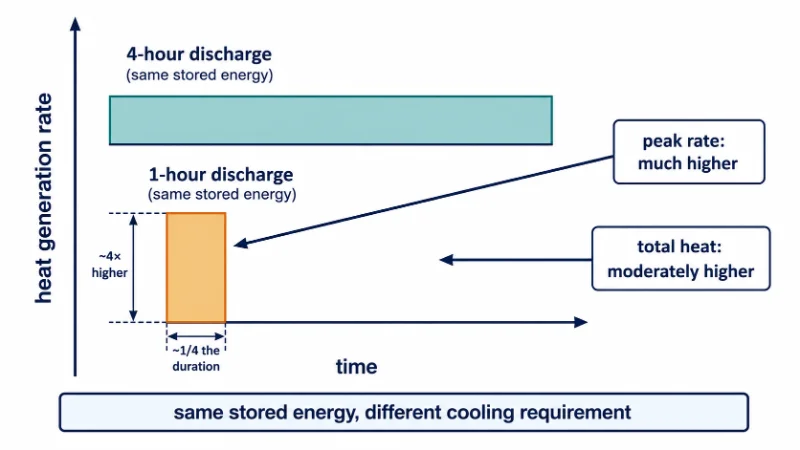
The gap between peak power and cumulative energy is what turns duration into a cooling question, not a capacity one. A cooling system has to reject the instantaneous peak; the average understates what it faces. Two systems storing identical energy, one cycling in an hour and one over four, therefore present cooling loads that differ by far more than their nameplate ratings suggest. This is why frequency-regulation assets and four-hour arbitrage assets rarely share a cooling architecture even when their capacities match, and why a high-C-rate application narrows the viable set of chemistries and enclosures before any commercial preference is applied.
Där kemi begränsar beslutet
Battery chemistry sets the thermal and safety envelope a solution is designed around. Its practical effect on configuration, though, is narrower than most comparison tables suggest. Lithium iron phosphate is generally more thermally stable than nickel-mangan-kobolt formuleringar, vilket påverkar prestandan vid brandtester på systemnivå. Blysyra förblir användbart där kostnaden dominerar och cykleantalet är lågt. Flödesbatterier frikopplar effekt från energi genom att skala upp stapel och tankar oberoende av varandra, vid lägre energitäthet. Natriumbaserade kemier är en framväxande klass som är positionerad på materialöverflöd.
Most guides present chemistry as the first decision, yet its dominant downstream consequence is thermal and regulatory, not electrical. A chemistry with greater intrinsic thermal stability may improve system-level fire-test performance. Separation distances and suppression requirements, however, are determined by the listed system configuration, the applicable code edition, UL 9540A test data, installation layout, and AHJ acceptance — not by chemistry alone. A chemistry selected without its thermal and code consequences priced in is a decision made twice.
Termisk hantering är där BESS-konfigurationer skiljer sig åt
Thermal architecture is a system-level routing decision. It is also the specification most likely to be inherited unexamined from a reference design built for a different C-rate. Commercial BESS products primarily use HVAC-based luftkylning eller indirekt vätskekylning. Immersionskylning är ett framväxande alternativ där temperaturuniformitet eller utbredningsmotstånd är prioriterat, även om dess implementeringsbas och tjänsteekosystem fortfarande är mer begränsade.
| Kylningsväg | Lämplig för | Huvudbegränsning |
|---|---|---|
| Varmluft (HVAC) | Låg koldioxidhalt, måttlig omgivningstemperatur, kostnadskänsliga platser | Luftens låga värmekapacitet begränsar borttagningshastigheten; gradienter växer över stora förpackningar |
| Indirekt vätska (kall platta) | Måttlig till hög C-halt, tät packning, breda omgivningssvängningar | Kräver kylvätskeslinga, pumpparasiter och läckageteknik |
| Nedsänkning | Hög C-hastighet, högt krav på likformighet, prioritet för utbredningsmotstånd | Vätskekompatibilitet, vikt, servicevänlighet, begränsad driftsättningsbas |
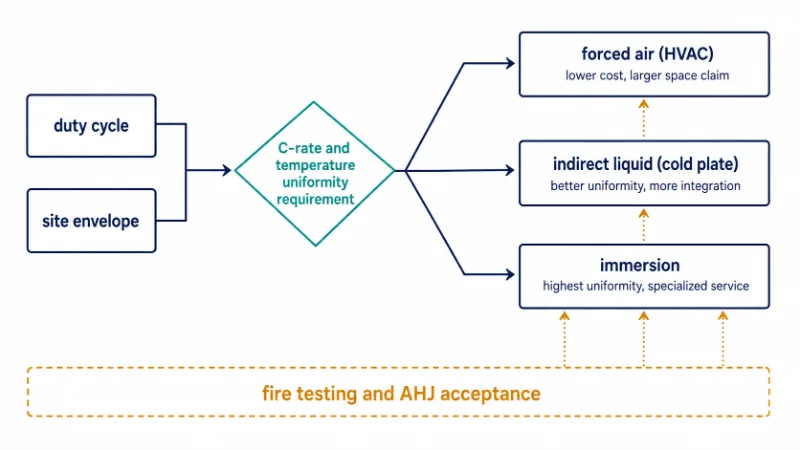
In a configuration decision, specify temperature spread at a stated level — cell, module, or rack — not just an average, because average-temperature figures cannot tell these three routes apart. Temperature non-uniformity across modules creates differences in internal resistance, available power, and ageing rate. Over time those differences increase cell imbalance, and the BMS reaches its voltage or temperature limits on the outlying modules before the pack as a whole is exhausted, which reduces usable system energy. A route that lowers average temperature while widening spread can cost more usable energy than it saves in cooling load.
Route selection is where this article stops; the mechanism behind that spread is pack-level engineering. That heat path moves in stages — from cell and module, across the thermal interface materials that couple them to the cold plate, into the liquid-cooling loop that carries heat away. Trumonytechs supplies the interface materials and cold-plate liquid-cooling components that sit at those middle stages. Matching a specific material or plate to a gap, an assembly stress, or a flow target is a separate engineering step, and the model-level conductivity or insulation values belong with verified product data, not a routing decision. The heat-generation sources, optimal lithium-ion operating windows, and cold plate heat-transfer design behind the spread fall under optimering av termisk hantering av batteripaket, a pack-level layer beneath this routing decision. Where the route is already fixed and the question is hardware and simulation scope, that sits with termisk hantering av batteripaket.
Standarder som definierar säkerhetsbaslinjen
United States BESS compliance spans product standards, fire and building codes, electrical installation requirements, and project-specific AHJ conditions. No single document covers it. UL 9540 is the safety standard for energy storage systems and equipment; systems are listed to it, not certified by it. UL 9540A is a test method for evaluating termisk rusning fire propagation. It produces empirical data, not a pass/fail result — data that designers and authorities having jurisdiction use to set separation distances, venting, and fire control strategies. Per UL Solutions, that evaluation runs at cell, module, unit, and installation levels. NFPA 855 is the installation standard for stationary energy storage systems, addressing barriers, suppression, monitoring, and ventilation at the site level. It carries force where a state, city, or AHJ has adopted or referenced it.
UL 9540, UL 9540A, and NFPA 855 sit alongside the adopted IFC or NFPA 1, NEC Article 706 for electrical installation, UL 1973 for batteries in stationary applications, UL 1741 for PCS and interconnection equipment, and local interconnection requirements. Projects outside the United States work to equivalent frameworks, with the IEC 62619 and IEC 62933 series as the usual reference points. Confirm the applicable set for the destination market before configuration is fixed.
Eftersom UL 9540A-resultaten påverkar hur stränga NFPA 855-kraven blir, påverkar ett systems testdata kostnaden på platsnivå innan en grund gjuts. Att begära dessa data är en indata för platskostnaden, inte en efterlevnadsformalitet. Rapporten är endast till hjälp om den testade konfigurationen matchar den föreslagna installationen. Bekräfta vilka utgåvor som gäller i måljurisdiktionen, eftersom kraven skiljer sig åt beroende på kapacitet, separationsavstånd och bostads- kontra icke-bostadsinstallation.
Vilken variabel som ska bekräftas först
Settle two inputs before any other specification work begins: the duty cycle (discharge duration, cycles per day, depth of discharge) and the site’s thermal and spatial envelope (ambient range, available footprint, indoor or outdoor placement).
Both are expensive or impossible to change later. Duty cycle is set by the commercial application, and the site is usually a fixed asset. Other variables retain some flexibility during concept design, but chemistry, enclosure architecture, and supplier platform should be frozen before detailed permitting, fire analysis, and balance-of-plant design. Each of those activities consumes the earlier choices as fixed inputs. Fixing a flexible variable before a fixed one produces the most common failure mode in BESS procurement: a system correctly built to a specification that no longer matches the application.
För kortvariga backup-applikationer utan tidsfördelning och utan exponering för efterfrågan/belastning kan en generator eller UPS mycket väl ha den lägre installerade kostnad per levererad kilowattimme. Battery storage is worth questioning there. The honest comparison needs a lifecycle model covering outage frequency and duration, fuel and maintenance, emissions and noise constraints, response time, demand-charge savings, any grid-service or capacity revenue, and the cost of unserved load. Storage generally earns its cost where it performs several functions at once. A single-function case can still stand up, but it should be tested, not assumed.
Parametrar värda att bekräfta skriftligen innan offerter jämförs:
| Parameter | Vad som ska bekräftas |
|---|---|
| Nominell växelström | Kontinuerlig och överbelastningsklassificering |
| Användbar AC-energi | Vid BOL och garanterad vid EOL |
| Varaktighet | Vid nominell AC-utgång |
| Effektivitet tur och retur | Testa gräns- och hjälplaster |
| Tillgänglighet | Definition och undantag |
| Temperaturjämnhet | Mätnivå: cell, modul eller rack |
| Hjälpförbrukning | Standby- och fulllastförhållanden |
| Degradering | Kalender- och cykelantaganden |
| Brandprovning | Exakt testad konfiguration |
| Garanti | Genomströmning, cykler, SOC och temperaturgränser |
Var du ska börja med din BESS-specifikation
Två variabler avgör: den driftcykel som applikationen ställer och det termiska och rumsliga höljet som platsen erbjuder. Om du korrigerar dessa, följer kemi, kylväg och hölje med mindre gissningsarbete. Allt nedströms – nedbrytningsprognoser, brandskyddsbudget, fotavtryck – ärver från dem.
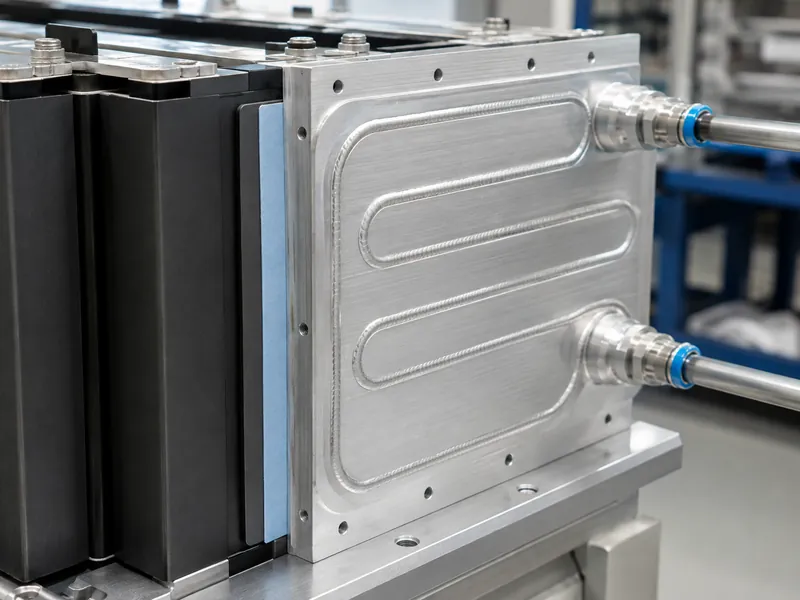
What remains project-specific is the interaction between duty cycle and local code environment, which no article resolves remotely. Where a pack’s cooling assumption is carried over from a lower-C-rate reference design without verification, the usual result is acceptable average temperatures alongside unacceptable module-to-module spread. The correction at that stage is a redesign, not a tuning exercise. Trumonytechs’ cold-plate and liquid-cooling components do their work at exactly this point, weighing the routes against a stated duty cycle, not a nominal rating, because they diverge most at the operating points where nominal figures converge.
Innan nästa leverantörssamtal, sammanställ urladdningstiden och cykler per dag-profilen, topp- och genomsnittlig effektförbrukning, platsens årliga omgivningstemperaturintervall, tillgängligt utrymmesutrymme och placering inomhus eller utomhus, gränsen för nätanslutning och AHJ:s nuvarande position gällande brandprovning på installationsnivå. Med dessa sex indata kan en leverantör dimensionera ett system och prissätta dess termiska och säkerhetsmässiga omfattning utan antaganden som ersätter data.
Var den här artikeln slutar
Tre beslut ligger precis utanför den här artikelns omfattning, vart och ett med en särskild vägledning:
- Cooling loop and cold plate design — once the route is fixed, channel geometry, flow balancing, and pump sizing follow. See Design av vätskekylsystem för elbilsbatterier och termisk hantering av ESS.
- Thermal runaway prevention at system level — the standards section here gives compliance coordinates only; the engineering behind propagation resistance is covered in hur man förhindrar termisk rusning i BESS.
- Installed cost ranges — this article deliberately avoids price figures, since they move with chemistry, market, and scale. Current ranges are in kostnad för solcellsbatterilagringssystem.
VANLIGA FRÅGOR
Betyder en högre MWh-klassning ett system som håller längre?
Nej. Kapacitet avgör varaktighet, inte livslängd. Livscykel beror på urladdningsdjup, driftstemperatur och koldioxidhalt — ett stort system som cyklas hårt i ett varmt klimat kan brytas ner snabbare än ett mindre som drivs försiktigt.
Vad är skillnaden mellan AC-märkt och DC-märkt kapacitet?
Likströmskapaciteten mäts vid batteriets poler. Växelströmskapaciteten är den som når anslutningspunkten efter PCS-omvandling och hjälpbelastningar. Levererbar växelströmsenergi är alltid lägre, och gapet vidgas när hjälpförbrukningen ökar, vilket är anledningen till att kylarkitekturen påverkar det antal som en garanti kan skrivas mot.
Kan kylarkitekturen ändras efter installationen?
Sällan utan betydande omarbetning, eftersom rutten avgör kapslingens geometri, strukturell belastning och ofta själva paketets design.
Kräver alla BESS-installationer UL 9540A-testning?
Requirements vary by capacity, separation distance, and installation type, and the applicable edition depends on jurisdiction. Confirm with the AHJ instead of assuming a blanket rule.
Vad bör en BESS-förfrågan innehålla?
Duty cycle, site ambient range, footprint and placement, interconnection limit, and the AHJ’s position on fire testing. Without these, a supplier substitutes assumptions for data, and the quotation reflects the assumptions instead of the site.
Vidare läsning
- UL 9540A Test Method for Battery Energy Storage Systems (BESS) — UL Solutions (standards body). Defines the cell/module/unit/installation fire-propagation test; the data is used by designers and AHJs to determine separation and fire-control measures, which supports this article’s point that requesting UL 9540A results is a site-cost input, not a formality.
- Installation Codes and Requirements for Energy Storage Systems (ESS) – FAQs — UL Solutions. Clarifies which codes and test-level requirements apply by residential versus non-residential installation and edition, supporting the standards-baseline section.
- NFPA 855, Standard for the Installation of Stationary Energy Storage Systems — NFPA (standards body). The site-level installation standard referenced for barriers, suppression, monitoring, and ventilation; confirm the edition adopted in your jurisdiction with the AHJ.
Relaterade artiklar
- Vad är en energicell? Batteriteknikens definition, design och termisk hantering — Defines the cell as the building block behind the MW/MWh and thermal limits discussed here, at the unit level.
- Vad är en ingjutningsmassa: Användningsområden och fördelar — Explains how potting compounds protect and thermally couple battery-pack electronics that sit alongside the cooling path.
- Vad är skillnaden mellan ingjutning och försegling? — Separates two protection methods a pack engineer chooses between when enclosing modules and electronics.
- Vilka är de bästa materialen för att försegla EV-batterier? — Reviews sealing and interface material options for battery packs, extending the interface-material step in the heat path.
- Alternativ till termisk pasta: Konstruerade alternativ och hur man väljer — Compares engineered thermal interface options that couple cells to the cold plate in the cell-to-coolant route.