
Custom Battery Pack Thermal Management Components for EV & ESS
Battery pack thermal management from Trumonytechs covers the heat path from cell to coolant: liquid cold plates, cooling tubes, manifolds and thermal interface materials, with CFD review before tooling. The cold plate configuration depends on cell format and heat load, and the TIM family on its use in the pack. We supply cold plates and cooling components built to your cell format, from prototype to volume production, alongside TIM from listed model ranges.
Start with your cell format and peak heat load: cell format sets the cold plate configuration, and heat load sizes the flow path.
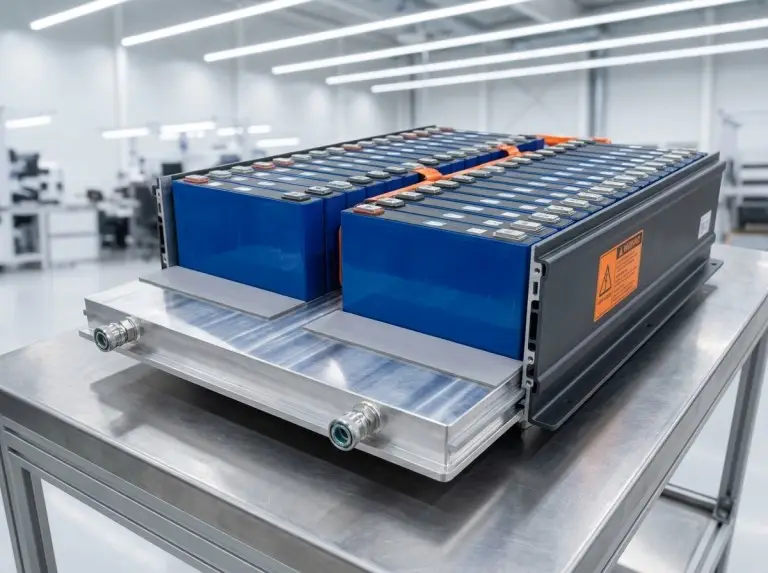
When a Battery Pack Needs Liquid Cooling — and When Air Is Enough
Liquid cooling earns its place in a battery pack when cell-to-cell ΔT has to stay below 3–5 °C, or when heat load per unit area rises past what air can carry away. High C-rate cycling and outdoor, containerized or utility-scale energy storage usually fall on the liquid side of that line.
Cell-to-cell ΔT target below which liquid cooling outperforms air.
- Passive cooling already works
Natural convection or a heat sink keeps cells inside their temperature limits.
- No room for a coolant loop
The system cannot host the pump, reservoir and heat exchanger a liquid loop needs.
- Incompatible working fluid
The fluid in the loop is not compatible with aluminum or copper.
Where any of these conditions holds, or a lower-density backup system runs at moderate ambient temperatures, air or passive cooling may be enough. We confirm that at the first technical review instead of defaulting to a more complex solution. Scale-specific requirements for grid, C&I and solar-plus-storage projects are covered on the ESS-kyllösningar sida.
Battery Pack Thermal Management Components: Cold Plates, Tubes and TIM
Battery pack components from Trumonytechs fall into four families, and which cold plate construction a pack uses depends on its cell format. Cold plates and TIM have their own product pages, manifolds are covered on the ESS cooling page, and the design review is described below.


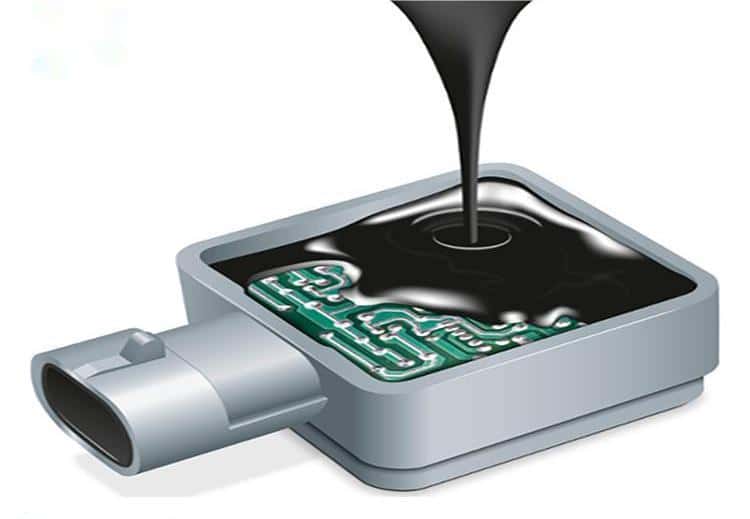


Matching Cold Plate and TIM to Cell Format and Joint Type
Cold plate configurations are listed by cell format, and TIM families by the joint they serve: gap filling, cell-to-plate bonding or module potting. Plates use 3003 or 1060 aluminum or copper, while the TIM families use silicone, epoxy or polyurethane chemistry.
| Cell format / joint | Cold plate configuration | TIM-familjen | Kemi | Selection note |
|---|---|---|---|---|
| Prismatiska celler | Microchannel, for large-area uniformity | Gap pad 30101, unreinforced | Silikon | Unreinforced pad recommended up to 300 × 200 mm |
| Påseceller | Microchannel, for large-area uniformity | No pouch-specific TIM recommendation is published | — | TIM reviewed in the thermal design discussion |
| Cylindrical modules (18650 / 2170 / 4680) | Snake tube, where routing space is tight | Gap pad 30101 with PI film or glass-fiber reinforcement | Silikon | Reinforcement adds body strength |
| Large-area plates at production volume (EV / ESS) | Stämplat | — | — | Needs a dedicated die; higher production MOQ threshold than CNC or FSW parts |
| Celler bundna till den kalla plattan | — | Polyurethane structural adhesive 30107 | Polyuretan | Fullständig härdning 7 dagar vid 23 ± 2 °C |
| Modulfyllning, isolering och ingjutning | — | Silicone potting compound 30103 | Silikon | Hand-mixed A/B; room or elevated temperature cure |
Within the pad family, reinforcement trades conductivity for handling. An unreinforced pad conducts heat better and costs less, but it is weak, tacks poorly, deforms in large pieces and is hard to place without trapped air. For pieces within 300 × 200 mm, the unreinforced pad is the lower-cost option. PI-film and PI-tape structures are recommended up to 500 × 420 mm; PI tape also adds insulation and a stronger bond to the plate, and may reduce manual placement cost.
Keep aluminum and copper parts out of the same coolant loop, and validate coolant chemistry early: certain glycol concentrations accelerate corrosion in certain alloy grades.
Where the Cold Plate Meets the TIM: Interface and Supply Scope
Contact resistance between cell, TIM and cold plate sits with one supplier when both parts come from Trumonytechs. Pads and gels also insulate electrically, with breakdown voltages from above 6 to above 12 kV/mm across listed pad models and 8 kV/mm for gels.
The scope covers cold plates, snake tubes, liquid distribution manifolds, brazed cooling assemblies and the five TIM families, with DFM feedback included in the quote at no extra charge. We review interface material selection inside the thermal design discussion at no additional cost.
Pumps and external heat exchangers are typically sourced from your system integrator or BOS supplier. We advise on how our parts integrate with them during the thermal design review.
From Thermal Design Review to Volume Production
Custom cold plate and cooling component development runs in five stages, with a client confirmation point at each one. No tooling or fabrication starts until your engineering team has approved the simulation outputs.
The thermal design review starts from the six inputs below. If some are still open, share what is confirmed, and the review identifies which variables need resolving before scoping continues. TIM selection enters at this review as an input; the five stages apply to the cold plate and cooling components.
- Cell format and pack layout
- Heat load and duty cycle, peak and continuous
- Maximum cell temperature and cell-to-cell ΔT target
- Coolant type and inlet temperature
- Flow range and allowable pressure drop
- Mechanical envelope, interface limits and TIM constraints
- Klienten bekräftar inmatningarGranskning av termisk design
Cell format, heat load, temperature targets and pack geometry checked for feasibility before any design work.
- Kundrecensioners resultatCFD-simulering
Flow distribution, temperature uniformity and pressure drop under defined inlet conditions.
- Tidslinje bekräftadPrototype build
Starts only after simulation sign-off; lead time set by plate type and geometry.
- KlientsigneringValidering av prov
Leak and pressure testing, thermal resistance measurement and client-specific documentation.
- Produktionen börjarVolymproduktion
Released only after the validated sample is signed off.
Development validation also covers mechanical load, flow resistance, internal corrosion and salt spray corrosion. The reasoning behind flow paths, coolant choice and validation is set out in our liquid cooling system design guide.
Cold Plate and TIM Pricing: Tooling, MOQ and Quote Scope
Process choice sets the tooling and MOQ picture for a cold plate: CNC-machined prototypes need no tooling, while stamped plates need a dedicated die and carry a higher production MOQ threshold. Cold plate selection also weighs heat load, plate size, available space, production volume and cost, and no price range is published on this page. Whether a tooling charge applies, and how it is calculated, is not published either; TIM is quoted by model, quantity and packaging format.
Send heat load and expected annual volume with your drawing; DFM feedback comes back with the quote at no extra charge.
Quality, Compliance and Delivery by Product Line
Inspection, paperwork and lead times differ between cold plates and TIM, so each product line is summarized here and detailed on its own page. The table keeps the two compliance statements apart because they cover different materials.
| Punkt | Kalla plattor och rör | Material för termiska gränssnitt |
|---|---|---|
| Outgoing inspection | Helium leak test on every part; CMM check including thermal-interface flatness; hydrostatic burst above rated working pressure; FAI; SPC on key dimensions | Not published on this page; model data list test methods for measured properties where provided |
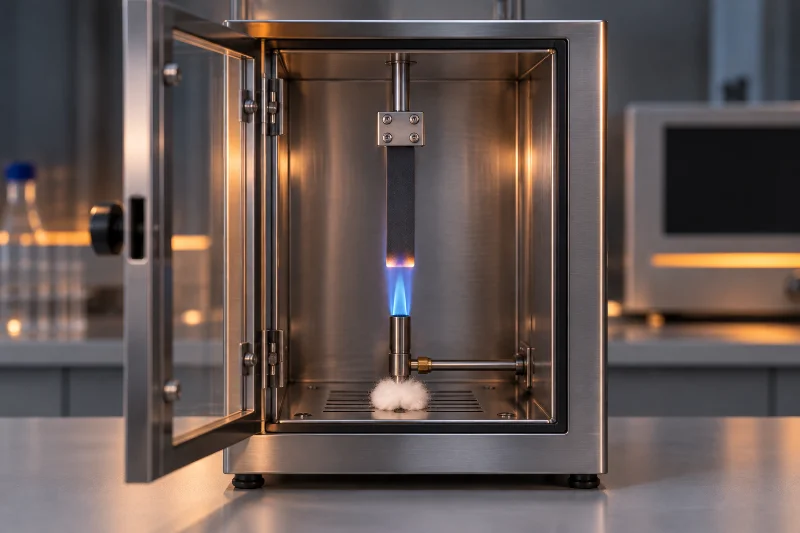
| Compliance documents | RoHS / REACH declarations and SVHC communication on request; material composition supports IMDS submission | RoHS-compliant formulation; UL 94 V-0 flame rating where the model data lists it |
| Quality system | Kvalitetssystemcertifikat (ISO 9001, IATF 16949) finns tillgängliga på begäran; specificera vilka du behöver i din förfrågan. | Certificate scope for TIM production is not published on this page |
| Prototype lead time | CNC prototypes usually 2–3 weeks after design confirmation; tooled prototypes longer, confirmed at design review | Not published on this page |
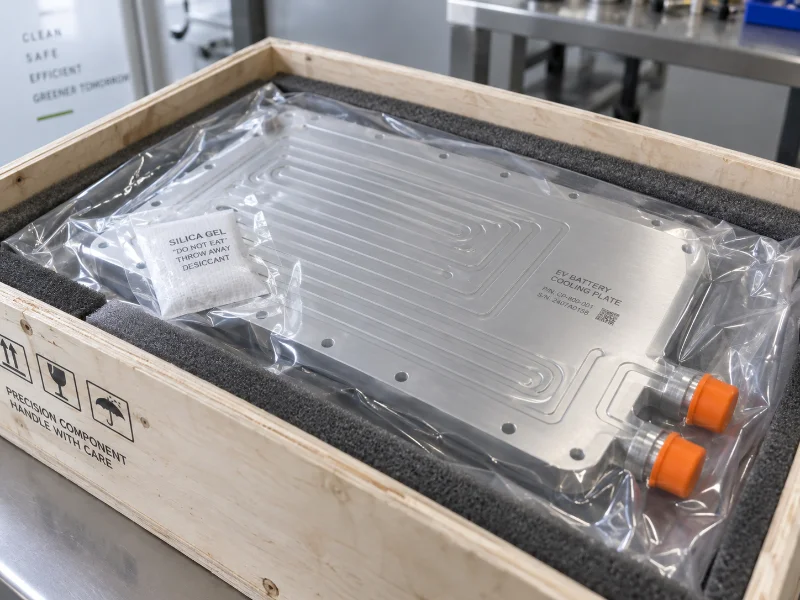
| Documents and packaging | CoC, TDS, mill certificate and packing list; moisture-sealed packing with desiccant, port sealing plugs, wooden crates for large orders, batch traceability labels | Not published on this page |
| Details | Vattenkylningsplattor | Material för termiska gränssnitt |
Where a cell reads "not published", state the lead time, documents or packaging information you need in your RFQ.
Cold plate development can produce FAI reports, a CFD evaluation summary and sample validation documentation for supplier qualification, subject to project requirements. Cold plate process capability covers FSW, vacuum brazing, stamping, extrusion and CNC, and volume production is released only after the validated sample is signed off. Third-party inspection arrangements are not published on this page either.


Questions Engineers Ask About Pack Cooling Parts
Which inputs most often change late in a battery pack thermal management project?
Coolant type and concentration, and coolant inlet temperature, are the two inputs most likely to shift after scoping. The water-glycol ratio affects conductivity, viscosity and pressure drop targets. When these inputs are treated as outputs rather than inputs, the first simulation can miss its temperature uniformity target and need redesign, so both are worth confirming early.
How reliable is CFD before cold plate tooling is committed?
CFD results are only as firm as their boundary conditions, and heat load, inlet conditions and flow rate all need confirmed values. Teams working from estimated or placeholder figures should expect updated outputs once final cell parameters are locked. Tooling waits for your sign-off on the simulation in either case.
Can a thermal adhesive bond cells directly to the cold plate?
Yes. Polyurethane structural adhesive 30107 is intended for bonding cells to the cold plate. The 0120 grade reaches 11 MPa Al/Al shear strength with 2.05 W/m·K conductivity measured to ASTM D5470. Surface-dry time is 35 minutes at 25 °C and the published full cure is 7 days at 23 ± 2 °C; handling and fixture-release times are not published.
Which thermal pad suits cylindrical cells on a snake tube?
Two reinforced 30101 constructions are listed for cylindrical cells and snake tube cold plates. PI film keeps the other properties of PI-tape reinforcement and suits pieces up to 500 × 420 mm. Glass-fiber cloth adds flexibility and body strength, conducts less heat than a plain pad and suits pieces up to 300 × 200 mm.
Are MOQ, pricing, payment and warranty terms published?
Prototype cold plates are accepted in flexible quantities, while production MOQ depends on process: stamped parts with dedicated tooling carry a higher threshold than CNC or FSW parts. TIM MOQ, prices, payment terms, warranty and after-sales terms are not published on this page. Ask for them with your RFQ.
Will you sign an NDA before we send pack drawings?
NDA and drawing-confidentiality terms are not published on this page and can be raised in the first message, before any drawings are sent, by email at [email protected] or through the quote form. The quote inputs accept either a CAD drawing or boundary dimensions.
How long is shipping, and who handles import duties?
Transit time depends on the destination port and shipping mode, and it is confirmed in the quote rather than published here. Import duties, customs clearance and local approvals depend on the destination country, so who carries each item should be settled before the order is placed.