
Thermally Conductive Silicone Potting Compound
30103 is a two-part, thermally conductive silicone potting compound for filling and insulating spaces inside assemblies. EV and energy storage (ESS) battery packs are the main applications, and the same compound is supplied for other applications as well. Four listed grades run from 0.8 to 4.0 W/m·K, and the one to trial depends on the heat each fill must carry, the weight the assembly can take and your mixing process. We supply all four grades as two-component silicone, mixed by hand and cured at room or elevated temperature.
Tell us which grade you want quoted, 0080, 0200, 0300 or 0400, with the quantity and the packaging form you need.
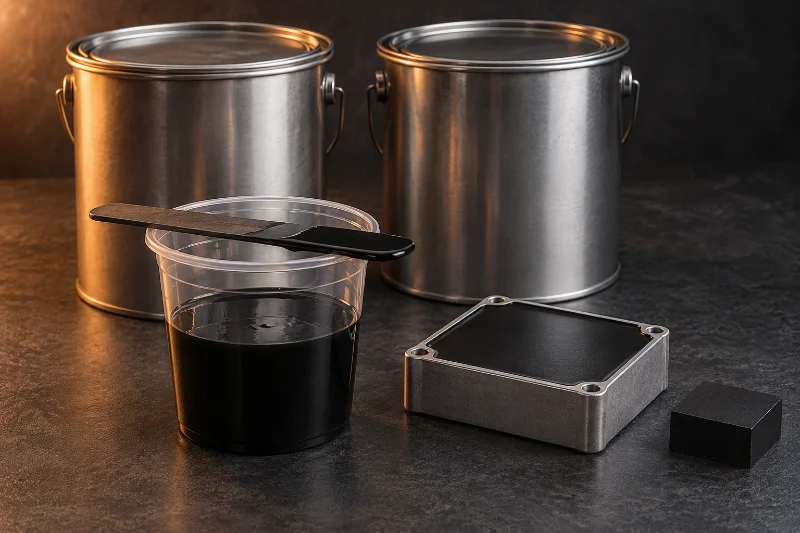
Where 30103 Potting Fits, and Where It Doesn't
30103 suits assemblies where the space between a heat source and the housing or cold plate is potted, since the cured silicone conducts heat, insulates and damps vibration in one layer; in a battery pack, that space lies between the cells or modules and the housing or cold plate. The listed grades span 0.8 to 4.0 W/m·K, so the heat each fill has to carry is the first input when choosing among them.
thermal conductivity across the four listed 30103 grades, measured to ISO 22007-2
- 01Your line dispenses automatically.
The 30102 hővezető gél is mixed through a spiral mixing tube for automatic dispensing, whereas 30103 is mixed by hand.
- 02Cells must be bonded to the cold plate.
30103 is described for filling, insulating and potting; bonding cells to the cold plate is what the polyurethane 30107 structural adhesive is described for.
- 03A pre-formed sheet can close the gap.
Where a hővezető pad can be placed by hand, it takes mixing and curing off your line, which makes the pad the simpler route.
Every 30103 grade is a silicone formulation, so a specification that calls for epoxy or polyurethane potting falls outside this series. For the wider comparison with pads, gels, structural adhesives and grease, see the termikus határfelületi anyagok overview; pack-level cooling choices are on the az akkumulátor hőkezelése oldal.
Four Potting Compound Grades, 0.8 to 4.0 W/m·K
Across the four 30103 grades, density rises with thermal conductivity, from 1.7 g/cc at 0.8 W/m·K to 3.2 g/cc at 4.0 W/m·K, so a higher-conductivity grade adds more mass per liter of fill. Hardness runs the other way at the top of the range: 30103-0400 is listed at Shore A 20, against 40 for 0200 and 0300 and 50 for 0080.
| Ingatlan | 30103-0080 | 30103-0200 | 30103-0300 | 30103-0400 | Test method |
|---|---|---|---|---|---|
| Thermal conductivity, W/m·K | 0.8 | 2.0 | 3.0 | 4.0 | ISO 22007-2 |
| Density, g/cc | 1.7 | 2.7 | 3.0 | 3.2 | ASTM D792 |
| Viszkozitás | A 2,500 cps / B 2,000 cps at 25 °C | 6,000 mPa·s | 9,000 mPa·s | 15,000 mPa·s | ASTM D2196 (0200–0400) |
| Hardness, Shore A | 50 | 40 | 40 | 20 | ASTM D2240 |
| Mix ratio, A:B | Nincs listázva | 1:1 | 1:1 | 1:1 | — |
Values are the listed data for each potting compound grade, not limits of the series. Viscosity for 0080 is given per component, while 0200–0400 list one figure each without stating whether it is for the mix or one part, so the two sets are not directly comparable.
All four grades are silicone formulations; what changes between them in the listed data is conductivity, density, viscosity and hardness. More properties are listed for 30103-0080 than for the other grades, including cure times, electrical values and a temperature range; for 0200, 0300 and 0400, ask for those properties before a trial.
Mixing, Curing and Cured Properties of 30103-0080
30103 is mixed by hand from its A and B parts and cures at room temperature or with heat. For grade 0080, the listed tack-free time is 90 minutes and the cure time 24 hours, both at 25 °C. No other grade lists cure times, so those figures need confirming before a line trial on 0200, 0300 or 0400.
| 30103-0080 property | Value | Test method |
|---|---|---|
| Tack-free time at 25 °C | 90 min | Kézikönyv |
| Cure time at 25 °C | 24 h | Durometer |
| Szakítószilárdság | 0.3 MPa | ASTM D412 |
| Nyúlás | 30% | ASTM D412 |
| Breakdown voltage | 10 kV/mm | ASTM D149 |
| Térfogati ellenállás | >10¹² Ω·cm | ASTM D257 |
| D4–D10 content | <100 ppm | GC |
| Lángállóság | V-0 | UL 94 |
| Ajánlott hőmérsékleti tartomány | −40 to +150 °C | — |
Published data for 30103-0080 covers a recommended range of −40 to +150 °C; use outside that range is not covered by the data here.
What a 30103 Quote Needs From You
30103 pricing is confirmed at quotation against the grade, order quantity and packaging form, and no price range is published here. What a quote includes is not listed either, and the site has no online estimator, so any samples or documents you expect belong in the RFQ.
Send all three together, naming one of the four grades, and we will quote against them.
Conductivity vs Weight Across the 30103 Grades
Between the 30103 grades, more thermal conductivity comes with more weight, because density rises from 1.7 to 3.2 g/cc as listed conductivity rises from 0.8 to 4.0 W/m·K. Which grade to trial first depends on whether heat transfer or assembly mass is the tighter constraint, and trials against your heat load and gap settle the choice.
0400 has the highest listed conductivity, 4.0 W/m·K, and the lowest listed hardness, Shore A 20. The trade is density, the highest listed at 3.2 g/cc, so each liter of fill adds the most mass.
0080 has the lowest listed density, 1.7 g/cc, and the highest listed hardness, Shore A 50. The trade is conductivity: at 0.8 W/m·K it carries the least heat of the four, so it suits fills where mass matters more than heat transfer.
How the 30103 Data Is Measured, and What It Does Not Certify
30103 figures come with a named test method wherever the data sheet lists one, and no reference projects are published. We list those methods so your incoming inspection can see what each figure was measured against. Outgoing inspection items, batch traceability and per-batch certificates of analysis are not published; if you need batch data, name the properties in your RFQ and ask whether they can be reported.
Conductivity to ISO 22007-2 for all four grades.
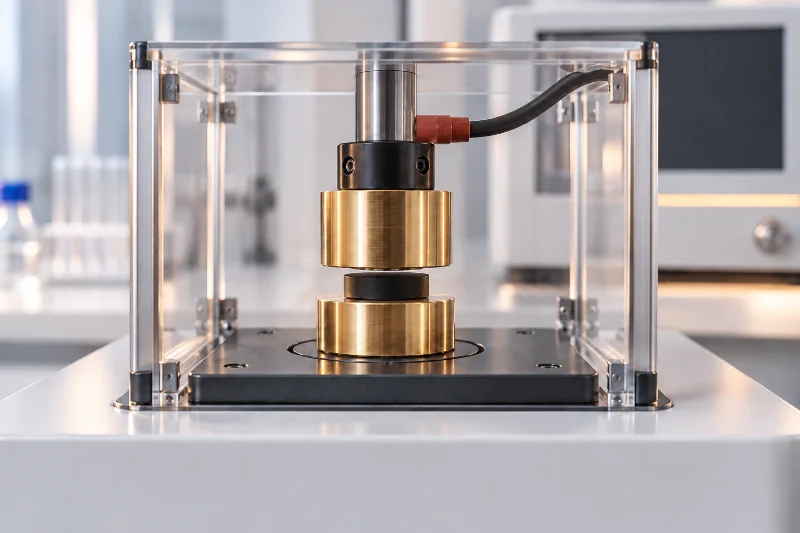
Breakdown voltage to ASTM D149 and volume resistivity to ASTM D257, listed for 0080.
Hardness to ASTM D2240 and density to ASTM D792 for every grade; viscosity to ASTM D2196 and tensile data to ASTM D412 where listed.
UL 94 V-0 flame rating and D4–D10 content by GC, listed for 0080.
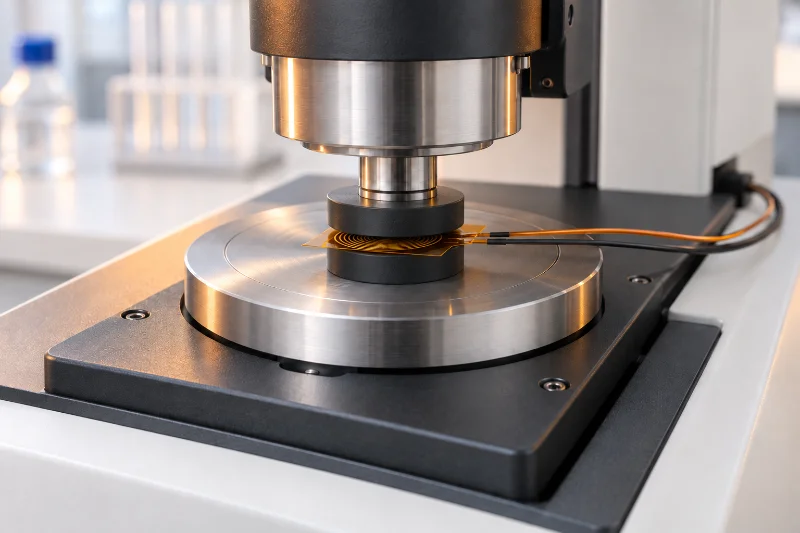

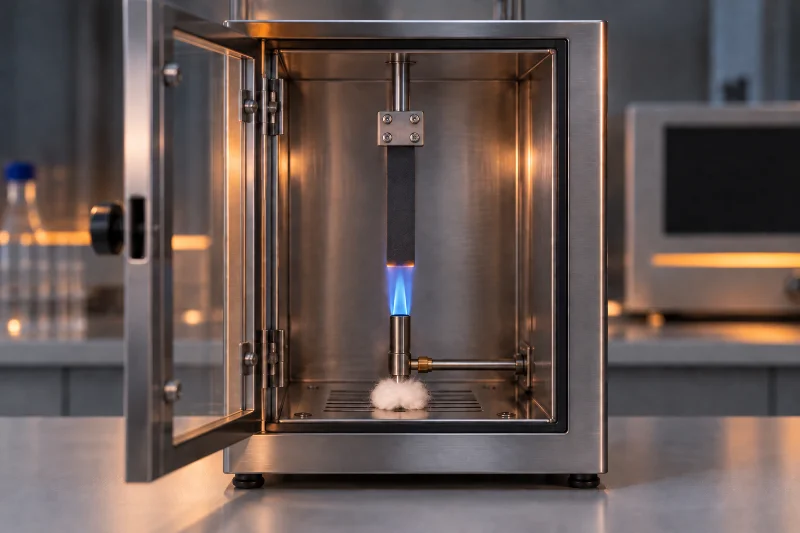
UL 94 V-0 is a material flame rating from the UL 94 test, not a UL certification, and the series is described as a RoHS-compliant formulation. Neither a UL yellow card nor a RoHS test report is published here, so any report your market requires has to be requested with the RFQ.
Ordering 30103: What to Ask For in Your RFQ
MOQ, sample and production lead times, packaging, shelf life and storage conditions, payment terms and pre-shipment inspection for 30103 are not published on this page. Shipping documents such as a TDS, SDS or batch certificate of analysis are not published either, nor are after-sales support and claims handling. Transit time, duties and import paperwork vary with the destination, so the RFQ should name your port and the documents you need. Supply capacity and warranty terms are also unpublished; ask for both with your RFQ, and give the annual volume the capacity has to cover.
30103 Potting Compound FAQ
How much weight does a potting compound grade add to the assembly? +
Mass follows density, which is 1.7 g/cc for 30103-0080, 2.7 for 0200, 3.0 for 0300 and 3.2 for 0400. One liter of fill therefore weighs 1.7 kg in 0080 and 3.2 kg in 0400, so weight-limited assemblies gain margin from the lower grades.
Does cured 30103 insulate electrically? +
Insulation is listed as a feature of the whole series, and grade 0080 backs it with a breakdown voltage of 10 kV/mm and volume resistivity above 10¹² Ω·cm. Those two values are not listed for 0200, 0300 or 0400, and they are worth requesting wherever the fill has to meet a voltage requirement.
What mix ratio does 30103 use? +
Grades 0200, 0300 and 0400 each list an A:B ratio of 1:1. No ratio appears in the 0080 data, so that ratio needs confirming before mixing is set up. Pot life and whether vacuum degassing is required are not listed for any grade, and both belong on the same list of questions.
Can 30103 be cured with heat? +
The series is described as curing either at room temperature or at elevated temperature. Only room-temperature figures are listed: 90 minutes tack-free and 24 hours to cure at 25 °C for grade 0080. No heat-cure temperature or time is given for any grade, so that schedule has to be requested before a heated cure is planned.
What does the UL 94 V-0 rating on 30103 cover? +
V-0 appears as a series feature and on the 0080 data sheet, as a flame rating of the material under the UL 94 test. The data does not state the specimen thickness used, and a material rating is not a rating of your finished assembly, so the test details are worth obtaining if your design approval rests on V-0.
What is the D4–D10 content of 30103? +
Grade 0080 lists a D4–D10 content below 100 ppm, measured by gas chromatography. The same figure is not given for 0200, 0300 or 0400, so where your specification caps D4–D10 content, the value for the grade you intend to use should be requested before qualification.
Can I test 30103 before ordering, and what is the MOQ? +
Sample terms and the MOQ for 30103 are not published on this page. Ask for both in your RFQ, naming the grade and the quantity your trial needs, and for 0200, 0300 or 0400 include the properties this page does not list.